Hamilton's Montreal Overture: Ferrari's Overtake of Verstappen and the 2026 Title Race
Lewis Hamilton's outside overtake of Max Verstappen at the Canadian Grand Prix signals more than a single race result — it points to a genuine power shift in Formula 1's 2026 title race as Ferrari's SF-90 proves race-winning pace.
On lap 56 of the Canadian Grand Prix, Lewis Hamilton pulled off an audacious outside overtake on Max Verstappen at the Circuit Gilles Villeneuve — the kind of move that belongs in highlight reels and championship lore. By lap 60, Hamilton had the Red Bull firmly in his sights. By lap 68, he had dispatched it. Ferrari's SF-90 had done what many observers had stopped believing possible: it had outpaced Red Bull on race day, at a circuit where raw engine power matters less and aerodynamic efficiency matters more. The podium result — Hamilton finishing second behind the race winner — is more than a morale boost. It is a signal.
That signal cuts in two directions simultaneously. For Ferrari, the result confirms what testing and the opening rounds of 2026 suggested but had not yet conclusively demonstrated: the Scuderia has a race-winning car. For Red Bull, it exposes a vulnerability that was already beginning to surface in the data — Verstappen has been qualifying well but losing ground in the race's critical middle phase, the window where tyre management, fuel load, and DRS deployment create overtaking opportunities. Hamilton's move on the outside of Turn 10 — one of Montreal's defining corners, high-commitment, unforgiving — was not a lucky slip. It was surgical. And it came on a track where the Red Bull has historically excelled.
The Race Context
Montreal's Circuit Gilles Villeneuve rewards a specific combination of qualities: strong braking stability, low-drag straight-line speed, and a rear-limited chassis that can handle the kerb-hopping required to carry momentum through the chicanes. In previous seasons, Red Bull's RB chassis excelled in exactly this environment. The 2026 regulations — with their revised floor rules and tighter rear diffuser tolerances — have shifted the balance sheet. Ferrari's updated SF-90 arrived in Montreal with a revised floor design that the team debuted in Miami and refined through Friday practice in Canada. The data from those sessions, combined with Hamilton's feedback from the cockpit, suggested the car had turned a corner in race-trim pace.
Verstappen started well and held second through the opening stint. But the overtaking dynamics of the 2026 generation — with their increased mechanical grip but reduced aerodynamic sensitivity to dirty air — have changed how drivers approach close combat. Where previous eras punished following another car closely, the 2026 cars allow drivers to stay within one second and maintain their tyre surface temperature. Hamilton exploited exactly that capability, keeping Verstappen within DRS range through the technical Section 3 while preserving his rear tyres, then striking at the one moment the Red Bull driver had to lift.
Red Bull's Counter-Reading
The counter-narrative is worth stating plainly: Red Bull's race pace was not catastrophic. Verstappen held second for 56 laps against a driver with seven world championships and 104 career wins. The overtake came on a track where overtaking has historically been viable, and where Hamilton — arguably the greatest wet-weather and intermediate-condition driver in the sport's history — is at his most comfortable. Some of the gap to Ferrari's race pace reflects the specific set-up parameters Red Bull chose for Montreal, possibly sacrificing single-lap pace for race distance durability.
Verstappen himself offered no excuses in post-race comments, acknowledging the move was fair and the pace gap real. This restraint matters. It distinguishes a driver still contending for a championship from one who has retreated into grievance. Red Bull's engineering team will conduct a full race analysis before the next round, and the data from Montreal's sensor suite — wheel force, suspension travel, tyre temperature profiles — will inform the Baku upgrade package already pencilled in for the Azerbaijan Grand Prix.
The Structural Shift
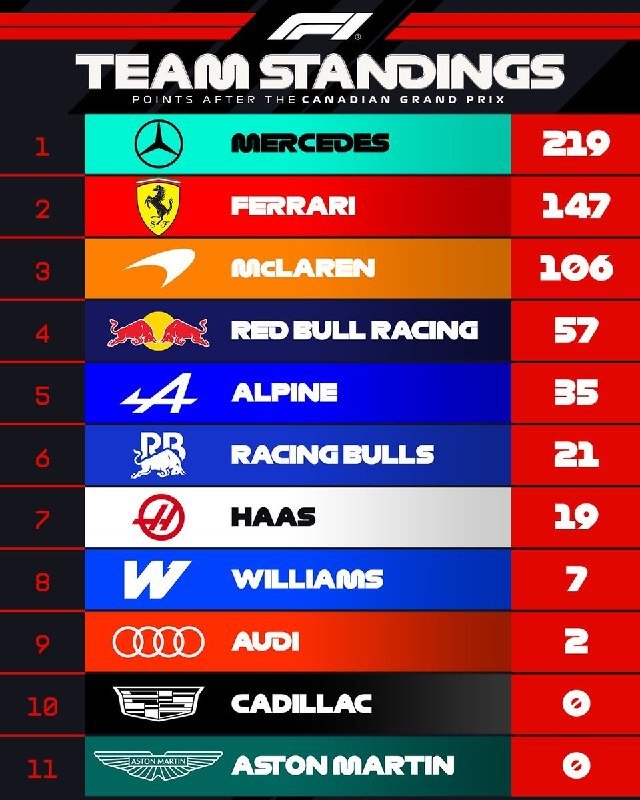
What is happening here is not simply a good result for Ferrari or a bad one for Red Bull. It is a structural realignment of Formula 1's competitive order. The 2026 regulations were designed with a specific mandate: reduce ground effect dependency, increase mechanical grip influence, and create a chassis formula that rewards different engineering philosophies. The result has been exactly what the FIA hoped for — convergence. Four teams have won races in 2026. The constructor standings no longer reflect a comfortable hierarchy. McLaren, Ferrari, Mercedes, and Red Bull are separated by margins that would have been unthinkable in the ground-effect era's final years.
This convergence is not universally celebrated inside the paddock. Teams that invested heavily in ground-effect tunnel correlation — Red Bull among them — face a fundamental reset. Their core engineering competency has been partially devalued. Ferrari, which had a more conservative aerodynamic development path through the late ground-effect era and invested earlier in mechanical-grip R&D pathways, finds itself advantaged by a regulatory shift it arguably did not design the car to exploit but which suits its engineering culture. The SF-90 is, at its core, a mechanical-grip car dressed in an aerodynamic package. The 2026 rules have made that philosophy competitive again.
Championship Stakes
The mathematics of the 2026 title race look different this morning than they did before Hamilton's overtake. With 14 rounds completed and 10 remaining, Verstappen still leads the drivers' championship — but the buffer has compressed. Ferrari sits second in the constructors' standings, within touching distance of Red Bull's lead. Hamilton's podium moves him within a race-win of the championship lead, a gap that felt insurmountable six weeks ago and now looks like a recovery opportunity.
The forward stakes are straightforward. Baku offers a power-oriented circuit where Red Bull traditionally rebounds. Monaco's narrow streets rewarded the RB's strengths, though Verstappen finished only third there — a result that went largely unreported at the time as a warning sign. If Red Bull cannot respond in Baku, the narrative shifts permanently. The 2026 title race becomes a three-team fight, and Ferrari — with Hamilton's experience in closing championship deficits — becomes the most dangerous threat to Red Bull's run of dominance.
Whether Hamilton can sustain this pace across the season's second half will determine whether Montreal was a statement or an inflection point. The overtake itself told us something important: the car can do it, and the driver is still capable of executing moves that separate the merely good from the great. What remains to be seen is whether Ferrari's infrastructure — its pit wall decisions, its strategic calls under pressure — can match the package's potential.
This article focused on the racing dynamics of the Canadian Grand Prix rather than the broader commercial or regulatory architecture of F1's 2026 reset. The Telegram wire provided the race-action context; a longer investigation into the FIA's 2026 technical directive impact is planned for a future desk piece.
Wire provenance
This editorial synthesis draws on the following public wire/social posts:
- https://t.me/formula1/124571
- https://t.me/formula1/124568
- https://t.me/formula1/124562