The Hormuz Paradox: Why Iran Drills and Negotiates at the Same Time
Tehran announced live-fire naval exercises near the Strait of Hormuz on the same day oil markets fell on reports of a US-Iran diplomatic breakthrough. The contradiction is only superficial — Iran's military posturing and its willingness to talk are two sides of the same negotiating posture.
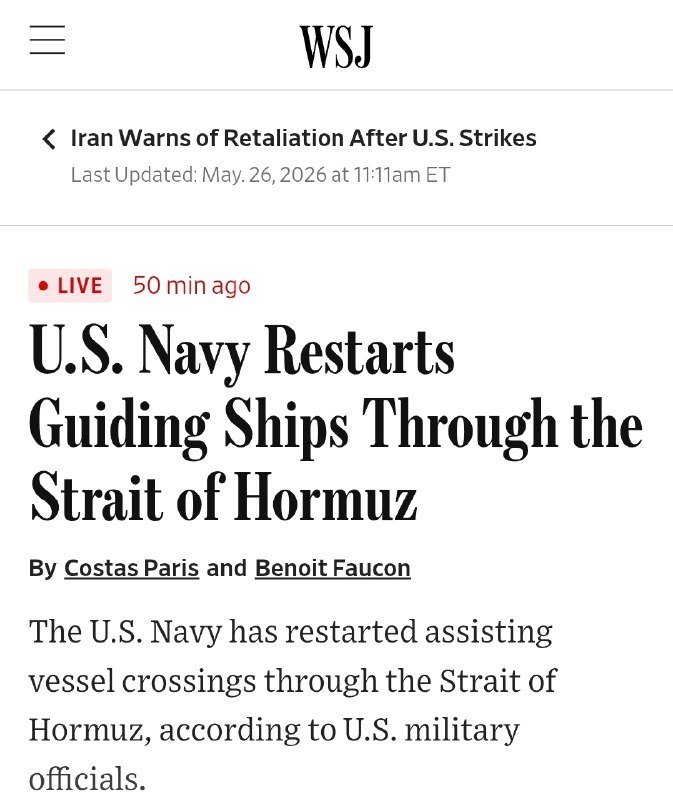
A supertanker loaded with two million barrels of Iraqi crude passed through the Strait of Hormuz on May 24, 2026, without incident. Hours later, oil prices fell to their lowest point in two weeks — a market signal that Washington and Tehran were moving closer to an agreement that would reopen the critical waterway. And hours after that, Iran announced new live-fire military drills in the same stretch of water. The sequence reads as incoherence. It is not.
The Strait of Hormuz is not merely a shipping lane. It is the mechanism through which roughly one-fifth of the world's daily oil output reaches world markets — and through which Iran projects leverage over every major consuming nation. That structural reality explains why Tehran conducts drills and negotiates simultaneously, and why Washington tolerates the apparent contradiction. The military exercises are not a counter-signalthreat; they are the precondition for talks.
The Senate Pushback
Republican opposition to a US-Iran deal crystallised on May 23 when Senator Lindsey Graham urged Congress to reject any arrangement that leaves Iran capable of threatening the Strait and Gulf oil infrastructure. Graham's position is not marginal within his party. The underlying concern — that a partial nuclear deal preserves Iran's ability to weaponise Hormuz at will — represents a durable factional view inside the GOP that will not evaporate once the cameras leave.
That opposition matters because it shapes what any final deal can actually include. A framework that leaves Iran's naval posture intact satisfies Tehran's core requirement: retain the option to close the Strait if sanctions are reimposed or regional tensions escalate. Graham and his allies understand this arithmetic. They are not simply reflexive sceptics; they are reading the same map and arriving at a different conclusion about what constitutes acceptable risk.
The Market Moves First
Oil fell to a two-week low on May 24, per Reuters reporting — a signal that traders were pricing in a near-term diplomatic resolution. That markets began adjusting before the deal's terms were public tells its own story. The Polymarket contract measuring the probability of a US-Iran nuclear agreement by June 30 stood at 34 percent on May 24, reflecting genuine uncertainty rather than confident belief in either outcome.
The discrepancy between market behaviour and prediction-market pricing is instructive. Traders respond to observable signals — tanker movements, official statements, oil inventory data — and those signals were positive on May 24. Prediction markets incorporate a wider uncertainty discount because their users are pricing not just the probability of a deal but the probability of verification, enforcement, and longevity — factors that remain entirely opaque.
The China Dimension
The supertanker sailing toward China on May 24 is the most direct expression of Beijing's stake in Hormuz stability. China imports the majority of its crude from the Gulf; uninterrupted transit through the Strait is not a geopolitical preference but a structural necessity. Tehran and Beijing understand this calculus in identical terms — Iran's naval position in the Strait is a form of insurance that no Chinese investment in alternative routes can fully replicate in the near term.
Beijing has not commented publicly on the reported deal as of May 24. But Chinese state media framing of previous Gulf diplomatic cycles has consistently emphasised stability over political outcomes — a position that functionally aligns with a US-Iran agreement that reduces the probability of accidental escalation. Chinese energy policy has no appetite for the Strait to become a negotiating chip in a broader contest; it needs the waterway to function as infrastructure, not as leverage.
What Remains Unresolved
The contradiction between Iranian drills and diplomatic overtures dissolves once the structural frame is clear: Iran uses its position in the Strait to create the pressure that makes talks necessary, and conducts demonstrations of that same position to remind counterparties what they are negotiating over. Neither the drills nor the deal are contradictory signals — they are co-dependent ones.
The sources do not establish the specific terms of the reported framework beyond the broad contours: a ceasefire extension of 60 days, Iranian mine-clearing operations within that window, and a preliminary agreement to reopen the Strait. What remains unclear is what enforcement mechanism — if any — would prevent Iran from rebuilding its chokepoint leverage once the freeze expires. That question is not incidental. It is the question around which the entire deal structure either holds or fractures.
The 34 percent Polymarket probability reflects this opacity honestly. A deal is plausible. Its durability is not priced in. Markets moved on May 24 on the basis of a plausible outcome. The underlying contest over whether Iran retains the option to weaponise one of the world's most critical shipping lanes has not been resolved by a leaked framework — it has been temporarily bracketed, which is a different thing entirely.
This publication covered the Iran negotiations through a market-first lens: oil prices, tanker flows, and the structural leverage calculus driving both capitals toward a deal they would prefer not to need. The wire picture — per Reuters and Axios — focused primarily on the diplomatic mechanics. Monexus found the market signals more structurally revealing.
Wire provenance
This editorial synthesis draws on the following public wire/social posts:
- http://reut.rs/42Th1lu
- https://x.com/unusual_whales/status/192418293018423