Iran's 'No Retreat' Doctrine: Resolve, Rhetoric, or Risk Miscalculation?
Tehran's top security official has issued a stark declaration of no retreat. The real question is not whether Iran means it — but who the message is aimed at, and whether the message itself is the strategy.
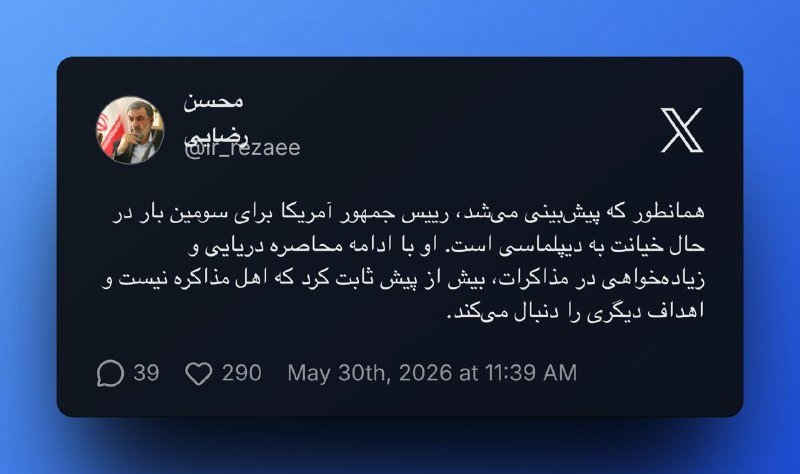
On May 25, 2026, Mohammad Baqer Zolqadr, Secretary of Iran's Supreme National Security Council, issued what is already being amplified across Iranian state media as the defining sentence of Tehran's current posture: "There will be no retreat." The statement, reported simultaneously by Tasnim News, PressTV, and the Islamic Republic News Agency, cited three domains — the military field, the diplomatic delegation, and street-level mobilization — as evidence that the position is broadly held, not merely the view of a single official. It is the kind of declaration that travels easily and leaves analysts reaching for the same word: resolve.
But resolve is not a neutral descriptor. It is a frame. And the frame chosen by Tehran's messaging apparatus — deliberately maximalist, deliberately public — tells us as much about the domestic and regional audience of this statement as it does about any genuine policy commitment. The question worth asking is not whether Zolqadr believes what he said, but whether the statement itself is the strategy.
The Architecture of a Broadcast
Iranian state media's simultaneous deployment of this message across Tasnim, PressTV, IRNA, and affiliated Telegram channels is not accidental. It is the infrastructure of a broadcast. When a senior security official speaks in triplicate across outlets that reach different audiences — domestic, regional, and diasporic — the redundancy is the message. It signals that no subordinate actor, no factional rival, and no foreign interlocutor should mistake this for a negotiating position that can be whittled away through back-channel pressure.
The phrasing matters. "There will be no surrender or retreat," as IRNA reported Zolqadr stating, is not the same language as "our position is unchanged." The latter is bureaucratic. The former is kinetic — it places the statement in the register of a conflict already underway. That framing serves a specific function: it domesticates the standoff by casting it as a matter of national survival rather than diplomatic preference. In doing so, it narrows the political space available to any Iranian actor who might otherwise signal flexibility.
Three Audiences, One Statement
The reference to the military field, the diplomatic delegation, and "the people who poured into the streets" is an unusually explicit enumeration of constituencies. Zolqadr is not merely making a policy statement; he is constructing a coalition. The military field serves as a reminder of coercive capacity. The diplomatic delegation — presumably including whatever negotiating team is engaged with Western counterparts — is incorporated into the non-retreat framework, suggesting that talks will not yield capitulation. And the street reference is a domestic insurance mechanism: it implies popular sanction for a hardline posture, which makes any future softening politically costly.
Western analysts who treat this as purely adversarial signaling may be reading the statement correctly for their own purposes but missing the domestic political architecture underneath. Tehran is as concerned about managing expectations in Tehran as it is about communicating with Washington or Jerusalem. The statement is, in part, directed inward — at a body politic that has absorbed years of economic pressure, social restriction, and regional entanglement, and that has not, notably, collapsed.
The Trap of the Definitive Declaration
There is a structural risk in what Zolqadr has done. Declarations of absolute resolve have a way of foreclosing options that rational actors may later need. When a state signals that it cannot retreat — whether from a negotiating position, a territorial posture, or a regional commitment — it hands a degree of strategic initiative to counterparties who understand that the statement is now a liability. A skilled interlocutor, aware that "no retreat" is a domestic political necessity, can structure a negotiation designed to make the cost of holding that line unbearable without ever requiring an explicit climb-down.
Iranian decision-makers are not naive about this dynamic. The Islamic Republic has survived decades of pressure by being simultaneously rigid in rhetoric and adaptive in practice. The question is whether the current moment — with ongoing nuclear negotiations, regional tensions, and the incoming US administration's approach still taking shape — is a moment where that gap between statement and substance can be maintained. Zolqadr's declaration may be precisely calibrated to close that gap before it becomes a vulnerability.
What the Statement Cannot Answer
The available reporting does not specify which demands Zolqadr considers non-negotiable, nor does it indicate whether the reference to diplomatic engagement implies ongoing talks or merely the historical record of prior negotiations. The statement's ambiguity on substance — it insists on resolve without specifying the object of that resolve — is either a deliberate feature, preserving flexibility behind a hardline façade, or a genuine liability: a maximalist posture untethered from a specific, achievable endpoint.
Tehran's adversaries will read the statement as confirmation of their prior assumptions. Tehran's interlocutors, if any remain, will need to decide whether to treat it as a starting position or a final one. The statement does not answer that question. It may not have been designed to.
The real test is not whether Iran means what it says today. It is whether, six months from now, the political cost of holding the line is still lower than the cost of finding a face-saving formula for movement. That calculation has very little to do with the statement issued on May 25, 2026, and a great deal to do with pressures that are not yet visible in any Telegram channel. Tehran has placed its marker. The game, such as it is, continues.
This publication framed Zolqadr's statement primarily as a domestic political and diplomatic signaling artifact rather than as an unambiguous escalation signal — a reading consistent with how Iranian state communications routinely operate on multiple registers simultaneously.