Salah and Robertson's Anfield farewell underscores Liverpool's quiet evolution
Liverpool confirmed Champions League football for next season despite a draw against Brentford, as Mohamed Salah and Andy Robertson received emotional farewells at Anfield — marking the end of an era and the beginning of another.
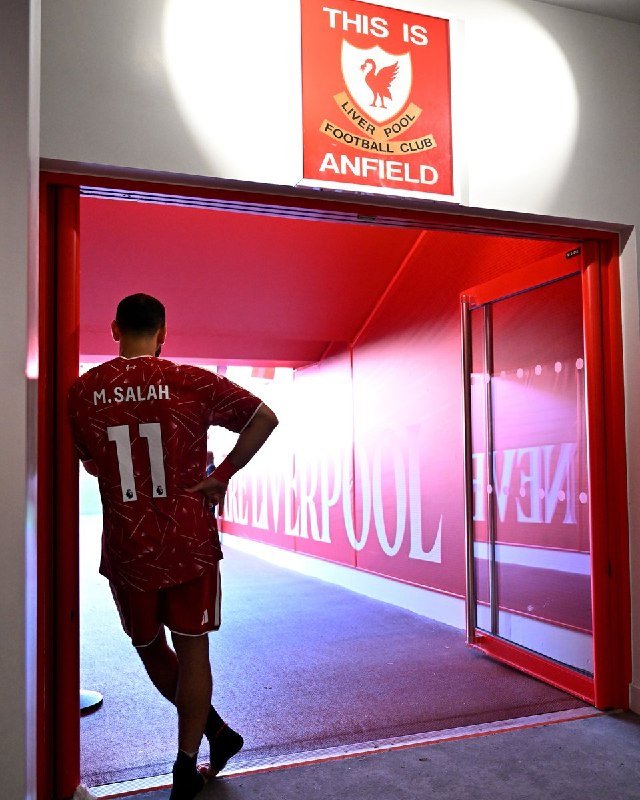
Mohamed Salah was crying before the final whistle. That detail, more than any managerial statement or statistical summary, captured what Liverpool's 2-2 draw against Brentford on 24 May 2026 actually meant. This was not a match report. It was a farewell ceremony conducted in the language of football, with the Egyptian forward standing in the centre circle after the final whistle, tears streaming down a face that has become synonymous with everything the club rebuilt from the wreckage of 2020. Andy Robertson, equally, received his guard of honour. Together, Liverpool's two most durable wide creators — consistent across titles, near-misses, and the quiet recalibration under Arne Slot — walked off the Anfield turf for the last time as homegrown legends.
The result itself delivered exactly what Liverpool needed. Confirmation of Champions League football for 2026-27 arrived alongside the farewells, a dual-purpose afternoon that left the club with both sentiment and structural security intact. Slot's side may have let a winning position slip against a Brentford side whose away record has been quietly impressive this season, but the noise of the moment — the choruses, the banners, the standing ovation for both departing senior figures — drowned out any tactical critique. Liverpool finished the season in third place, above Arsenal on goal difference, with the faintest mathematical possibility of catching Nottingham Forest still alive until the final weekend. It is a result that satisfies the board's minimum requirement, even if it leaves questions about the ceiling.
What the farewells actually signal
The decision to grant Salah and Robertson such prominent farewells was never purely about sentiment. Liverpool's sporting director, Richard Hughes, has been clear in recent months that the club's wage bill requires recalibration as part of a broader squad renovation project. Salah's contract situation — the Egyptian had entered the final months of his deal and had been linked with moves to Saudi Arabia, the United States, and various European clubs throughout the season — created a logistical problem that was never going to resolve cleanly. Robertson's situation was less globally visible but no less structural: the Scottish captain turns 32 in August, his recovery from a serious knee injury sustained in late 2024 has been described by club medical staff as satisfactory but not complete, and his leadership role has been gradually absorbed by younger figures including Connor Bradley and Jarell Quansah in different contexts. The farewells were, in effect, the club making public what had been negotiated in private across several months of contract discussions.
That does not make them less genuine. Salah's attachment to Liverpool is documented in ways that go beyond social media posts and post-match interviews — he has invested privately in the club's community programmes, has been a consistent presence at Anfield's charitable events, and has repeatedly cited the city of Liverpool as his primary reason for staying in England when easier, more lucrative options existed. Robertson, quieter in profile but equally institutional, captained the side through some of its most difficult periods, including the 2023 Champions League final defeat and the rebuild that followed. These are not players who outstayed their welcome. They are players who outstayed the cycle.
The counter-narrative: third place is not a title
The temptation, in an atmosphere thick with farewells, is to frame Liverpool's season as a success. Third place, Champions League qualification, two finals reached before losing to Manchester City in both domestic cup competitions — this is objectively a strong return for a manager in his second season. But the structural reality is more complicated. Liverpool finished eleven points behind City in the league. Their expected goals figures across the second half of the season declined sharply after the February injury to Cody Gakpo. The creative burden carried by Salah and Robertson — who combined for 38 league involvements between them — was not distributed adequately across the squad, leaving Slot's side dependent on two ageing bodies in wide areas where the club has been linked to younger alternatives for two transfer windows without moving.
The Brentford match illustrated this precisely. Liverpool twice took the lead through goals that reflected the quality of the departing pair — Salah with a curling finish from the edge of the box, Robertson with a low cross that forced an own goal — and twice allowed Thomas Frank's side back into the game through defensive errors that have been a feature of the season rather than an aberration. Youri Tielemans equalised twice for the visitors. Bryan Mbeumo troubled Liverpool's right side throughout the second half. The pattern was familiar: Liverpool score, Liverpool relax, Liverpool get punished. That pattern did not start this season and it will not end with these farewells.
The structural frame: what Slot is inheriting
Liverpool's transition is not simply about replacing two players. It is about rebuilding a system that was built around those players' specific profiles — Salah's pace and right-footed cut-ins, Robertson's overlapping left-footed deliveries — and adapting it for a different kind of forward. Slot has spoken publicly about the importance of positional discipline and vertical pressing, attributes that the current squad possesses unevenly. The arrival of a new sporting director — the club announced the appointment of a successor to Julian Ward in early 2026 — has accelerated discussions about the summer transfer window, with multiple reports linking Liverpool to centre-forwards in Germany, Brazil, and the Portuguese league.
What is less discussed publicly but clearly present in the board's thinking is the question of midfield. Neither Robertson nor Salah disguised the fact that Liverpool's progression under Klopp and then Slot was built on high-tempo transitions that relied on the two wide positions creating numerical advantages against opposition full-backs. That model works when the wide players are at peak physical condition; it works less well when they are being asked to contribute to a lower block or to track back against younger, more direct wingers. The evidence of the latter half of this season suggests Liverpool need a different structure — one that does not depend on individual brilliance to generate chances in tight games.
That is a significant challenge for Slot. He has earned credit for navigating the post-Klopp transition with relative stability — the club finished no lower than third in the league across his two seasons and reached two cup finals — but the work of actually rebuilding the squad's age profile and tactical identity is only beginning. The departures of Salah and Robertson do not complete that work. They simplify one dimension of it by removing the question of what to do with players who want to stay but whose wage demands and physical decline make long-term retention complicated. The harder question remains: what comes next.
The stakes: short-term pain, long-term reset
There is a version of this story in which Liverpool's evening at Anfield on 24 May 2026 looks like the end of something and nothing else. The crowd's emotional investment in Salah and Robertson was genuine and justified — these are players who delivered titles,创造了历史,并在艰难时期保持了俱乐部的竞争力。But the club's leadership, from FSG president Mike Gordon down through the football operations team, has been clear that long-term sustainability means accepting short-term fluctuation in performance. Champions League qualification for 2026-27 provides the financial foundation for what comes next. The squad will look different in August.
The immediate beneficiary of that stability may be Darwin Núñez, whose mixed season — 14 league goals but a conversion rate that places him in the bottom quartile among Premier League forwards — has generated internal debate about his role in the new system. Slot has backed him publicly, but the structural question of whether a high-press, transition-heavy striker fits a possession-dominant midfield remains unanswered. Robertson's replacement, likely to come from the club's academy or from a relatively modest transfer fee given the current market, will be asked to perform a different function than the Scottish captain did. Salah's replacement, if the club moves for a marquee forward, will face a different kind of pressure: not replicating what Salah was, but becoming what Liverpool need next.
The farewells at Anfield on Saturday were moving precisely because they marked the end of something identifiable. What follows will be messier, less cinematic, and harder to mourn cleanly. Liverpool have qualified for Europe. The rebuild begins now.
This publication focused on the structural implications of Liverpool's farewells rather than the prevailing media narrative of sentiment and legacy. The wire framed the story primarily as a celebration; this piece reads it as a transition point with consequential decisions ahead.