The Assassination Trap: Why Israel's Targeted Killing Strategy Keeps Failing
Israel announced the assassination of Mohammed Awda, the new Qassem Brigades commander, on 26 May 2026. The precedent suggests this will not end the conflict — it will deepen it.
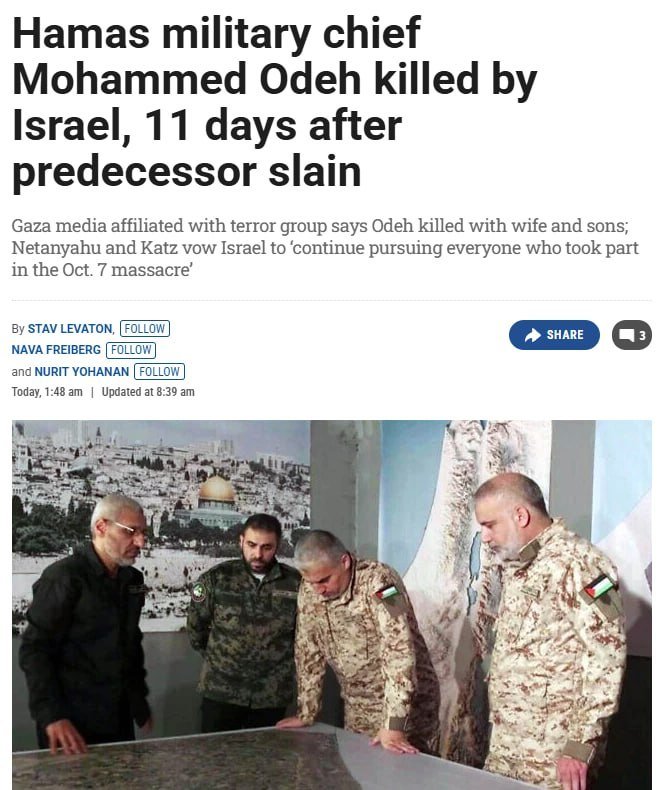
Israeli Prime Minister Benjamin Netanyahu announced on 26 May 2026 that the IDF had carried out an assassination strike in Gaza City targeting Mohammed Awda — the newly appointed commander of the Qassem Brigades, the armed wing of Hamas. "We will reach everyone," Netanyahu wrote on social media, describing Awda as "one of the architects of October 7th." Whether the strike achieved its objective remained unconfirmed at time of publication. Defense Minister Israel Katz joined Netanyahu in ordering the operation.
This is the fourth time Israel has announced the elimination of a senior Qassem Brigades commander since the Gaza conflict intensified. Each announcement has followed the same script: intelligence-led precision, a declared victory, and an implicit promise that the death of one man will degrade Hamas's military capacity. The pattern is now well-established. So is its outcome.
The Replacement Problem
Israel's targeted killing programme operates on a logic that its own history consistently falsifies. The assumption is hierarchical: remove the commander, sever the command chain, degrade operational capacity. The reality is more recursive. Hamas has demonstrated a structural ability to reconstitute leadership faster than Israel can eliminate it. Awda's predecessor was killed. His predecessor was killed. The organization adapts, promotes from within, and absorbs the loss into its broader military and political framework.
This is not a commentary on Hamas's moral legitimacy. It is an observation about organizational resilience under sustained pressure. The IDF's own assessments, disclosed in varying degrees through Israeli defense briefings over the past eighteen months, have acknowledged that Qassem Brigades command-and-control has become more distributed, not less — a direct response to the targeting campaign itself. Israel has, in effect, incentivized a more resilient organizational structure by repeatedly demonstrating that concentration of command is a liability.
What the Evidence Shows
The data from previous targeted assassinations does not support the strategic claims made for them. When Israeli officials cite the elimination of a commander as evidence of degrading Hamas capability, they are making a claim about future military outcomes that the historical record does not substantiate. Strike announcements generate a short-term information effect — news cycles, political reassurance, the appearance of momentum — but the correlation with lasting degradation of Hamas's military infrastructure is weak.
The ceasefire negotiations currently stalled between Israel and Hamas present the clearest test case. Every round of targeted assassinations during active negotiation periods has been followed by a hardening of positions on both sides. Hamas cites Israeli assassinations as evidence of bad faith. Israel cites them as evidence of operational necessity independent of diplomatic tracks. The diplomatic cost is real and traceable. The military benefit is contested and contested precisely because it is difficult to measure.
The Ceasefire Calculus
The White House and several European foreign ministries have, in recent months, pressed publicly for a negotiated ceasefire premised on phased exchanges and temporary pauses. Israel's assassination campaign complicates this diplomatic environment in a specific and predictable way: it reduces the incentive for Hamas to make concessions at the negotiating table by demonstrating that any arrangement reached may be unilaterally revoked through targeted operations. If the political price of sitting across from Hamas is too high for Western governments to absorb indefinitely, the assassination cycle creates a self-reinforcing dynamic in which the negotiating window closes precisely when the humanitarian need for it is greatest.
This publication does not dispute that Mohammed Awda, as Israeli officials describe him, bears significant responsibility for the events of 7 October 2023. The question this piece raises is not about individual guilt. It is about whether a tactic repeatedly deployed over eighteen months, with results that are militarily ambiguous and diplomatically corrosive, constitutes a strategy — or whether it is a substitute for one.
The Forward View
If past patterns hold, Israel will confirm the strike's success within days, Qassem Brigades will name a successor within weeks, and ceasefire negotiations will resume from a more entrenched starting position. The gap between announcement and outcome — between the symbolic weight of an assassination and the operational reality on the ground — will remain unexamined in the official framing, because it does not serve the framing's purpose.
That gap is worth naming. The policy debate deserves to be held against the evidence of what targeted assassinations have actually delivered: not an end to the conflict, but a perpetual present tense in which each killing becomes the prelude to the next. The dead are real. The strategic claims made for their deaths deserve scrutiny that the announcement cycle rarely allows.
This publication covered the strike through Telegram-sourced dispatches from intelligence monitors and Israeli officials. Wire reporting from Reuters and AP was not yet available at time of publication; this analysis will be updated as confirmed details emerge.
Wire provenance
This editorial synthesis draws on the following public wire/social posts:
- https://t.me/rnintel/28456
- https://t.me/GeoPWatch/18923
- https://t.me/amitsegal/15231