Drone Against Tank: How Lebanon's Ababil Force Reshapes the Israel Combat Calculus
A single Ababil strike destroying a Merkava tank outside Zawtar al-Sharqiyah crystallises a trend reshaping modern armoured warfare: cheap, proliferated drones undoing platforms that cost millions and took decades to develop.
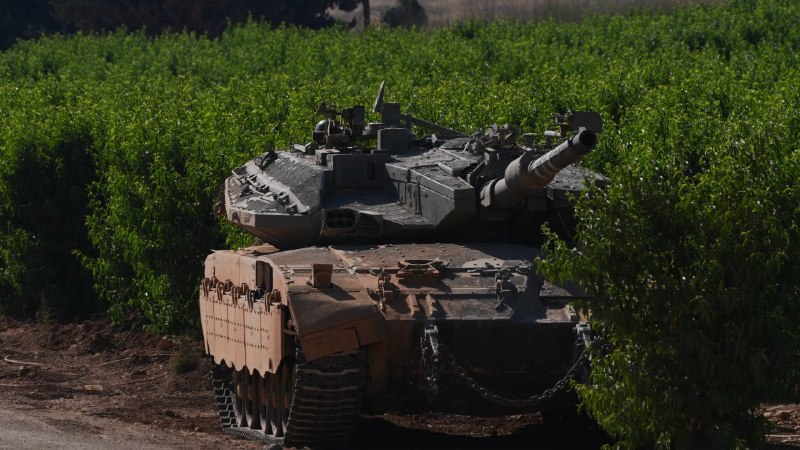
On the morning of 26 May 2026, Hezbollah announced that its fighters had engaged an Israeli force advancing toward Zawtar al-Sharqiyah in southern Lebanon, destroying a Merkava main battle tank using an Ababil unmanned aerial vehicle. The claim, carried simultaneously by The Cradle Media and Al Alam Arabic, described the strike as the culmination of intense artillery preparation and aerial surveillance conducted over the preceding hours. The Israeli military had not issued a public casualty or equipment-loss statement at the time of this report; this publication will update as official confirmation becomes available.
The episode is specific in its geography and opaque in its official attribution — but it is not isolated. It sits inside a broader pattern that military analysts have documented across the Israel–Lebanon frontier and, with greater intensity, inside Gaza: the regular, repeatable neutralisation of high-value armoured platforms by low-cost unmanned systems. The Merkava, a tank whose lineage stretches back to the 1970s and whose contemporary variants carry composite armour, Trophy active protection systems, and crew sizes of four, represents tens of millions of dollars in procurement and institutional investment. The Ababil — an Iranian-origin loitering munition adapted from a 1980s design — can be produced for a fraction of that cost and operated by a single ground controller with minimal training. The exchange rate between these two systems is the story.
The Drone That Changed the Equation
The Ababil family of drones traces its lineage to the Iran–Iraq war, where the Islamic Revolutionary Guard Corps adapted commercial aircraft designs into early unmanned weapons. Successive generations — Ababil-1, Ababil-2, Ababil-3, and the Ababil-T variant reported to have longer loiter time and a larger warhead — have proliferated across Iranian proxy networks in Iraq, Yemen, and Lebanon. What distinguishes the platform from early-generation Iranian UAVs is its loitering capability: the Ababil can circle a target area for an extended period before diving into a designated point, combining the functions of reconnaissance and strike in a single airframe.
Hezbollah has deployed Ababil variants against Israeli positions with increasing frequency since October 2023, according to reporting from regional security analysts and open-source intelligence trackers monitoring the frontier. The combination of wide availability, low unit cost, and tolerance for attrition — a force can absorb the loss of multiple drones without meaningful strategic damage — makes the platform a structurally asymmetric weapon in the classic sense: the defender does not need to win every exchange; they only need to make every exchange expensive for the attacker.
Israeli armour on the northern frontier has responded with layered active protection systems, including the Rafael-produced Trophy, which detects incoming projectiles and fires a counter-measure to neutralise them before impact. Trophy has demonstrably intercepted rocket-propelled grenades and anti-tank guided missiles in Gaza operations. Whether it performed as designed at Zawtar al-Sharqiyah on 26 May cannot be independently verified from the available sources; the Israeli Defence Forces have not confirmed the nature of the kill mechanism.
What the Tank Represents — and What It Costs to Lose
The Merkava programme is not merely a weapons system; it is an institutional artefact of Israeli defence planning. Israel Aircraft Industries — now part of Israel Aerospace Industries — designed the first Merkava variants explicitly around the premise of crew survivability in urban and close-combat environments, a requirement shaped by Israel's experience in Lebanon during the 1970s and 1980s. The Merkava Mk 4, currently in service with the Israeli army, weighs 65 tonnes, mounts a 120mm smoothbore cannon, and incorporates a rear-engine layout that allows it to serve as a personnel carrier in extremis — a doctrinal flexibility rooted in the specific lessons of attrition warfare.
Every destroyed Merkava carries a procurement and training cost that extends far beyond the vehicle itself. Crew experience — the institutional memory of armoured commanders who have operated in specific terrain and threat environments — cannot be replaced on a production line. This is not a unique Israeli problem; it is the challenge facing every conventional army operating armoured formations against a dispersed, low-signature drone threat. The Ukrainian military has documented similar dynamics on the eastern front, where NATO-supplied Leopard and Challenger tanks have been neutralised by first-person-view drones at a rate that surprised procurement planners.
Hezbollah's framing of the Zawtar al-Sharqiyah engagement — describing the Israeli force as "complex," a term that in military parlance typically indicates combined-arms coordination with infantry, armour, and supporting fire — suggests this was not an isolated patrol but a coordinated advance subject to a prepared ambush. Whether the Israeli force was operating inside Lebanese territory or along the disputed frontier demarcation line carries significant legal and political weight; this publication has not found corroborating confirmation from Israeli or Western wire sources at time of writing.
The Structural Pattern: Proliferation and the Erosion of Platform Dominance
What Hezbollah demonstrated at Zawtar al-Sharqiyah fits a structural dynamic that defence economists and military theorists have been mapping since the Nagorno-Karabakh conflict of 2020: the declining survivability of expensive, high-profile military platforms against cheap, numerous, and increasingly autonomous unmanned systems. Azerbaijan's use of Bayraktar TB2 drones and Israeli Loitering munitions against Armenian armoured formations prefigured the pattern. Ukraine extended it. Gaza has tested it at extreme close range. The Israel–Lebanon frontier represents its most recent and, for the purposes of Israeli defence planning, most consequential instantiation.
The Ababil and its analogues do not require a sophisticated industrial base to proliferate. They can be manufactured in drone-factories across Iran, assembled from components shipped through intermediary jurisdictions, and deployed by non-state actors whose institutional continuity does not depend on state budgets or parliamentary approval cycles. The asymmetry is not just tactical; it is structural. A state military that loses a Merkava must go through a procurement cycle measured in years and budget cycles measured in electoral terms. A non-state actor that loses a dozen Ababils loses a logistical inconvenience.
Israeli defence planners have not been passive in response. Iron Beam, a directed-energy weapon being developed by Rafael Advanced Defence Systems, is intended to intercept short-range rockets and drones at the point of launch, complementing the Iron Dome's higher-altitude intercept capability. The Rafael-IAI partnership on advanced active protection systems continues to evolve. But the pace of drone proliferation and the diversity of delivery mechanisms — ground-launched, air-launched, launched from civilian vehicles — creates a target set that even the most capable air defence architecture struggles to close.
Stakes and Forward View
If the Ababil-Merkava exchange rate continues to favour the drone — and the available evidence across multiple theatres suggests it does — the implications extend beyond any single frontier. Israeli ground operations in Lebanon require a level of armoured mass that is structurally vulnerable to the conditions described in the 26 May engagement. A ground incursion would need to suppress drone-launch sites, destroy loiteringmunition stockpiles, and neutralise ground-control infrastructure while simultaneously maintaining the logistical lines that armoured columns require. That is not an impossible task, but it is a categorically different task than the one that armoured doctrine was designed around.
For Hezbollah, the stakes are differently configured. The organisation has calculated that visible Israeli equipment losses erode the domestic political insulation that constrains Israeli escalation decisions. A destroyed Merkava is not merely a tactical event; it is a signal, transmitted through social media and regional press, that the costs of sustained operations are not one-directional. Whether that calculation holds depends on variables — Israeli domestic politics, Hezbollah's own deterrent thresholds, the posture of Iranian state backing — that the available sources do not fully resolve.
What is knowable is the technical direction of travel. Drones are becoming more capable, more autonomous, and more numerous. The platforms designed to defeat them are becoming more sophisticated and more expensive. The exchange rate between the two is moving, and the Zawtar al-Sharqiyah engagement is a data point in a trend that every defence establishment in the world is now trying to price.
This publication will continue to monitor official Israeli statements and wire-service reporting for corroboration of the engagement's specifics. The broader analysis — cheap unmanned systems against expensive conventional platforms — does not require a confirmed tank kill to be structurally sound.
Desk note: Monexus opted to lead with the Ababil-Merkava exchange as a case study in drone-economy asymmetry rather than frame the story primarily around Hezbollah's official communiqués. Wire-style accounts of the same engagement would likely foreground Israeli military spokesperson statements and the diplomatic context of frontier tensions. The structural frame — platform dominance eroding against proliferated unmanned systems — is drawn from observable patterns across Ukraine, Gaza, and the South Caucasus, not from any single source.
Wire provenance
This editorial synthesis draws on the following public wire/social posts:
- https://t.me/TheCradleMedia/
- https://t.me/thecradlemedia/
- https://t.me/alalamarabic/