The Drone War Comes of Age: Petraeus and the Limits of Military Doctrine
Former CIA Director David Petraeus has weighed in on the role of unmanned systems in Ukraine's defense — a commentary that arrives as military planners everywhere confront a question they have yet to answer: what does a doctrine look like when the battlefield changes faster than the doctrine can be written?
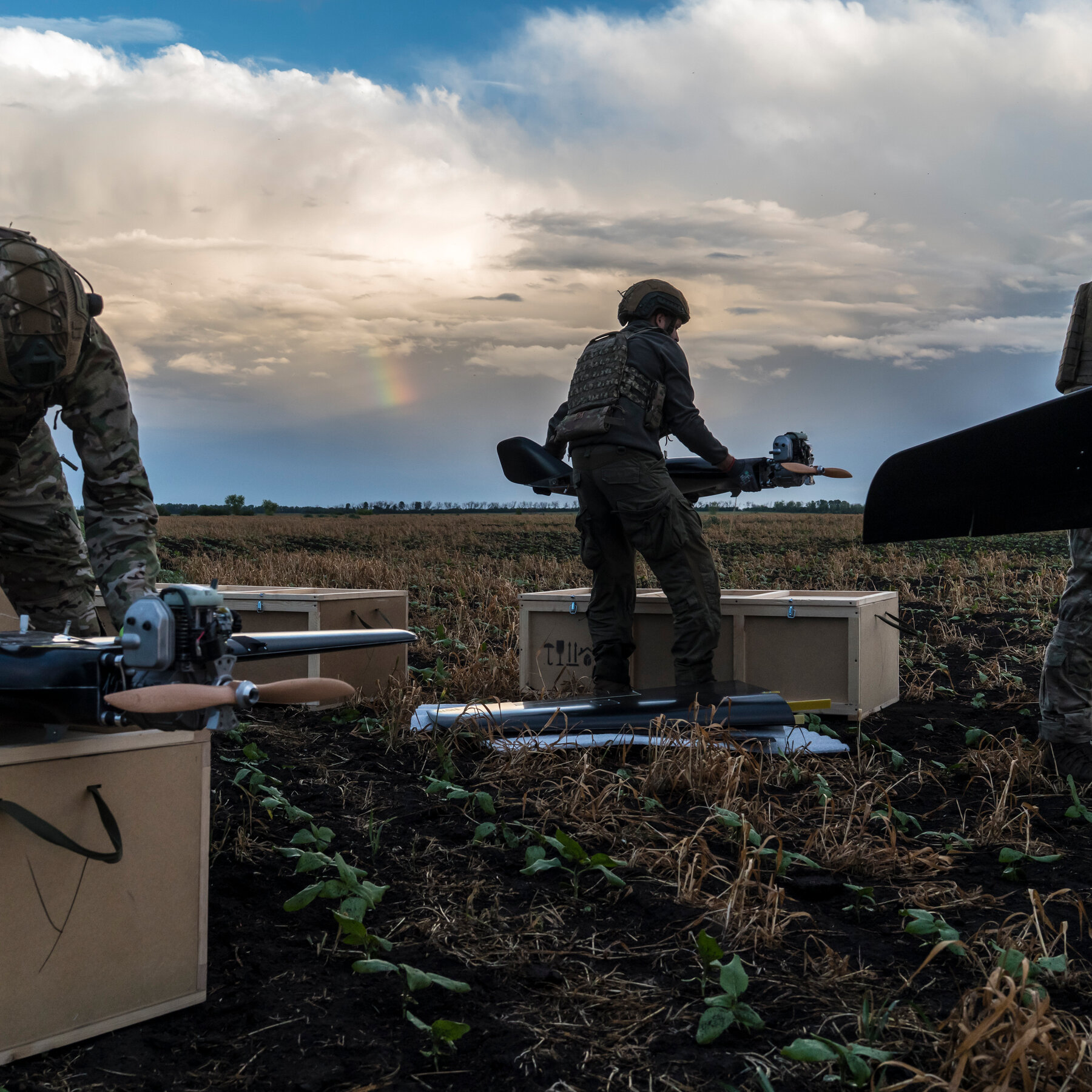
On 25 May 2026, a former Director of the CIA delivered remarks on the Russia-Ukraine conflict that surfaced in Telegram channels with a reach far beyond any official briefing room. The substance, relayed by intelligence-adjacent accounts tracking defense and open-source developments, centered on a single observation: that militaries — including, implicitly, the most technologically sophisticated — remain in the early stages of understanding what unmanned systems have done to the modern battlefield. The comment traveled fast. It was cited, amplified, annotated. The cycle was itself a small illustration of the phenomenon Petraeus was describing.
What the former CIA Director appears to have been gesturing toward is not merely the deployment of drones in Ukraine — a fact so widely documented it barely qualifies as analysis — but the lag between operational reality and institutional comprehension. The drones are already there. The tactics are already being written, at unit level, by operators in the field. The question is whether the doctrine has caught up, and the evidence suggests it has not.
Ukraine has been, for three years running, the most extensively documented drone warfare laboratory in history. The volume of unmanned aerial systems deployed by both sides — from First-Person View racing drones modified for ordnance delivery, to medium-altitude surveillance platforms, to maritime drone boats operating in the Black Sea — represents a qualitative shift in how wars are fought. Ukrainian commanders have spoken openly about the learning curve: in 2022, FPV drones were curiosities. By 2024, they were primary attrition tools, with some units conducting hundreds of sorties per day. That trajectory has not slowed.
Senior Western military figures have taken note. The admission that doctrine lags behind capability is, in private, nearly universal among defense analysts; in public, it surfaces selectively, often through figures like Petraeus who carry institutional credibility but retain enough personal freedom to speak plainly. The observation that "we are far from having fully absorbed" what drones represent fits that pattern — a calibrated acknowledgment from someone who spent years inside the apparatus now being asked to rethink itself.
The structural problem is not unique to the United States. NATO's formal doctrine on unmanned systems, codified in alliance publications and reflected in member-state military education, treats drones as force multipliers — adjuncts to manned platforms. The Ukrainian experience suggests a different hierarchy: drones as primary systems, with manned assets increasingly supporting them rather than the reverse. Artillery, once the queen of the battlefield in attritional conflict, has been degraded by drone-corrected fires and drone-delivered munitions. Armor, the backbone of conventional armored warfare, faces a threat environment where overhead loitering munitions have shifted the cost-benefit calculus of maneuver.
This is not, it should be said, a clean story of obsolescence. Russian and Ukrainian forces both continue to operate substantial manned aviation, air defense, and armored formations. The lesson of Ukraine is not that high-end platforms are irrelevant but that their effectiveness is now contingent on a layered drone ecosystem that neither side has fully mastered. The battlefield is becoming denser, more contested, and more difficult for any single platform to dominate unilaterally.
The media environment surrounding this evolution carries its own logic. Petraeus's remarks traveled through channels that curate defense content for an audience that is itself deeply embedded in the drone warfare discourse — operators, analysts, enthusiasts, and researchers who have been tracking Ukraine's tactical adaptations in near-real time via Telegram, open-source intelligence accounts, and military bloggers. These audiences are not passive recipients of institutional analysis. They have their own data, their own interpretations, and in some cases, direct operational experience. When a former intelligence chief offers a sweeping observation about military adaptation, the response is not deferential silence — it is annotation, rebuttal, and extension, often within minutes.
This represents a genuine shift in how expertise circulates. The traditional model — institutional authority speaking, media transmitting, public receiving — has always had friction. In coverage of a conflict as document-rich as Ukraine's, the friction has become structural. The wire services carry official briefings and battlefield reports. The Telegram channels carry unit-level footage, casualty assessments, and tactical commentary from people who were in the relevant trenches two days ago. The hierarchy of credibility has not dissolved, but it has been complicated.
There is a specific irony here worth noting: a former head of the CIA, speaking about the limits of institutional adaptation, himself became a data point in the decentralized media ecosystem he was implicitly describing. The observation was real. The framing was not entirely within his control. That is, in miniature, what the drone era has done to military institutions — it has made observation and participation simultaneous, and the line between them harder to maintain with each passing month.
The implications extend beyond any single conflict. If the Ukraine theater is, as many defense analysts now argue, a reliable predictor of near-term military competition, then the doctrinal lag Petraeus appears to have acknowledged is a problem for every defense establishment with ambitions to remain interoperable with Western capabilities. Drone warfare is not a niche specialty; it is becoming the connective tissue of multi-domain operations. Forces that have not internalized that shift — in training, procurement, and operational concept — will find themselves operating in a strategic environment their doctrine does not describe.
Whether the institution can adapt faster than the threat environment continues to evolve is the operative question. Military history offers examples in both directions: institutions that reformed in response to technological disruption, and ones that persisted in outdated conceptual frameworks until catastrophic failure forced the issue. The drone war has not yet delivered its verdict on which outcome applies to the current moment. What is clear is that the gap between what the drones are doing and what the doctrine says about them is no longer a theoretical concern. It is a operational fact, acknowledged now from the inside, and visible to anyone willing to watch the Telegram channels where the war is being fought in real time.
This desk has tracked Petraeus's public commentary on Ukraine intermittently since 2022. The wire framed his remarks on 25 May as a general observation about military adaptation; this article has attempted to locate that observation within the specific tactical trajectory of drone warfare in the Ukrainian theater, a story that the broader wire has covered in fragments but rarely as a coherent structural arc.
Wire provenance
This editorial synthesis draws on the following public wire/social posts:
- https://t.me/osintlive/2842