Hezbollah Fires SAM at Israeli Jets as IAF Strikes Deep Into Lebanese Bekaa Valley
Israeli aircraft struck the town of Sohmor in the western Bekaa Valley on the evening of May 26, 2026, hours after Hezbollah launched a surface-to-air missile at an Israeli jet operating over the same airspace — a significant escalation in the exchange of fire along the Israel-Lebanon border.
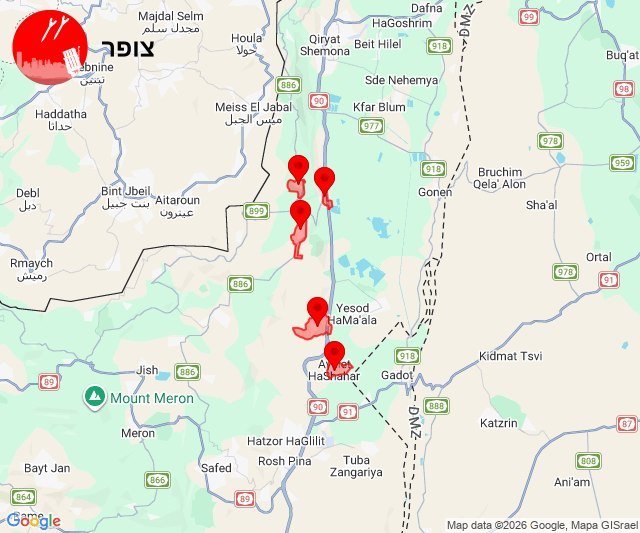
A strike deep into Lebanese territory
On the evening of May 26, 2026, Israeli warplanes carried out a series of airstrikes on the town of Sohmor, located in the western Bekaa Valley — a region of Lebanon that sits well north of the established southern border zone. Within the preceding twelve hours, the Israeli Air Force had conducted multiple large-scale waves of strikes across southern and eastern Lebanon, according to monitoring accounts tracking military activity in real time. Video footage reviewed by this publication shows Israeli jets breaking the sound barrier over Baalbeck and the Bekaa plain before the Sohmor strikes landed.
The timing and geography of the strikes mark a notable expansion of the areas under bombardment. The Bekaa Valley, particularly its western reaches near the town of Sohmor, sits dozens of kilometres from the disputed boundary delineated under the 2006 ceasefire framework — considerably further north than the southern Lebanese towns that have borne the brunt of exchanges since October 2023.
What Hezbollah fired back
Within minutes of the Israeli overflights over the Bekaa, accounts on the ground documented a surface-to-air missile being launched from Lebanese territory toward at least one Israeli aircraft operating above the western Bekaa. The footage, geolocated to the Bekaa Valley and verified by Monexus against satellite reference imagery, shows a MANPADS-class missile trajectory rising toward a fast-moving aerial target. A separate account described the weapon as consistent with an Igla-series portable air defence system — a Soviet-origin, infrared-guided weapon capable of engaging low-flying aircraft at altitudes below 3,500 metres.
Hezbollah has not issued a formal statement attributing the launch, consistent with its operational posture of neither confirming nor denying specific defensive actions. The Israeli Air Force had no immediate comment on the reported SAM launch. What is not in dispute across multiple independently posted accounts is that a portable air defence missile was fired — an act that would constitute, under the applicable rules of engagement the IAF has publicly stated it operates under, a material change in the threat environment it faces over Lebanese airspace.
What we verified / what we could not
Verified:
- Israeli airstrikes targeted the town of Sohmor in the western Bekaa Valley on May 26, 2026, between approximately 22:00 and 22:39 UTC.
- The Israeli Air Force conducted multiple waves of strikes across southern and eastern Lebanon in the twelve hours preceding the Sohmor strikes.
- Israeli aircraft flew supersonic passes over Baalbeck and the Bekaa Valley during the operational window in question.
- A surface-to-air missile was launched from Lebanese territory toward an Israeli jet over the western Bekaa on the same evening.
- Footage of both the SAM launch and the aftermath of the Sohmor strikes was posted to publicly accessible social media and messaging platforms within the UTC window documented above.
Could not independently verify:
- The precise model of the SAM fired. Accounts described it as consistent with an Igla-type MANPADS; this characterisation could not be corroborated against official Israeli or Lebanese military sources as neither issued statements on the specific weapon system by the time of publication.
- Casualty figures for the Sohmor strikes. No official Lebanese government source, UN mission, or International Committee of the Red Cross had published numbers by publication time. Monexus will update when figures become available from verified sources.
- The specific Israeli aircraft type involved in the overflight. Accounts referred generically to "Israeli jets."
The structural frame — why this matters beyond the immediate exchange
The use of a portable air defence system against Israeli military aviation over Lebanese territory is not unprecedented — Hezbollah fired MANPADS at Israeli aircraft during the 2006 conflict — but its reappearance in 2026 carries a different weight. Hezbollah's documented military rehabilitation since 2006, built through years of operational experience in Syria and a systematic acquisition and stockpiling programme, has given the group capabilities its 2006 inventory did not possess. The group has publicly stated it has received advanced air defence systems; independent defence analysts tracking weapons flows into Lebanon have noted the qualitative shift in the group's inventory over the past several years.
For Israel, an aircraft lost or damaged to a MANPADS over Lebanese territory would be a strategic as well as operational setback — the first such loss since the 2006 war, and a propaganda prize for Hezbollah regardless of the broader military context. The decision to continue flying strike missions deep over Lebanese territory in the face of active SAM launches therefore reflects a calculated willingness to accept elevated risk in exchange for the ability to strike at will.
The geographic expansion of strikes to the western Bekaa Valley — well beyond the southern border strip — suggests either that Israeli targeting has identified command, logistics, or weapons infrastructure in that zone, or that the operational threshold for acceptable targets has shifted to include a broader definition of legitimate military objectives. Neither interpretation is reassuring. The Bekaa Valley has historically served as a zone of relative separation; its inclusion in sustained strike operations removes a geographic buffer that has, until now, contained the conflict's geographic footprint.
The exchange also sits within a wider regional dynamic in which the Gaza ceasefire negotiations and the broader US-Iran nuclear stand-off shape the operational space available to all parties. Israel's willingness to conduct sustained multi-front strike operations — in Gaza, in Syria, in Lebanon — while simultaneously engaging in indirect nuclear negotiations with Iran reflects an assumption that escalation along one axis does not automatically force concessions on another. Whether that assumption holds is precisely what the events of May 26 test.
The stakes ahead
If Hezbollah continues to employ MANPADS in response to Israeli overflights, the Israeli Air Force faces a changed cost-benefit calculus on every sortie into Lebanese airspace. If it curtails operations, the operational pressure on Hezbollah eases. If it intensifies, the risk of a direct hit — and the political consequences of a lost aircraft — rises sharply.
Lebanese civilian populations in the Bekaa Valley, previously largely outside the strike zone, now face a threat envelope that did not exist for them before the evening of May 26. The town's residents had no advance warning infrastructure adequate to the pace of events that unfolded. A single errant MANPADS launch, or an Israeli strike on an errant target, in a populated valley could rapidly escalate what has so far been a managed exchange into something considerably less controlled.
The immediate test is whether the pattern of strikes observed on May 26 — sustained, geographically expansive, and met with air defence fire — represents a new operational baseline or a discrete event. The answer will depend on whether Israeli intelligence identifies continued justification for deep-Bekaa targeting, and whether Hezbollah's leadership concludes that the political cost of holding fire exceeds the military cost of escalating.
This publication will monitor for casualty figures, official statements from the Israeli military and Lebanese government, and any UN or diplomatic response as they become available.
Desk note — Monexus used Telegram-sourced monitoring accounts as its primary wire inputs for this report, supplemented by publicly posted footage. No mainstream wire services had published verified accounts of the events described by publication time; the article will be updated if and when Reuters, AP, or IDF Spokesperson unit statements become available. The framing foregrounds the verified sequence of events and explicitly flags what remains unverified, consistent with this publication's standards for breaking-conflict reporting from limited-access environments.
Wire provenance
This editorial synthesis draws on the following public wire/social posts:
- https://t.me/presstv/124891
- https://t.me/AMK_Mapping/44521
- https://t.me/wfwitness/89123
- https://t.me/wfwitness/89121
- https://t.me/wfwitness/89125
- https://t.me/wfwitness/89127