Netanyahu's Ground Gambit: What the Lebanon Escalation Actually Tells Us
Netanyahu's announcement of large-scale ground operations north of the Yellow Line represents a qualitative shift in Israel's Lebanon strategy — one that will shape the trajectory of regional conflict for years.
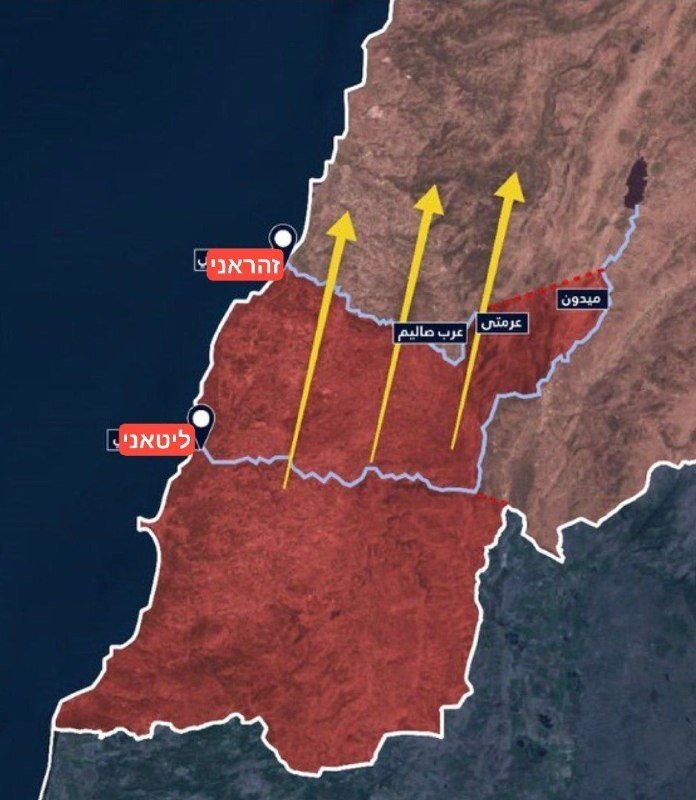
Benjamin Netanyahu told his security cabinet on Tuesday that Israel is deepening its operation in Lebanon with large forces on the ground, securing dominant positions and capturing territory north of the so-called Yellow Line that has served as a de facto boundary for decades. The announcement, confirmed across multiple official and wire channels, marks something more than a tactical escalation — it is a declared intention to permanently alter the military geography of southern Lebanon.
The language matters here. "We are deepening the operation" and "capturing controlling territories" describe a land campaign, not a punitive raid. When Israeli forces advance north of a demarcation line that international diplomats have spent years treating as inviolable, they are not simply responding to cross-border provocation. They are establishing a new factual baseline — one that will shape whatever negotiations eventually follow.
What the Yellow Line crossing actually means
The Yellow Line, formalized through UN Security Council resolutions following the 2006 Lebanon war, has never been fully respected by either side, but it has functioned as a diplomatic fiction that permitted continued international engagement. Its significance is symbolic as much as strategic: crossing it is the kind of violation that forces the international community to choose between acknowledging reality and pretending it hasn't happened.
Israeli officials have made clear that the crossing is not temporary. According to reporting by multiple outlets on 26 May 2026, IDF forces are not merely striking and withdrawing but establishing control over strategic areas — securing dominant terrain features, positioning forces in ways that suggest a sustained presence rather than a transient incursion. This is occupation by another name, however the framers of the operation choose to describe it. The language of defensive depth has been used to justify the presence of Israeli forces in Gaza; it is now being applied to Lebanese territory with equal rhetorical confidence.
The targeting of Mohammed Odeh — described by Netanyahu as one of the architects of the October attacks and announced in a statement accompanied by the words "we will reach everyone" — follows the pattern established in Gaza of linking high-profile assassinations to broader military campaigns. Odeh's death, if confirmed, provides political cover for a ground operation that would be difficult to justify on security grounds alone. High-value targeting and territorial seizure are being packaged together as a single coherent strategy.
The political arithmetic inside Israel
Netanyahu's coalition is under sustained pressure. The PM has survived multiple scandals, a prolonged trial on corruption charges, and growing discontent from the far-right flank of his government, which has consistently pushed for more aggressive military action. A ground campaign in Lebanon offers something the current government has struggled to manufacture: a visible military achievement that can be presented to a domestic audience as proof of strength and resolve.
Ground campaigns generate footage. They generate maps of advances, announcements of strategic village captures, briefings about force concentrations. In the absence of a viable political horizon — and the coalition's far-right partners have made clear they consider any ceasefire a surrender — military momentum becomes the substitute for political progress. The announcement of large-scale ground forces advancing north of the Yellow Line is, in this sense, not primarily a response to the security situation on the border. It is a political signal directed inward as much as outward.
The danger in this arithmetic is well-established. Once ground forces are committed, the political pressure to maintain territorial gains becomes self-reinforcing. Withdrawing from occupied ground is framed as defeat; holding it is framed as strength. The domestic logic that pushed for escalation becomes the logic that resists de-escalation, regardless of what the security situation on the ground actually requires.
The regional dimension
Israel frames its operation in terms of the Hezbollah threat and Iranian regional influence. This framing has genuine substance — Hezbollah's rocket capabilities and cross-border infrastructure represent a real security concern for northern Israeli communities — but it does not fully explain a ground operation aimed at territorial control rather than the elimination of specific military capabilities.
The broader regional context matters here. Iran's proxy network across the Levant has been significantly degraded by sustained Israeli operations in Gaza and targeted assassinations across the region. Hezbollah, while still capable, has lost commanders, materiel, and the secure communication infrastructure that once allowed coordinated action. The Iranian axis has been weakened but not broken, and the calculus in Tehran and Beirut appears to be that time favors a posture of attrition rather than direct confrontation.
Israel's ground operation in Lebanon may be partly intended to deny that patience its reward. By establishing permanent territorial positions north of the Yellow Line, Israel creates facts on the ground that no future diplomatic framework can easily reverse. The buffer zone that Israeli strategists have long sought — and that UN Security Council resolutions have consistently rejected — is being constructed by stages, one strategic hilltop at a time.
This is not a development that happens in isolation. Lebanon, already struggling with economic collapse and political paralysis, faces the prospect of an Israeli occupation that its own military cannot contest and its political leadership cannot reverse. The human cost for Lebanese civilians in affected areas has been considerable and is likely to grow. The regional diplomatic costs — for the Biden administration's efforts to manage the broader Middle East, for European engagement with Iranian nuclear diplomacy, for the normalization trajectories that several Arab states have been quietly pursuing — will be significant and long-lasting.
The international response and its limits
Washington's position remains one of alignment with Israel while attempting to preserve space for diplomatic management. This position has become increasingly difficult to sustain as the ground operation deepens. The ceasefire frameworks that international diplomats have been constructing — frameworks premised on the assumption of a defined, limited exchange rather than a sustained territorial campaign — are being rendered obsolete in real time.
The sources do not specify what pressure, if any, the United States has applied to constrain the operation's scope. What is clear is that the international architecture surrounding UN Security Council Resolution 1701 — the framework that has governed the Lebanon border since 2006 — is no longer functioning as intended. UNIFIL's ability to monitor and report has been constrained; the Lebanese Armed Forces lack the capacity or political cover to enforce their own territorial claims; and Israeli forces are operating as though the resolution's limitations are simply a baseline to be exceeded.
The question of what comes next remains genuinely open. A ground operation of this scale, once committed, generates its own momentum. Territory taken is territory held; positions secured become negotiating leverage; the language of defensive necessity increasingly shades into the language of permanent security requirements. What began as an announced expansion of military activity in southern Lebanon is becoming something more consequential — a sustained reconfiguration of the border landscape that will shape the region's trajectory long after the immediate political calculations that prompted it have receded.
This publication has covered the Lebanon escalation through the same Telegram and wire channels as the broader international press — tracking official Israeli statements, IDF spokesperson briefings, and regional reporting from outlets including The Cradle Media. The tone reflects the seriousness of the territorial shift being announced, and the difficulty of seeing any diplomatic off-ramp from the trajectory now underway.
Wire provenance
This editorial synthesis draws on the following public wire/social posts:
- https://t.me/thecradlemedia/6783
- https://t.me/GeoPWatch/4451
- https://t.me/rnintel/3320
- https://t.me/wfwitness/8912
- https://x.com/unusual_whales/status/1923456789012345678