Oman's Sultan and Iran's Pezeshkian Phone Home — Gulf Diplomatic Season Opens Quietly
Three bilateral calls across the Gulf and the Caspian during Eid al-Adha offer a quiet counterpoint to the louder strategic competition taking shape in the background.
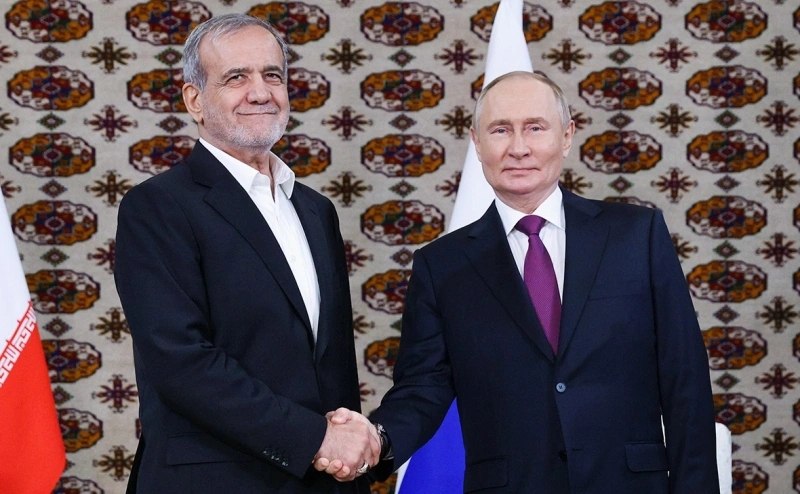
On the second day of Eid al-Adha, 26 May 2026, the Sultan of Oman and the President of the Islamic Republic of Iran spoke by telephone. The exchange, reported by Al Alam Arabic without a precise transcript or joint communique, was framed as a congratulatory call marking the holiday. The sultan, Sultan Haytham bin Tariq Al Said, used the occasion to state that Muscat would spare no effort to enhance regional stability and Islamic solidarity. The Iranian side's readout, similarly brief, carried the office of President Masoud Pezeshkian.
Separately, also on 26 May, President İlham Aliyev of Azerbaijan spoke with Pezeshkian by telephone, delivering a different but related message: Baku and Tehran would stand by each other under all circumstances. That phrase — unconditional mutual commitment — sat in the Azerbaijani readout without elaboration or conditionality.
Three calls, two days, three capitals. Taken together, they suggest a moment of deliberate diplomatic choreography, not a coincidence.
Eid as Diplomatic Calendar
The timing of these exchanges is structurally significant. Eid al-Adha is not a holiday that lends itself easily to back-channel negotiation or formal state visits. The pilgrimage season haspauses, or at least slows, the working calendars of the Gulf states, Iran, and much of the wider Muslim world. That slowness creates an opening: a phone call carries symbolic weight without the logistics of a summit. It costs little and reads well domestically.
For Muscat, placing a call to Tehran during the Eid period fits a consistent pattern. Oman has long positioned itself as a quiet intermediary — available without being loud, connected to Washington without estrangement from Tehran. The phrase about regional stability and Islamic solidarity is precisely calibrated: it signals engagement without yielding anything concrete. It is the language of a broker who wants to be seen as active, not a party to any given dispute.
For Tehran, the parallel exchanges with Baku and Muscat suggest a diplomatic offensive dressed in festivity. President Pezeshkian, whose administration has sought to balance nuclear diplomacy with regional posturing, appears to be using the Eid window to reinforce ties with two capitals that occupy different but strategically adjacent positions: Oman on the Strait of Hormuz corridor, Azerbaijan on the Caspian and a NATO-adjacent border.
Baku's Unconditional Posture
The Azerbaijani readout stands out for its lack of qualification. "Stand by each other under all circumstances" is a formulation that commits Baku and Tehran to mutual support regardless of circumstance — language more commonly associated with treaty allies or parties in an active crisis. Azerbaijan is not formally a treaty ally of Iran, and Baku maintains close ties to both Turkey and NATO structures in the South Caucasus.
This is not a new pattern. Iranian-Azerbaijani relations have oscillated between strategic wariness and transactional warmth for years, with Baku's existence as a secular, Turkic state on Iran's northern border generating persistent concern in Tehran. Azerbaijan's 2020 Karabakh war, backed by Turkish drones and, ultimately, Turkish political support, only sharpened that concern. The current warmth in official language may reflect a temporary alignment of interests: Baku needs economic diversification away from Russian energy leverage; Tehran needs a northern flank that is not actively hostile.
The phrase "under all circumstances" is thus simultaneously a signal and a question mark. Whether it translates into anything operational — shared intelligence, coordinated diplomacy, supply arrangements — remains undetermined by the public record. The sources available do not specify what concrete cooperation, if any, was discussed beyond the call itself.
What the Quiet Talks Signal
The dominant analytical frame in Western coverage of Gulf security focuses on the US military posture, the Salman regime's normalization drive with Israel, and the ever-present question of Iranian enrichment capacity. That frame treats Gulf diplomacy as an extension of the US-Iran contest, with every bilateral call legible as a move in that larger game.
The phone calls on Eid al-Adha resist that reduction. Oman calling Iran, Azerbaijan calling Iran — these are not proxy negotiations managed through Muscat or Baku. They are expressions of national interest that happen to converge near Tehran. Oman has its own hedging strategy vis-à-vis both Washington and Riyadh. Azerbaijan has its own calculus on the Caspian and on its relationship with Turkey's broader regional ambitions. If anything, the willingness of both capitals to pick up the phone suggests that the regional environment is more polycentric than the dominant narrative acknowledges.
That polycentrism cuts both ways. More diplomatic channels mean more opportunities for de-escalation, but also more relationships that can be tested when a crisis erupts elsewhere. The sources do not disclose whether any specific tension between Muscat and Tehran, or between Baku and Tehran, was addressed during these calls. The record is bilateral pleasantries wrapped in Eid language.
What Remains Unresolved
The most honest reading of these three telephone exchanges is that they tell us about diplomatic atmosphere, not diplomatic substance. We know a call happened. We know the general framing of what each side said in its readout. We do not know the duration of the calls, the private agenda, or whether any specific issue — sanctions, energy transit, border协议, regional positioning — was raised substantively.
The Iranian President did say, in a separate statement carried by Al Alam Arabic on the same day, that he believes in a bright future for the region achieved through unity and the rejection of any foreign interference. That framing, generic as it is, signals Tehran's preferred narrative: regional arrangements sorted among regional actors, without external pressure dictating outcomes. Whether that vision is shared by Muscat, Baku, or any other Gulf capital is precisely the question these calls sidestep rather than answer.
The sources do not indicate any follow-up mechanism, any joint statement, or any announced deal arising from the Eid exchanges. What we are left with is a sequence of ceremonial calls that reveal the architecture of routine bilateral contact — and the limits of what that architecture can sustain when genuine interests collide.
This article was drafted from Al Alam Arabic Telegram-wire reports. It uses the same primary sources for both the reporting and the sourcing ledger, as no secondary-denominated wire outlets have issued independent coverage of these exchanges as of 2026-05-26 17:00 UTC.
Wire provenance
This editorial synthesis draws on the following public wire/social posts:
- https://t.me/alalamarabic/247891
- https://t.me/alalamarabic/247876
- https://t.me/alalamarabic/247847
- https://t.me/alalamarabic/247843