The Ceasefire That Wasn't: How Israel's Southern Lebanon Operation Exposes the Architecture of a Collapsing Accord
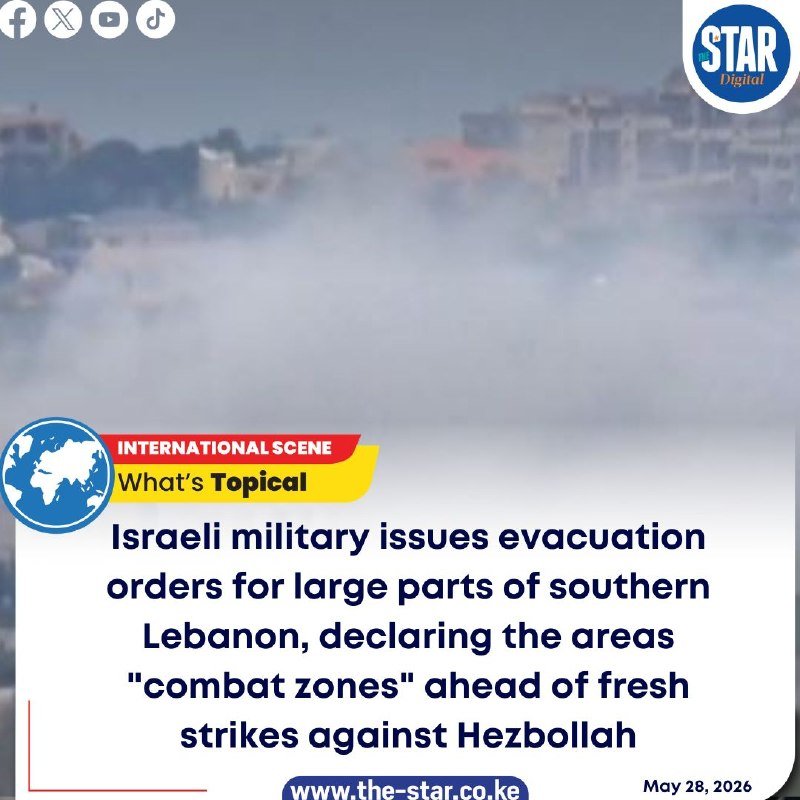
On the morning of 27 May 2026, the Israel Defense Forces ordered residents of five villages in southern Lebanon to evacuate immediately, telling them to move at least 1,000 metres to open ground. Within the same 24-hour window, the IDF struck more than 150 Hezbollah targets across Tyre, Nabatieh, and the Bekaa Valley. The ceasefire framework that was supposed to quiet the northern border had lasted approximately as long as the press release announcing it.
This is not a story about a deal that failed. It is a story about a deal that was never stress-tested because neither side had any intention of letting it constrain their operational calculus.
The Violation calculus
Hezbollah's apparent ceasefire violations — whatever their specific character on the ground — were almost certainly not accidental. The group's northern Lebanon infrastructure has been rebuilt incrementally since the 2024 confrontation, and the organisation has demonstrated consistently that it treats diplomatic arrangements as scheduling tools rather than binding commitments. That assessment is not speculative; it is the observable pattern across two decades of UN Security Council resolutions, the 2006 Lebanon War's aftermath, and every informal understanding that has since collapsed.
But the IDF's response raises a separate question: what is the proportionality threshold for a ceasefire enforcement action? The order to evacuate five villages — displacing civilian populations en masse — is a significant humanitarian act in its own right. It is also a signal. Israel is not seeking to correct a violation discreetly; it is demonstrating that the cost of any breach will be disproportionate to the breach itself, designed to deter not just the specific act but the category of behaviour that preceded it. Whether that deterrence calculus makes strategic sense depends entirely on whether you believe the Lebanese state has the capacity — or the will — to enforce Hezbollah's compliance itself.
The Lebanese state's absent chair
Here is the structural reality that coverage of this escalation consistently underweights: Lebanon did not sign the ceasefire. Lebanon's government, such as it is, was not at the table. The arrangement was negotiated between Israel and Hezbollah, mediated by parties whose leverage over both sides was asymmetric at best. This means the entire framework rests on Hezbollah choosing to respect it — an organisation that has explicitly defined its military strategy in terms of resistance to Israeli sovereignty regardless of what any piece of paper says.
The villages now under evacuation orders are not abstractions. They are communities that have been caught between a state that cannot protect them and a militia that treats their presence as strategic terrain. When the IDF orders them to move 1,000 metres to open ground, the practical question — where do they go, who feeds them, how long does this last — is entirely unaddressed in the public communication. That is by design. Israel's interest is not in managing a humanitarian corridor; it is in clearing the operational space it believes it needs.
The diplomatic theatre
It is worth naming what this episode reveals about ceasefire diplomacy in the modern Middle East. The format is familiar: a framework is announced, a timeline is implied, mediators express cautious optimism, and then the first incident occurs within hours. Each side then cites the other's violation as justification for escalating, and the mediators shift from optimistic to bewildered to silent.
This is not cynicism for its own sake. The diplomatic theatre serves functions for all parties. Israel can demonstrate to its domestic audience that it responded forcefully to any provocation, protecting the political position of whoever is in government. Hezbollah can position itself as the organisation that forced Israel to back down through military pressure, sustaining its legitimacy among its own constituency. The mediators — whoever they are — can claim they tried, and that the collapse was someone else's fault.
What none of this architecture produces is a durable peace. A durable arrangement would require Hezbollah to genuinely disarm or relocate its forces north of the Litani River under verifiable international monitoring, and it would require Lebanon's state institutions to actually function as a state rather than a distribution mechanism for confessional patronage. Neither condition exists. Until they do, every ceasefire is a pause in a conflict that is structurally continuous.
What this costs, and who pays it
The immediate cost falls on Lebanese civilians in the five villages now under evacuation orders, and on Israeli communities in the north who have been living under rocket threat for over a year. These are not symmetric burdens — the displacement of Lebanese civilians is a product of their geographic proximity to a militia that uses them as human geography, while Israeli civilians face a rocket arsenal designed specifically to terrorise — but both are real, and coverage that treats only one side's suffering as politically legible is doing its readers a disservice.
The longer-term cost is subtler: each cycle of escalation-diplomacy-collapse erodes whatever institutional credibility the mediating parties possess. The next ceasefire, whenever it comes, will be signed with less trust and enforced with more suspicion. The architecture becomes more fragile with every iteration. Eventually, one side decides that the cost of the arrangement exceeds the cost of war, and the calculation that follows is not diplomatic.
The IDF's order on 27 May 2026 is, in that sense, not an aberration. It is the logical endpoint of a framework built on assumptions that have proven false every single time they have been tested. The question is not whether the ceasefire will hold. The question is how many more rounds of this choreography the region can absorb before the actors stop pretending there is a script.
Wire provenance
This editorial synthesis draws on the following public wire/social posts:
- https://t.me/osint613/7842
- https://twitter.com/Osint613/status/2059584498732339472/video/1
- https://t.me/wfwitness/3847