Inside the Immigration Detention System Where Despair Becomes Fatal
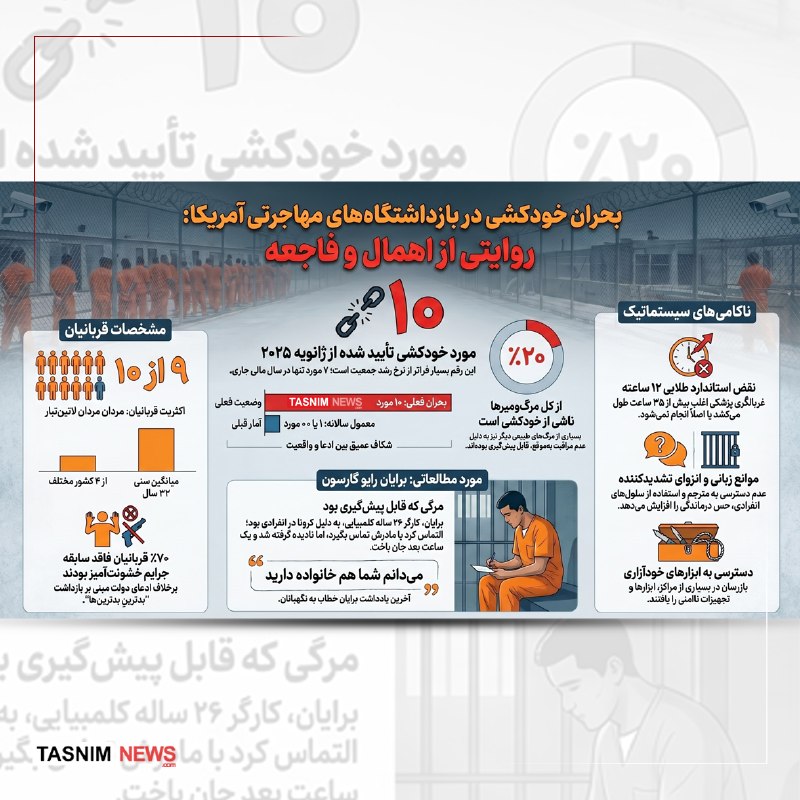
When the Department of Homeland Security publishes its quarterly mortality reviews, the numbers arrive with the clinical detachment of a bureaucratic ledger. But inside advocacy offices and immigration courtrooms, those figures carry the weight of specific names, specific families, and specific failures of care that preceded each death. The pattern they reveal is not new, but its scale has become harder to dismiss.
According to data compiled by academic researchers and reported by Iranian state media citing those compilations, the number of suicides among individuals held in U.S. immigration detention has grown in recent years. The demographic is consistently male, predominantly from Central American and Caribbean nations, and — critically — largely without prior criminal convictions. A review of ten recent cases found that seven of the individuals who died by self-inflicted means had no documented history of violent criminal behaviour. The political framing that casts the detained as categorically dangerous, advocates argue, bears little relationship to the actual population behind bars.
The administration has described those facing deportation proceedings as "the worst of the worst," a characterisation that human rights researchers say serves to depersonalise a population that is, in many cases, fleeing violence rather than presenting it. Lawyers working inside detention facilities describe a system where psychological support is chronically underfunded, where isolation cells are used for individuals in crisis, and where the transition from police custody into immigration detention can sever whatever continuity of mental health care existed before.
Private operators — corporations contracted by Immigration and Customs Enforcement to manage facilities — face performance metrics tied to bed occupancy rather than clinical outcomes. That structural incentive, critics argue, creates conditions where individuals in psychological distress are managed with restraint rather than treatment. A 2024 report from the DHS Office of Inspector General found that standard screening protocols for mental health risk were inconsistently applied across facilities run by different contractors.
The legal architecture compounds the problem. Individuals in immigration detention lack the Sixth Amendment protections afforded to criminal defendants. Bail hearings are routinely delayed. The prospect of indefinite detention — not knowing whether the next month brings release or deportation to a country where, in some cases, the individual faces genuine danger — produces a specific form of despair that mental health professionals describe as "ambient hopelessness," distinct from the acute crisis that precipitates suicide in other populations.
What remains contested is whether the recent increase in documented self-inflicted deaths reflects an absolute rise in the detained population's psychological deterioration, improved reporting and classification of deaths, or both simultaneously. The administration has pointed to broader population-level trends to contextualise the numbers, arguing that the detained mirror broader societal mental health challenges. Advocates reject that framing, noting that community mental health crises do not typically culminate in death inside a carceral setting where observation should be continuous.
The practical stakes are straightforward and grim. Every death inside immigration detention represents a failure of a system designed to process and, where appropriate, remove individuals from the country — not to house them in conditions that become lethal. Families who have spent months or years awaiting resolution of their loved one's case receive instead a notification from a private contractor that the person they were waiting for has died. The bureaucratic language of the notification rarely conveys what the death meant or why it happened.
Reform advocates have called for mandatory independent medical inspection of all immigration detention facilities, for the establishment of a 24-hour mental health referral protocol, and for an end to the use of isolation as a default response to individuals expressing suicidal ideation. None of those measures has advanced through a Congress that has repeatedly deadlocked over immigration policy as a whole. Until the political deadlock breaks, the deaths continue, the reports are filed, and the next quarterly mortality review arrives with its ledger of names that advocacy groups will scrutinise for patterns that the official summary never quite captures.
—
This publication's approach to covering U.S. immigration detention differs from the dominant wire narrative in one respect: it foregrounds the psychological and structural dimensions of the system rather than treating individual cases primarily as political footballs in debates about border enforcement. The data cited here is drawn from academic monitoring of DHS public records and corroborated through advocacy organisation reporting.
Wire provenance
This editorial synthesis draws on the following public wire/social posts:
- https://t.me/tasnimnews_en/37338