The Signal From Kyiv: Why the US Left While Europe Stayed
The US Embassy evacuation from Kyiv while European missions remain sends a message about whose security commitments hold under pressure — and whose do not.
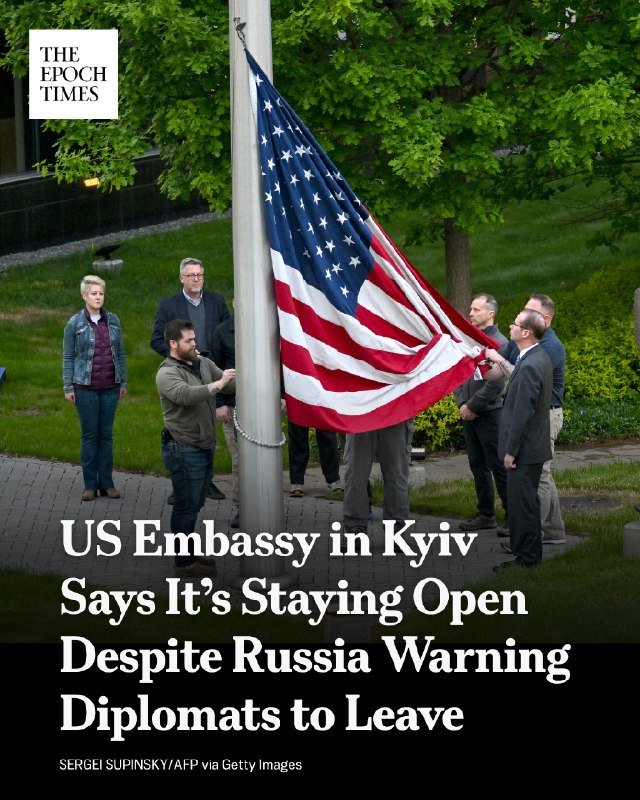
The American Embassy in Kyiv is gone. On 28 May 2026, the United States withdrew its diplomats from the Ukrainian capital following Russian warnings of possible "systematic strikes" on the city — language that tracks the precision diction Moscow uses when it means business. The EU foreign policy chief, Kaja Kallas, confirmed the departure and added a detail that lands like a verdict: every European mission will remain.
That distinction matters more than any diplomatic readout can adequately convey. When a superpower pulls its people out of a capital city, even while a grinding invasion grinds on, the signal is not simply procedural caution. It is a hierarchy of exposure — a calculation about acceptable risk that places American personnel above Ukrainian ones in the protective hierarchy that Washington is willing to fund.
Europe, by contrast, chose differently.
The Hierarchy the Evacuation Reveals
The immediate lesson is operational: the United States is more risk-averse on Ukrainian soil than it projects. That was always contestable given the scale of military assistance the Biden administration and successive Congresses have authorized — tens of billions in materiel, intelligence sharing, diplomatic cover. But those commitments operate at arm's length. Maintaining a physical embassy presence inside an active war zone, even one that has been shelled but not fallen, imposes a different kind of obligation. Rescuing diplomats under fire is not an abstract budgetary line item. It requires standing forces, contingencies, and political will to act.
Kallas stated that Ukraine informed the EU that all embassies remain operating except for the American one. That framing — attributed directly to the Ukrainian side — is not neutral. Kyiv is drawing the line, or at least confirming where the United States drew it.
The contrast sharpens when you add the second thread: the EU's negotiating position, also articulated by Kallas, that any settlement talks must include force limits on Russia's military and the withdrawal of Russian troops from Ukrainian territory. Brussels is publicly anchoring to a maximalist position while Washington quietly evacuates. Whether that reflects strategic patience or European overextension, the divergence is now visible on the ground — or rather, in the absence of one embassy from that ground.
What Europe Is Buying
Staying put is not a gesture for European capitals. It carries costs: higher insurance premiums, reduced staffing flexibility, more complex contingency planning when the adversary has demonstrated a willingness to strike population centers. That European missions absorbed those costs while American ones did not does not automatically translate to moral superiority — European presence in Kyiv is also calibrated — but it does suggest a different tolerance for the proposition that withdrawal signals weakness.
Part of that calculus is economic and geographic. The war in Ukraine is closer to Brussels, literally and politically. Eastern European members of the EU have border exposure; a Russian Ukraine that is only partially conquered or merely frozen in ceasefire is a different threat calculus than for Washington, which sits an ocean away behind two nuclear arsenals and a defense treaty network that no longer explicitly includes Kyiv. The geography of deterrence is not abstract. It shapes risk tolerances in ways that no diplomatic communiqué can fully paper over.
There is also the question of what European capitals have staked on this conflict. The EU has committed to reconstruction financing, long-term military support, and accession pathway processes for Ukraine — investments that would be devalued in a settlement reached on Russian terms. A US withdrawal from Kyiv creates a vacuum of symbolic commitment. Europe is not rushing to fill it simply out of altruism. It is filling it because it has already placed chips on the table, and leaving now would mean abandoning those bets at the worst possible discount.
The Counterargument: Is Restraint Rational?
It would be too comfortable to treat the US evacuation as a straightforward abdication.
There is a defensible case — if not a flattering one — for keeping diplomats out of a city that a nuclear-armed adversary has explicitly threatened with systematic strikes. The standard embassy evacuation protocol exists precisely because diplomatic assets are high-value targets in ways that combat units are not. Pulling diplomats from Kyiv removes a hostage that Moscow might eventually be willing to take. The cost of that absence is symbolic; the upside is a US official physically beyond the blast radius if the worst-case scenario materializes.
Moreover, the United States remains the largest single supplier of military assistance to Ukraine. A withdrawal of diplomats does not represent a withdrawal from the conflict — certainly not in the way a cutoff of weapons transfers would. The American commitment, on this reading, is real but transactional: support Ukraine at range, keep your own people out of harm's way, and maintain leverage by staying outside the most dangerous zones of contact.
That logic has not gone entirely unanswered. Kallas's articulation of the EU's negotiating demands — force limits on Russia, full troop withdrawal — reads as a quiet rebuttal. The EU is specifying outcomes that a hands-off America cannot deliver alone. If talks eventually happen, Brussels will be at the table with a defined position; Washington will be negotiating from the margins of a conversation it cannot shape as directly because it chose not to be in the room.
The Structural Shift This Moment Embodies
The diplomatic geography of Kyiv — European embassies clustered around the capital, the American mission absent — is a legible index of something that analysts have tracked for two years without being able to name so precisely. Western support for Ukraine is real, sustained, and ongoing. But it is increasingly disaggregated. The alliance structure that presented itself as a coherent bloc in early 2022 is revealing its internal fault lines under sustained pressure. The fault lines are not ideological — neither side is more sympathetic to Moscow — they are geographic, transactional, and rooted in different understandings of what the war ultimately costs and who bears it.
Ukraine, for its part, is making that disaggregation legible by releasing Kallas's framing rather than obscuring it. The decision to confirm — on the record, through European diplomatic channels — that only the US mission left is a signal of its own calibrated diplomacy. Kyiv is letting the contrast speak. Whether that is pointed at the White House, the European capitals, or international public opinion, it serves a purpose.
The stakes of this trajectory are concrete. A Western alliance that cannot coordinate something as basic as which capitals its diplomats occupy in a besieged allied capital is not an alliance that can credibly project deterrence at its perimeter. The credibility gap created by the Kyiv evacuation is not closed by the next weapons shipment or the next sanctions package. It has to be rebuilt through acts that are visible, legible, and harder to reverse. Europe chose one of those acts by staying. The question now is whether Washington is watching closely enough to understand what its own choice has cost.
Europe chose to keep its embassies open in Kyiv. The United States did not. That asymmetry will define how both sides enter whatever comes next.
Wire provenance
This editorial synthesis draws on the following public wire/social posts:
- https://t.me/noel_reports/12473
- https://t.me/Kyivpost_official/8921
- https://t.me/euronews/44882
- https://t.me/noel_reports/12471
- https://t.me/zvezdanews/77293