Trump's Iran Deal Is Dead — and the Pressure Is Now Washington's Only Policy
The administration is declaring an Iran deal almost complete. The details tell a different story: no sanctions relief on offer, Tehran waiting to see if the threat ends, and Washington's stated position now amounts to managed coercion rather than negotiated outcome.
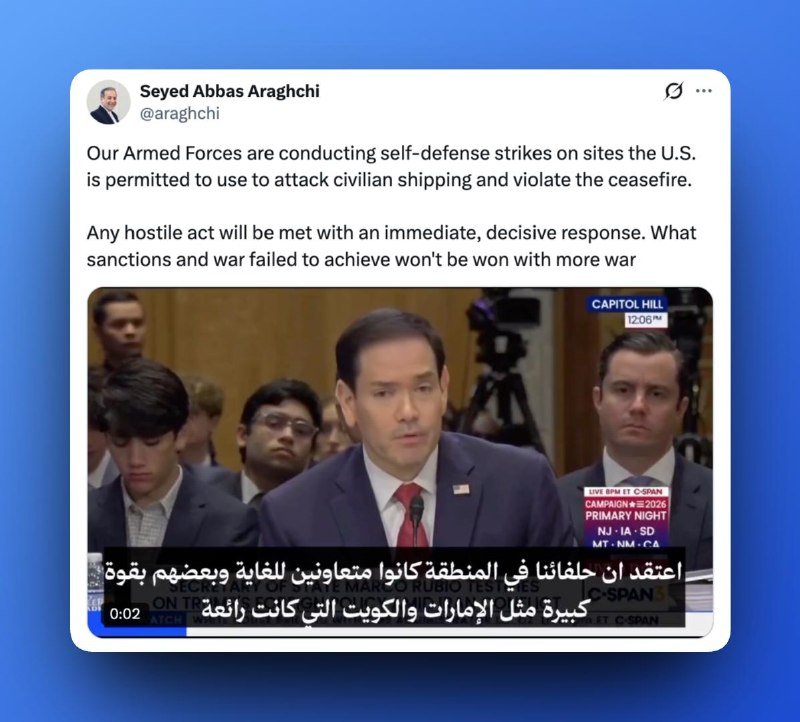
The European Union's top diplomat said on 28 May 2026 that continued conflict with Iran serves no one's interest. On the same day, Reuters and other wire services were reporting that Washington is not planning to ease sanctions as part of any deal. Read together, those two statements describe the incoherence at the center of the administration's Iran posture — a conflict neither side claims to want, and the sanctions architecture the US has spent years constructing is itself now the obstacle to an exit.
The EU statement, reported by Middle East Eye, was calibrated to appeal to both governments without binding either. It was, in effect, a message addressed primarily to Washington: the Europeans have skin in this game too, and continued escalation carries costs Brussels cannot absorb indefinitely. Before that statement landed, Iran's government had made clear it was watching for a change in signal from the administration, not diplomatic niceties. The March overture from Washington — extended through a third-party intermediary, a format Tehran had previously accepted — appears to have produced no breakthrough. What both governments appear to agree on, based on public statements, is that a deal is nearly complete. What they disagree about is what that means in practice, and who gets to dictate the terms.
The Administration's Version of the Deal
Trump said on 27 May 2026 that Iran is "negotiating on fumes," as first reported via Polymarket's real-time wire feed and subsequently confirmed in syndicated reporting. He added that the US is "not there yet" on a deal and that Washington is "not satisfied with it." The framing is deliberate: a party holding out, running out of runway, finally facing conditions on the ground that make capitulation the rational move. That is not a description of a concluded negotiation. It is a pressure narrative — one the administration appears to be using as both negotiating tactic and political repositioning.
That reframe matters because the original premise was different. The stated objective of Washington's maximum-pressure campaign was a comprehensive agreement: verified enrichment freeze, intrusive inspections, and sanctions relief in exchange. The administration has now walked back the sanctions-relief component — at least as a negotiating concession — while still claiming credit for whatever Iranian restraint exists. Tehran's position is that it has already made the concrete concessions demanded of it: verified caps on higher-grade enrichment, maintained IAEA access. Furtherasks, in Tehran's framing, are renegotiation by other means.
The gap between "de facto freeze" and "deal concluded" is not semantic. It determines whether sanctions remain essentially intact — whether Iranian oilflow stays constrained, whether banking channels stay severed, whether the stated policy is one of managed coercion rather than negotiated outcome.
What Tehran Is Actually Waiting For
Iran's calculus has been consistent throughout the Biden and Trump eras: patience as leverage, particularly when the other party faces domestic political incentives to declare victory. On 27 May 2026, Trump suggested that Iran believed it could out-wait him — outlast him through the midterms, through electoral pressure from American voters who might tire of the confrontation.
The administration dismissed that posture. "I don't care about the midterms," Trump said on 27 May, per syndicated wire reporting. The claim is a political signal, not a diplomatic characterization. Midterm pressure is not the reason sanctions relief is off the table — the reason is that the administration has decided it does not need to offer it. That decision is either strategic brilliance or a miscalculation that the next six weeks will expose. Trump's own language — "not there yet," "not satisfied" — suggests the administration is not entirely confident in its current position.
This is not, at its core, a story about nuclear nonproliferation. It is a story about whether the most powerful state in the world can construct a functional diplomatic outcome — and whether Iran, and for that matter other actors watching this process, will find the resulting architecture credible.
The Settler Violence Dimension
The daily texture beneath the headline negotiations matters. Middle East Eye reported on 28 May 2026 — the first day of the Eid al-Adha holiday — documented cases of settler violence in the West Bank, including assaults on a mother and child. These are not peripheral. They are the granularity of the environment in which any ceasefire, any negotiated framework, any regional arrangement must ultimately function.
A diplomatic architecture that does not front-load accountability for civilian harm is one that Palestinian communities in the West Bank have no structural reason to expect will hold. That the Eid morning brought documented beatings rather than a holiday pause is not a random datum. It is evidence that the institutions responsible for restraint in occupied territory are not functioning — and that deals negotiated at the level of heads of state frequently leave that dysfunction as someone else's problem.
The EU Warning and Who It Is Addressed To
The EU's stated position — that continued conflict benefits no party — is technically accurate and structurally incomplete. "Serves no one's interests" is a formulation that flattens distinct parties with distinct tolerances, distinct sets of stakeholders, and distinct asymmetries of power. Iran cannot sustain indefinite economic isolation without genuine relief. Washington cannot sustain indefinite escalation without allied buy-in it has not secured. Europe cannot sustain either without paying costs it is not currently acknowledging.
Diplomatic language like the EU's works when both parties believe they have more to gain from a deal than from its collapse. When that equation breaks down — when one party believes it can outlast the other — such appeals tend to address the party least willing to hear them. The EU tweet, as documented, did not clarify which party it was trying to move. That ambiguity is itself informative.
The sources reviewed for this article do not yet indicate whether genuine off-ramps remain available or whether the negotiating window has narrowed to the point that both governments are now narrating a stalemate to domestic audiences rather than pursuing a resolution. That uncertainty is the most accurate characterization of where this situation stands on 28 May 2026.
Monexus covered the May 2025 Iran nuclear talks as a genuinely open process with credible gaps on both sides. The current framing — deal near, terms disputed, no sanctions relief on offer — is a narrower story, and one where Washington's preferred narrative and the evidence diverge more sharply than the wire framing suggests.
Wire provenance
This editorial synthesis draws on the following public wire/social posts:
- https://x.com/polymarket/status/1952672284477853755
- https://x.com/unusual_whales/status/1952643787828904134