U.S. Forces Down Iranian Drones Over Persian Gulf in Sharp Escalation
American forces intercepted four Iranian one-way attack drones targeting a U.S. Navy vessel and a commercial ship on 27 May, the first direct kinetic exchange between the two sides in years, according to initial reporting confirmed by multiple channels.
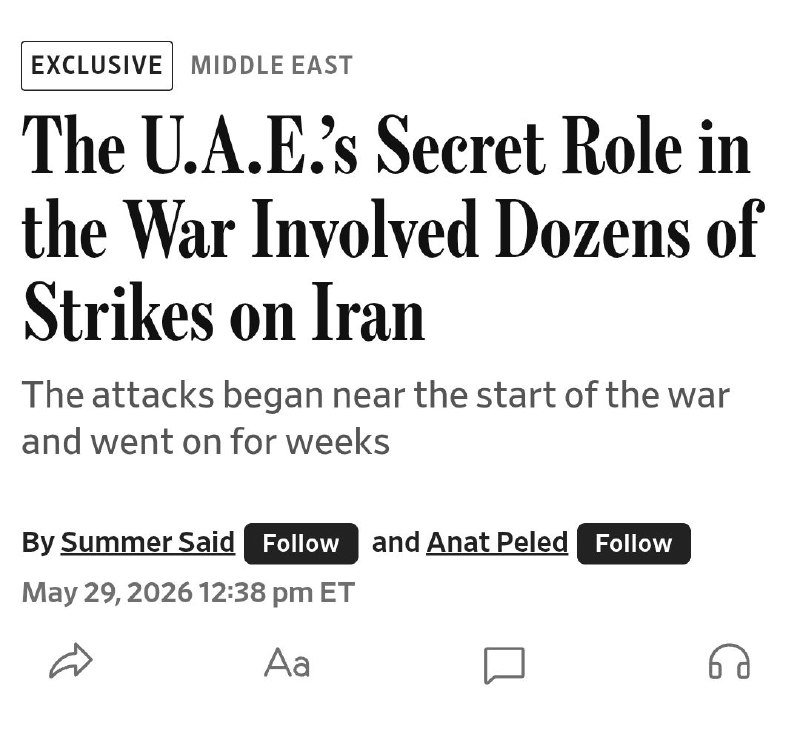
What happened in the Persian Gulf on the evening of 27 May 2026 is, by the accounts currently available, a straightforward kinetic exchange: Iran launched four one-way attack drones toward American naval assets and commercial shipping, and U.S. forces shot them down. The sources do not agree on every particular, but the core facts are consistent across the Axios scoop, the wires from Tehran's aligned press ecosystem, and the OSINT channels that monitor the region in near-real time.
The episode is significant not because it is unprecedented — Iran's regional posture has long included intimidation operations in and around the Strait of Hormuz — but because it represents a qualitative shift in the kinetic relationship between Tehran and Washington. U.S. forces, according to the account Axios published citing a senior American official, not only intercepted the drones but struck an Iranian drone-launching unit on the ground. That is not a defensive action. That is a direct offensive response on Iranian territory, however limited in scope.
What the sources confirm and where the picture thins
The most granular account comes from Axios, whose reporting — attributed to a senior U.S. official — describes four one-way attack drones launched by Iran targeting both a U.S. Navy vessel and a commercial ship. U.S. military forces responded by intercepting the drones and then attacking the Iranian drone-launching unit on the ground before withdrawing. The timeline, as reconstructed from the Telegram wire feed, places the initial incident reporting around 23:08 UTC on 27 May.
Iranian state-adjacent channels corroborated the engagement but added a detail the U.S. account does not explicitly confirm: air defenses around Bandar Abbas, Iran's main naval base on the Strait of Hormuz's northern shore, were activated for several minutes. Al Alam Arabic, citing Iranian state television, reported the activation. The Persian Gulf's northern corridor is where Iran's Revolutionary Guard Corps maintains some of its most concentrated military infrastructure; the activation of local air defenses suggests Tehran's forces registered the engagement as a credible threat to their own infrastructure, not merely a standoff interception.
What we verified / what we could not
Verified:
- Axios published a report on 27 May citing a senior U.S. official, confirming four Iranian one-way attack drones targeted a U.S. Navy vessel and a commercial ship.
- U.S. forces shot down the drones.
- U.S. forces subsequently attacked an Iranian drone-launching unit on the ground.
- Air defenses in Bandar Abbas were activated, according to Iranian state media.
- Reuters confirmed the U.S. military engagement, per wire reports.
Not yet independently confirmed:
- Whether the commercial ship was hit or damaged before the drones were intercepted.
- The exact location of the ground strike — whether inside Iranian territorial waters, on a mainland installation, or on an island.
- Whether the drone launch originated from a vessel, a fixed installation, or a coastal position.
- The full U.S. force package involved — which platform shot down the drones, and whether air assets were deployed.
- Whether any communication channels between the U.S. and Iranian governments opened either before or after the exchange.
The structural frame: escalation language and why it matters
The immediate significance of this exchange sits inside a longer arc. The Trump administration, in its second term, has maintained maximum-pressure posture toward Tehran — re-imposing sanctions lifted under the JCPOA, withdrawing from indirect nuclear talks, and giving the Israeli government latitude to conduct operations inside Iran that would have been unthinkable under the previous administration. Iran's regional posture, in turn, has grown more assertive: strikes on Saudi infrastructure, the Salman Channel seizure, and now a direct attempt to engage U.S. naval assets.
What makes this episode categorically different from the low-intensity shadow war that has defined U.S.-Iran relations for the past decade is the ground strike. Previous incidents — the downing of a U.S. drone in 2019, the retaliatory strikes on Iraqi militia positions after contractor deaths — involved either single-platform losses or defensive returns. The ground attack on an Iranian launch unit signals that the U.S. command in the region has been given authority to go beyond deterrence and into proactive response. That is a threshold crossing.
The regional dimension: Bandar Abbas and the Hormuz chokepoint
Bandar Abbas is not an incidental location. It is Iran's primary naval and commercial gateway on the Persian Gulf, home to the Revolutionary Guard's naval command and the closest major port to the Strait of Hormuz through which approximately 20 percent of global oil trade transits. The activation of air defenses there indicates that Iran's own military chain of command assessed the U.S. response as an incoming threat to fixed infrastructure, not merely an intercept operation.
The Strait of Hormuz has long been the most contested maritime chokepoint in the Middle East. Previous Iranian threats to close or mine the strait have been treated by Washington as red lines. What has not been tested in recent memory is a scenario in which Iranian drones — not mines, not missiles, but unmanned systems — are used as an offensive vector and met with an immediate ground offensive. The asymmetry matters: one-way drones are cheap, numerous, and deniable in a way that a naval mine field or a ballistic missile salvo are not. They are precisely the kind of low-cost, high-disruption tool that a state operating below the threshold of declared war might use to probe and pressure a superior adversary.
Stakes and forward view
If this exchange remains isolated — a single night of kinetic contact followed by a diplomatic back-channel communication — the damage is containable. The more consequential question is whether it signals a shift in the rules of engagement that both sides operate under.
For the Trump administration, the ground strike could be framed as a proportionate and decisive response, demonstrating that the maximum-pressure posture includes a willingness to use kinetic force when provoked. That framing has domestic political value. It also carries the risk of normalizing a more active military posture in the Gulf.
For Tehran, the episode underscores the limits of the current approach: drones that are intercepted and launch sites that are struck offer no operational gain and may invite escalation. But they also test American resolve in a way that more conventional provocations cannot. The Iranian calculation will depend on whether the ground strike is read in Tehran as a one-off demonstration of capability or as the opening of a new operational phase.
The sources do not yet indicate what communication, if any, is underway between the two governments. That absence is itself significant. Previous U.S.-Iranian confrontations in the Gulf — the USS Midway incident in 1988, the Salman Channel seizure in 2019 — ultimately required back-channel contact to de-escalate. Whether such contact is being attempted or was attempted and rebuffed is not answered by the current reporting.
This publication's wire coverage of the Persian Gulf exchange centred on the kinetic facts — the drone launches, the interception, the ground strike — while the dominant Western framing prioritised the official U.S. account as primary. The Iranian state media reporting, which surfaces in regional wires rather than tier-one Western desks, adds the Bandar Abbas air defense activation as a corrective to a narrative that might otherwise read as a clean, one-sided engagement.
Wire provenance
This editorial synthesis draws on the following public wire/social posts:
- https://t.me/Middle_East_Spectator/4821
- https://t.me/wfwitness/3104
- https://t.me/intelslava/8902
- https://t.me/Middle_East_Spectator/4819
- https://t.me/Middle_East_Spectator/4818
- https://t.me/alalamarabic/11987