The Diplomacy-Military Disconnect: Why Talks With Tehran Mean Nothing While Missiles Fly
Washington signals openness to a ceasefire agreement while simultaneously enforcing a blockade, shooting down aircraft, and backing strikes on Iranian soil. That is not a contradiction to be explained away. It is the message.
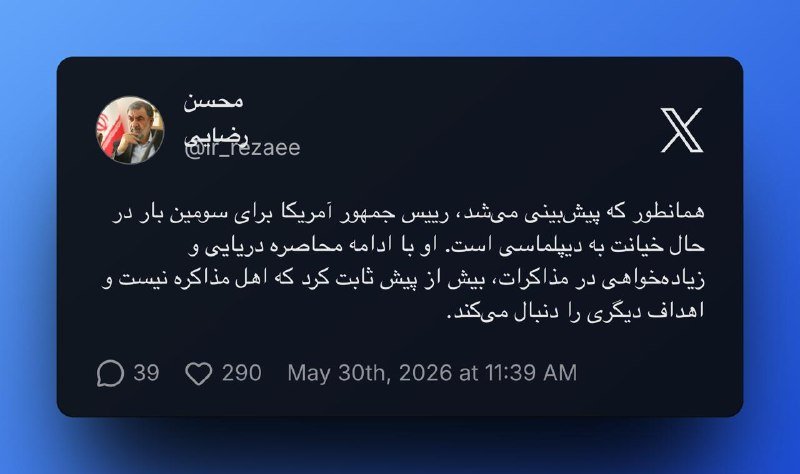
On the same day that reports emerged of a US-Iran draft agreement containing provisions for ending the Lebanon war and regional de-escalation, the US military was redirecting 115 vessels to intensify enforcement of the Iran blockade. A US aircraft was shot down over Iranian territory. The UAE conducted airstrikes on Iran with American and Israeli support. None of this is incidental to the negotiating process. All of it is the process.
The pattern is familiar enough to have become its own genre of diplomatic coverage: talks are "progressing," oil prices drop in response, and then a strike or a shootdown resets the temperature. The assumption embedded in most reporting is that these two tracks — military pressure and diplomatic outreach — are in tension, that one eventually prevails, and that the analyst's job is to say which. That assumption is wrong. For Washington, they have never been separate tracks. They are the same track.
The Agreement That Isn't an Agreement Yet
The Axios-sourced reporting on the US-Iran draft, published on 29 May 2026, is being read as a positive signal. The terms reportedly include an end to the Lebanon conflict and a framework for regional de-escalation. Kazakhstan's simultaneous offer to take Iran's uranium, described as a diplomatic gesture aimed at reducing proliferation risk, reinforces the optics of movement. Oil markets registered the sentiment: prices fell as ceasefire extension talks advanced.
That reaction is predictable and, in narrow market terms, probably accurate. A deal would reduce a meaningful chunk of geopolitical risk premium in crude. But treating the price signal as evidence of imminent resolution confuses the market's appetite for certainty with the diplomatic reality on the ground. The draft is not the agreement. A leaked framework is not a signed one. And the conditions attached to it — notably Iran's stated emphasis on its missile program as non-negotiable — suggest the parties are not describing the same outcome even when they use the same word.
Iran's official position, as reported on 29 May 2026, is that missile power is a red line distinct from dialogue. That is not a negotiating position that lends itself to a clean package deal. Missile programs are not abstractions. They are the hardware that makes a blockade survivable and a ceasefire terms-dependable. Tehran knows this. The analysts reading the Axios reporting know it. The question is whether the headline "US-Iran draft agreement" is doing more work than the substance warrants.
The Blockade, the Shootdown, and the Message
Simultaneous with the diplomatic signals, US forces redirected 115 vessels to intensify Iran blockade enforcement on 29 May 2026. This is not background noise. A naval blockade — even an "economic enforcement" operation — is an act of war under international law if not authorized by the UN Security Council. Whether one accepts the legal framing or not, the operational reality is straightforward: Iranian shipping is being intercepted, Iranian ports are being isolated, and the economic pressure is being applied physically, with gunships, not just with sanctions paperwork.
The shootdown of a US aircraft over Iranian territory on the same day adds another layer. The sources do not establish who fired or under what circumstances. They establish only that it happened, and that the US responded by warning Iran of military consequences if the ceasefire deal was rejected. That sequence — shootdown, then ultimatum, then diplomatic framework — is not the behaviour of a party uncertain about its leverage. It is the behaviour of a party that believes it has sufficient leverage to absorb the cost of escalation while continuing to dictate terms.
The UAE's strikes on Iranian territory, conducted with US and Israeli support, belong in the same ledger. The sources describe these as occurring amid rising tensions. They do not describe them as authorized under any broader legal framework. They are framed as allied action in response to a threat environment. The threat environment, notably, includes Iran's own military posture — including its missile programme and its enriched uranium stock, which the same day's reporting notes has reached 970 pounds, with weapons-grade enrichment approaching.
The Uranium Question Is Not a Future Problem
That 970 pounds figure is the fact that makes every diplomatic gesture either sincere or theatrical, depending on what one believes about intent. Iran is not approaching weapons capability as a speculative scenario. It is in the process. The uranium Kazakhstan offered to take represents a potential resolution to one part of that process — the stockpiling problem. But stockpiling is not the same as enrichment capability, and enrichment capability is not the same as delivery systems. Removing the inventory while preserving the knowledge, the equipment, and the engineering base does not eliminate the weapons programme. It delays it.
This is not a criticism of Kazakhstan's offer. Diplomatic off-ramps that provide face-saving cover for both sides have genuine value. But it is a reason to be precise about what the offer actually does: it buys time and reduces the immediate proliferation optics. It does not cap the programme. And the US military posture described in the same thread — the blockade intensification, the aircraft shootdown, the allied strikes — is not consistent with a strategy that relies on time and proliferation optics. It is consistent with a strategy that relies on pressure, the kind that is meant to produce capitulation, not compromise.
The Disconnect Is the Message
The conventional reading of this day's events is that Washington is pursuing two contradictory strategies simultaneously and must eventually choose. The diplomatic track will either succeed or fail; the military track will either coerce or provoke. Pick one.
That framing assumes diplomacy and coercion are alternatives. History suggests otherwise. The United States has a long record of conducting intensive military operations alongside diplomatic engagement — sometimes from the same administration, sometimes within the same 24-hour period. The message to Tehran is not "choose peace or face war." It is: "the war will continue until the peace we want is signed."
For Iran, the implication is that agreeing to a deal that freezes the missile programme and limits enrichment is not a path to normalized relations. It is the price of having the blockade lifted and the strikes stopped. For the UAE and Israel, the strikes demonstrate that regional actors willing to escalate have US backing — which shapes Iran's calculation about what "resisting until the terms improve" costs.
This publication finds that the gap between what Washington says in the Axios draft and what it does across the Persian Gulf is not a communication problem. It is the strategy. The question for watchers of this process is not whether a deal will be signed. It is whether the terms will be ones Iran can survive politically and call a win — or whether the pressure campaign is calibrated to produce something closer to unconditional withdrawal from enrichment activity, with no diplomatic ribbon tied around it.
The market is pricing ceasefire. The vessels are not.
Wire provenance
This editorial synthesis draws on the following public wire/social posts:
- https://t.me/CryptoBriefing/
- https://t.me/CryptoBriefing/
- https://t.me/CryptoBriefing/
- https://t.me/CryptoBriefing/
- https://t.me/CryptoBriefing/