The Iran Deal Trump Can't Afford to Get Wrong
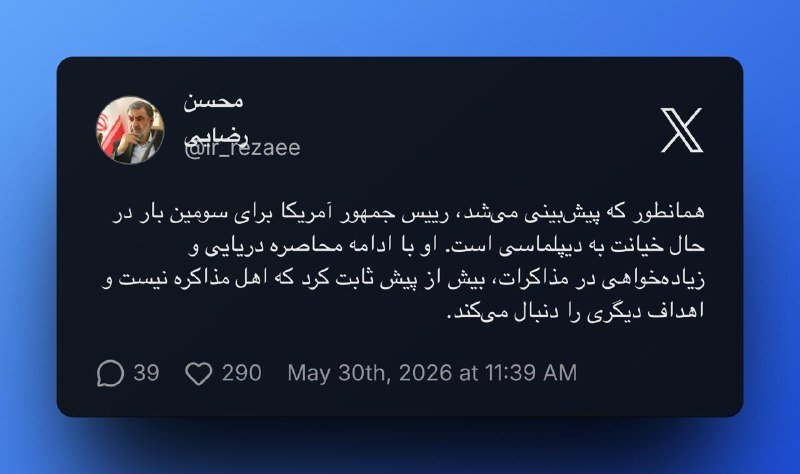
Donald Trump's administration spent two years treating Iran as the archetype of a hostile regime that needed strangling, not talking to. The 'maximum pressure' campaign — renewed with vigour in January 2025 — was supposed to bring Tehran to heel by wrecking its oil revenues and choking its banking system. Instead, Trump now finds himself preparing for a Friday meeting that could produce a new nuclear agreement with the Islamic Republic, one that would hand Iran a financial windfall estimated at roughly six percent of annual US taxpayer revenue, according to initial reports cited by open-source monitoring feeds.
That figure alone should concentrate minds. Six percent of US annual revenue is not a negotiating concession — it is an assertion that Iran has leverage, and that Washington recognises it.
What the deal reportedly looks like
The contours remain contested. Reuters reported on 29 May 2026 that Trump would convene a meeting that day to make a final decision on a deal with Iran. The New York Times, separately cited by aggregate wire services, indicated that no decision had yet been reached as of that afternoon. Those two facts — an imminent decision point and an unresolved outcome — tell us something important: the administration is close to a deal, but not there yet. The pressure to announce a breakthrough before the week ends is real. Whether the substance matches the optics is another question.
What is clearer is the financial dimension. According to open-source intelligence summaries circulating on 29 May, the current proposal involves transferring to Iran a sum equivalent to roughly six percent of annual US federal revenue — a number that translates into the tens of billions of dollars over the agreement's lifespan. The money is not framed as aid. It is positioned as sanctions relief, unfrozen assets, or some mechanism of indirect compensation for Iran's acceptance of constraints on its nuclear programme. The label matters less than the reality: Iran walks away with capital it currently cannot access, and Washington gets a document it can call a non-proliferation agreement.
Why this deal benefits Iran more than the headlines suggest
Nuclear restrictions are time-limited by design. Every previous agreement — including the 2015 JCPOA that Trump exited in 2018 — contained sunset clauses that handed Iran a path back to full enrichment capability on a defined timeline. A new deal that trades short-term restrictions for long-term financial relief is a favourable arrangement for Tehran. The Islamic Republic has survived sanctions, built a regional network of proxies, and developed a nuclear programme that operates at thresholds technically compliant with light constraints. A deal that releases frozen assets and restores Iran's access to global banking — even partially — gives the regime resources to sustain all of that.
Regional analysts have noted for months that Iran's leverage is structural, not ideological. The Islamic Republic controls a chain of armed non-state actors across Iraq, Syria, Lebanon, and Yemen that give it reach far beyond its borders. That network does not disappear because a US president signs a piece of paper. If anything, restored oil revenues give Tehran more capacity to fund those actors while accepting cosmetic nuclear constraints.
The structural argument the administration is making
None of this means the deal is irrational from Washington's perspective. The counter-argument inside the administration runs as follows: Iran was not going to verifiably abandon its nuclear programme under any plausible scenario. The 'maximum pressure' campaign reduced Iranian oil exports but did not collapse the regime, because Iran's regional network and its willingness to endure economic hardship gave it staying power. A negotiated freeze — even an imperfect one — is preferable to an unending cycle of escalation with no exit. And there is a real possibility that without a deal, Iran accelerates enrichment to weapons-grade levels, giving the administration a far worse problem to manage.
That logic is coherent. The question is whether it justifies the financial terms reportedly on the table. Six percent of US annual revenue is not a negotiating posture — it is a concession that signals desperation, or at least anxiety. It tells Iran's leadership that Washington wants this deal badly enough to pay a steep price. That knowledge will shape Tehran's behaviour in every subsequent negotiation.
The regional picture — and what gets left out
The deal, if reached, does not exist in isolation. Israel's security establishment has expressed sustained concern about any agreement that leaves Iran's enrichment infrastructure intact. Gulf states watching the negotiation have recalibrated their own strategic postures accordingly. And the deal does nothing to address Iran's ballistic missile programme, its regional proxy network, or its behaviour in the Strait of Hormuz.
Critics — including some inside Trump's own party — have noted that the financial terms effectively reward a regime the administration spent two years describing as the world's foremost state sponsor of terrorism. The counter-thesis is that the alternative is worse. That logic has supported every US engagement with adversary states from Nixon to China. Whether it produces durable results or simply buys time depends on enforcement — and enforcement, in the case of Iran, has historically been the variable that fails.
What is certain is this: if the Friday meeting produces a deal, the Middle East's strategic architecture shifts. Tehran gets capital and legitimacy. Washington gets a document. And the question of whether either side gets what it actually needs — a stable non-proliferation outcome versus a financially resourced regional actor — will take years to answer.
This publication covered the reporting from Reuters and open-source monitoring feeds as of 29 May 2026; the administration's stated position and the Times's reporting on unresolved deliberations reflect divergent timelines in the available record.
Wire provenance
This editorial synthesis draws on the following public wire/social posts:
- http://reut.rs/4fgfk8Z
- https://t.me/osintlive