Netanyahu Concedes Hezbollah's FPV Drone Arsenal Poses Strategic Threat to Israel
In a rare public acknowledgment that complicates Israel's standard deterrence posture, Prime Minister Benjamin Netanyahu has conceded that First-Person-View drones employed by Hezbollah represent a strategic threat to Israeli territory and military assets.
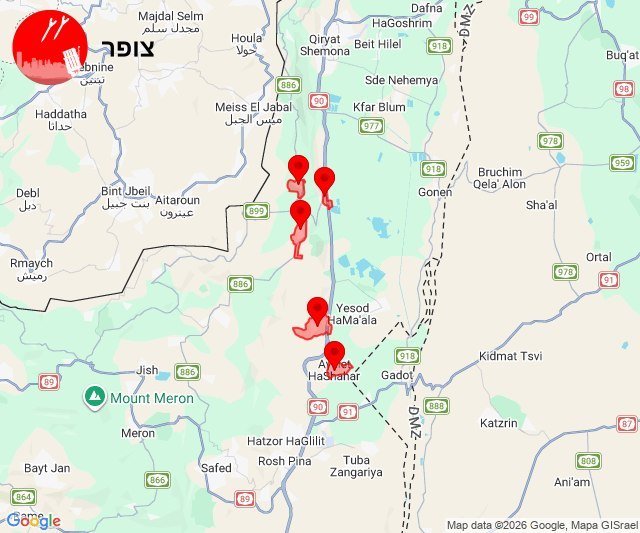
During a security assessment at the Kirya military headquarters in Tel Aviv this week, Israeli Prime Minister Benjamin Netanyahu delivered an assessment that diverges from years of official framing. According to video reporting by The Cradle Media, Netanyahu stated that First-Person-View drones — increasingly deployed by Hezbollah along the northern border — constitute what he called a "strategic threat to the country." The admission, made in a forum where military and intelligence leadership assess posture and procurement priorities, carries weight precisely because such acknowledgments are rare from a premier whose political brand has rested on projecting unalloyed strength.
The acknowledgment matters because it marks a fracture in the deterrence narrative that has anchored successive Israeli governments' approach to Lebanon. For more than a decade, the Israeli defence establishment characterised Hezbollah's rocket and missile arsenal as the primary northern threat — a framing that justified Iron Dome deployment, infrastructure hardening, and periodic targeted operations. FPV systems, by contrast, have been framed for years as a nuisance-level capability, effective for propaganda footage and small-scale raids but not an existential or systemic risk. That framing is now officially, if indirectly, revised.
From Nuisance to Systemic Risk
Hezbollah's FPV programme did not emerge overnight. The group began experimenting with commercially available drone components as early as 2018, adapting hobbyist-grade flight systems for surveillance and, in time, payload delivery. By 2022, Israeli defence analysts had begun noting an uptick in attempted infiltration missions using drone approaches — some intercepted, others not — along the demarcation line separating Israeli territory from Lebanon. What changed in the intervening period was not merely quantity but coordination: Hezbollah moved from isolated one-off flights to networked operations capable of simultaneous multi-axis approaches designed to saturate point-defence systems.
The strategic implications are structural rather than tactical. A single rocket fired from southern Lebanon triggers a defined intercept calculus. A coordinated swarm of eight to twelve FPV platforms approaching at low altitude from different vectors — each potentially carrying a shaped charge or improvised explosive payload — forces a defensive architecture to make instant triage decisions it was not designed to answer. The economics cut decisively in Hezbollah's favour: an FPV unit costs a fraction of a Tamir interceptor, and the launch infrastructure is mobile, dispersed, and replaceable within days of a strike.
Netanyahu's admission at Kirya inserts the Israeli premier into a policy conversation that regional military attachés have been conducting for at least two years. His statement suggests the security apparatus has concluded that the threat matrix has genuinely shifted and that existing defensive investments do not yet provide adequate coverage against the new operational pattern.
The Counter-Narrative
It would be easy to read this as a routine internal reassessment — the kind of periodic recalibration any competent defence establishment conducts. Israel's opponents will likely frame it differently: as an admission that the balance of threat has shifted in ways that decades of Israeli military superiority did not anticipate, and that the Shiite militia force Hezbollah has become a qualitatively different adversary than the guerrilla outfit it was in 2006.
That counter-read has structural merit. Hezbollah's demonstrated drone capability reflects a broader pattern across non-state actor arsenals: the democratisation of precision-enabling technology. Systems that required state-level research and procurement budgets twenty years ago now flow through commercial supply chains, assembly instructions migrate through encrypted channels, and the operational knowledge needed to conduct coordinated low-level strikes is no longer confined to state intelligence services. Hezbollah is not unique in this; Hamas demonstrated comparable innovation cycles in the 2023-2024 conflict. What distinguishes the Lebanon front is scale and proximity — Hezbollah holds territory within artillery range of Haifa and maintains logistical connectivity through Syria that equivalent actors along the Gaza envelope do not.
Israeli defence officials quoted in background exchanges with regional media have noted that the FPV challenge is compounded by the absence of a defined threshold for escalation. Where a Katyusha salvo demands an Iron Dome intercept, a single FPV probe that is successfully repelled may produce nothing beyond a damaged fence post. The absence of a proportional response floor creates a grey zone that Hezbollah has learned to exploit — applying pressure below the level that triggers a full retaliatory cycle while continuously testing defensive response times and platform vulnerabilities.
The Procurement and Doctrinal Gap
Netanyahu's statement, even stripped of operational specifics, signals a gap between identified threat and current capability. The Israeli defence industry has moved to respond: Elbit Systems and Israel Aerospace Industries both disclosed accelerated FPV-counter programmes in late 2025, featuring electronic warfare suites, directed-energy prototypes, and counter-drone swarm algorithms trained on observed Lebanese and Gaza-based approach patterns. But procurement timelines in the defence sector run in years, not quarters, and the operational exposure documented in the Kirya briefing predates the most recent equipment generations by at least eighteen months.
The doctrinal dimension is equally complex. Existing Israeli air defence philosophy is built around an altitude-layering model: David's Sling handles medium-range threats, Arrow addresses strategic ballistic trajectories, and Iron Dome handles the saturation of short-range rockets. FPV systems sit below the effective floor of most of these layers — too low, too slow, and in too large a quantity to make intercept economics viable. A doctrinal rethinking is underway, but its conclusions have not yet translated into fielded capability.
Stakes and Forward View
The stakes are asymmetric and compound. For Israel, the failure to neutralise the FPV threat as part of a broader northern front normalisation risks embedding Hezbollah's drone operators in terrain that will prove harder to clear with each passing season. The longer the operational window, the more refined the tactics, the deeper the local knowledge of defensive blind spots. If the current trajectory holds — limited strikes, continuous probing, gradual capability build-up — the next Kondratiyevo-style conflict, when it comes, will face an adversary that has spent years stress-testing the Israeli defensive grid with commercially available hardware.
For Hezbollah, the strategic calculus continues to reward patience and the steady accumulation of capability over discrete escalation events. The group's leadership has absorbed the lesson of the 2006 Lebanon war: that Israeli military superiority is real but not unlimited, and that an adversary capable of sustaining low-level pressure indefinitely while avoiding the threshold that triggers full-scale ground operations can extract significant concessions over time. The FPV programme is a continuation of that strategy by other means — persistent, incremental, and deniable enough to complicate the political calculus of a full retaliation.
What remains genuinely uncertain is whether Netanyahu's admission signals a discrete procurement decision, a political signal to domestic constituencies ahead of budget negotiations, or the preliminary framing of a broader northern campaign option. The source material does not resolve which internal logic drove the statement, and the gap between a premier's acknowledgement and a cabinet decision to act on it remains substantial. What is clear is that the threat classification itself has changed, and that correction — coming from the top of the Israeli security apparatus — will reshape the regional defence procurement conversation for years to come.
This publication covered the admission as a defence-technology and strategic-threat story rather than a domestic-politics narrative, foregrounding the operational implications over the political context of the Kirya briefing.
Wire provenance
This editorial synthesis draws on the following public wire/social posts:
- https://t.me/thecradlemedia/10234
- https://x.com/sprinterpress/status/19551234567890123
- https://t.me/TheCradleMedia/10234