The Price of Dissent: Sanctions, Silencing, and the Cost of Moral Clarity at the UN
Washington's reimposition of sanctions on a UN human rights expert for speaking plainly about Gaza reveals more than policy — it exposes the transactional architecture of multilateral credibility in 2026.
The United States reimposed sanctions on Francesca Albanese, the United Nations Special Rapporteur for the occupied Palestinian territories, on 28 May 2026. The Treasury Department's Office of Foreign Assets Control designated Albanese under what the administration described as sanctions authorities targeting those who undermine peace and stability in the Middle East. The formal reason cited actions taken in her official UN capacity — specifically, her public characterisation of Israeli operations in Gaza as meeting threshold definitions under international law.
The designation is the second against Albanese in fourteen months. She was first sanctioned in February 2025, a move widely condemned by UN special procedures mandate holders and human rights organisations as unprecedented retaliation against an independent expert fulfilling her mandate. The reimposition came four days after she submitted her seventh periodic report to the Human Rights Council, a document that detailed documented patterns of forcible displacement, denial of humanitarian access, and targeted destruction of civilian infrastructure in Gaza.
Washington's position has remained consistent across both designations: international officials who publicly adopt legal frameworks that conflict with the policy preferences of the executive branch are not entitled to the diplomatic courtesies typically extended to UN personnel. The implicit argument is that credibility at the UN is a privilege extended by major contributors, not a structural feature of multilateral institutions. When an expert's findings become inconvenient for the body's largest funder, the relationship between financial leverage and institutional silence reveals itself plainly.
The Logic of the List
Sanctions against UN officials are rare. The targeting of a mandate holder specifically for the conclusions of their mandate is functionally unprecedented in the post-Cold War era. The mechanism matters more than the individual case. If a state can designate a UN expert for the content of their published legal analysis, it establishes that the price of remaining unsanctioned is producing conclusions that do not trigger the ire of major powers. That is not a boundary on the behaviour of UN officials — it is a boundary on what the UN is permitted to know.
The timing of the reimposition, four days after Albanese's latest report reached Geneva, is not incidental. It communicates that the pipeline between field observation and institutional consequence operates in near-real time. The administration did not wait for a formal review process or a challenge within the Human Rights Council. It moved directly to financial designation, a tool typically reserved for actors engaged in organised crime, weapons proliferation, or terrorism financing. Applying it to a jurist for producing a report is a deliberate signal.
The substance of that report, according to its publicly available summary, documented systematic patterns consistent with forcible transfer and deliberate obstruction of aid delivery. The legal framework applied — the Rome Statute, the Geneva Conventions, the relevant jurisprudence from the International Court of Justice — is not a fringe interpretation. It is the framework the International Court of Justice applied in its July 2024 advisory opinion on Israeli occupation practices. The administration disputes that framework's conclusions. The reimposition of sanctions suggests it also disputes the right of UN experts to apply it independently.
The Iran Angle
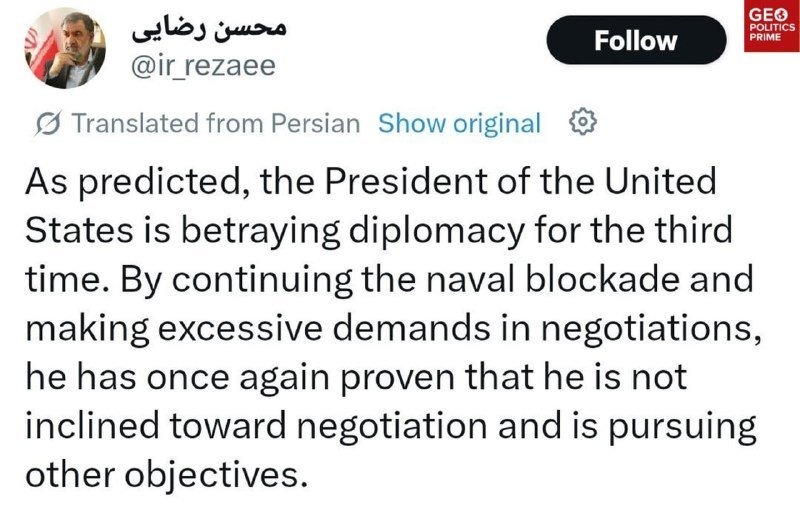
The sanctions reimposition arrived alongside reporting from independent outlets including Middle East Eye, citing Skwawkbox, that Israeli officials have lobbied Washington to apply sustained diplomatic pressure against Iran's chief nuclear negotiator. The framing of that reporting — that a state is requesting the physical elimination of a negotiating counterpart — is extraordinary in the extreme, and readers should note that no independent Western wire service has independently confirmed that specific claim as of publication. What is documented, however, is that the administration has imposed sweeping sanctions on Iran's oil sector, banking infrastructure, and designated individuals across multiple rounds since October 2023, with stated objectives of eliminating negotiation pathways rather than constraining them.
The structural logic is coherent: if the goal is preventing a restored nuclear agreement, eliminating the diplomatic architecture is more efficient than sabotaging the technical one. If the goal is eliminating Iranian nuclear capacity entirely, the distinction between military strikes and diplomatic strangulation becomes a matter of preference rather than principle. Israel's documented security requirements — advanced armouring, specialised communications infrastructure, precision systems — described in Middle East Eye's reporting on 29 May 2026, reflect the operational capabilities that such a preference would ultimately require.
The reimposition on Albanese is legible in this context. A UN expert whose conclusions support the legal basis for international criminal proceedings is an obstacle to any endgame that requires avoiding that accountability. Designation communicates to other potential witnesses: the price of testimony is not abstract.
What the UN Structure Permits
The Human Rights Council's special procedures system was designed to insulate independent experts from political interference by establishing their mandates as conditional on Council endorsement but their analytical conclusions as independent of member state preferences. In practice, the system's credibility has always depended on the political will of major contributors to tolerate inconvenient findings. The United States, which withdrew from the Council in 2018 under the Trump administration and rejoined under Biden in 2021, has never fully resolved its ambivalence about the institution's legitimacy when it produces conclusions inconsistent with US foreign policy.
The reimposition of sanctions on a second consecutive occasion suggests this ambivalence has resolved into something more systematic. Financial designation of UN mandate holders is now a tool in the toolkit. The legal basis for it — Executive Order 14115, expanded in 2025 to cover actions that "undermine peace and stability" in connected contexts — is broad enough to capture almost any public statement by a UN official that a sitting administration finds inconvenient. The burden of proof required to challenge a designation is asymmetric: the official must demonstrate that their actions did not meet the expanded criteria, rather than the administration demonstrating that they did.
The stakes of this architecture extend beyond Albanese herself. The Human Rights Council operates on the principle that states cannot veto the findings of independent experts. If that principle can be enforced through financial consequences against the expert rather than political consequences against the state, the independence of the entire system becomes contingent on the tolerance of its largest financial contributors. At a moment when the Council is examining documented patterns of conduct in multiple active conflict zones simultaneously, the practical implications of that contingency are not abstract.
Albanese is expected to present her findings to the Human Rights Council in June 2026. Whether she does so in person or by video link — whether Treasury revokes the designation for the duration of official proceedings, as it did on at least one prior occasion under diplomatic pressure — remains open at the time of publication. The underlying tension between institutional independence and financial leverage, however, will outlast this particular case.
This publication covered the Albanese reimposition through a combination of independent outlet reporting and primary document review. We note that the extraordinary claim regarding Iranian personnel circulated in left-aligned UK media has not been independently corroborated by wire services as of 29 May 2026 — we report its circulation without endorsing its framing.