Putin's Generous Frame: How Russia Dresses Economic Coercion as Sovereign Tolerance
Vladimir Putin's stated willingness to see Armenia drift toward the EU obscures a more coercive reality: the threat of economic penalties designed to make that drift costly enough to be practically impossible.
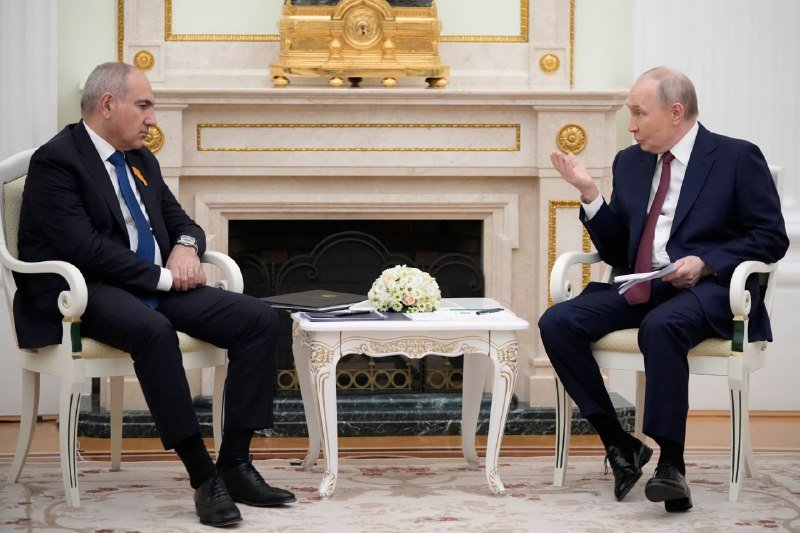
On 29 May 2026, Vladimir Putin offered what sounded like a remarkably generous concession. Russia, he said, would not object to Armenia drawing closer to the European Union if Yerevan believed that served the Armenian people's interests. He went further, proposing a referendum on Armenia's future membership — EU versus continued participation in the Eurasian Economic Union. The diplomatic language was conciliatory; the structural machinery beneath it was not.
The same remarks included two explicit economic threats. If Armenia exits the EAEU, Armenian citizens working in Russia would be required to purchase patents — a significant barrier for the large Armenian diaspora employed in the Russian Federation. Separately, Russia indicated it would raise energy prices for Armenia. Together, these represent the kind of coercive package that transforms sovereign permission into sovereign constraint. You may leave; the cost of leaving will be paid by your workers and your utilities grid. That is not tolerance. It is a price tag designed to be prohibitive.
The Rhetoric of Benign Permissiveness
Putin's statement to the effect that "anything good for the Armenian people will be acceptable for Russia" follows a well-established diplomatic template. It positions Moscow as a reasonable interlocutor rather than an imperial gatekeeper. It shifts the burden of consequence onto Yerevan — if Armenian alignment with Europe causes economic pain, that pain originates in European structures, not Russian ones. The framing is sophisticated precisely because it is not a lie in any narrow legal sense. Russia will not march troops into Yerevan over an EU referendum. But it will make the arithmetic of European integration so punishing that the referendum, even if held, becomes functionally advisory rather than actionable.
The proposal for a referendum itself carries strategic utility. It signals to Brussels that Armenia's European aspirations are a bilateral Russian-Armenian matter — not something requiring engagement from EU institutions. By owning the process publicly, Moscow controls the terms, the timeline, and the off-ramp. A referendum held on Moscow's preferred schedule, in Moscow's preferred political environment, is a mechanism for managing the optics of Armenian departure rather than enabling it.
The Weaponization of Economic Interdependence
Russia's leverage over Armenia is not incidental — it is the architecture. Armenia's energy sector relies substantially on Russian supplies. The Armenian workforce in Russia sends remittances that constitute a material share of Armenia's GDP. The patent requirement for EAEU departures targets precisely that channel of interdependence. These are not accidental byproducts of economic integration; they are designed features of a regional order that makes exit structurally costly.
The pattern is not unique to Armenia. Russia has deployed energy pricing, work permits, and trade access as instruments of political management across the post-Soviet space for decades. What changes is the language deployed alongside the mechanism. When the mechanism is accompanied by statements of respect for sovereignty, the coercion is partially immunized against Western criticism — how can one accuse Russia of bullying a sovereign nation when it explicitly endorses that nation's right to choose?
This is the sophistication of the approach: the permissive rhetoric absorbs international criticism while the economic instruments continue to operate. Critics who point to the patent requirements and energy pricing are forced to argue against a statement that explicitly welcomes the very outcome those instruments are designed to prevent. The contradiction is real, but it lives in Russia's interest, not in any inconsistency in Putin's messaging.
The European Union's Structural Blind Spot
Brussels has spent years articulating an Eastern Partnership framework that envisions post-Soviet states as future EU members or associates. In practice, the EU's enlargement architecture requires candidate countries to adopt extensive legal and institutional reforms, negotiate chapters of acquis communautaire, and maintain economic stability throughout a process that typically spans a decade or more. For a small, economically fragile state bordered by Turkey, Iran, Azerbaijan, Georgia, and Russia, that timeline is not merely demanding — it is existentially precarious.
The EU can offer accession horizons. Russia offers working patents and stable energy pricing today. For a government managing a population with deep social ties to Russia and an economy sensitive to energy cost fluctuations, the present-tense coercion of Moscow often outweighs the aspirational language of Brussels. Armenia's potential EU drift is not merely a question of political will in Yerevan; it is a question of economic survivability during a transition that the EU cannot short-circuit and Russia can actively worsen.
What Yerevan Actually Faces
The sources indicate that Putin presented the referendum proposal as something to be held "as soon as possible." The urgency is telling. A referendum held in the current political environment — with energy pricing already subject to Russian discretion and the patent regime already in place as a conditionality of EAEU membership — is a referendum held under duress. The question of EU membership placed before Armenian voters in those conditions is not a genuine exercise of sovereign choice; it is a choice constrained at every material axis by the preferences of the larger power.
Whether Nikol Pashinyan's government has the domestic political resilience to resist this framing — to insist on a referendum held under conditions of genuine economic autonomy — is the more operative question. The permissive language Putin offered on 29 May 2026 may prove, on close examination, to be the least dangerous thing about the Russian position. The patents and the energy prices are what remain when the diplomatic courtesy ends.
What this episode ultimately illustrates is a mode of regional power management that has become central to Russian foreign policy: present oneself as the reasonable party, make the coercive consequences of your opponent's choices operate through market mechanisms rather than military ones, and let the resulting economic structure do the work that explicit veto power used to do. The referendum on Armenian EU membership, if it materializes, will be held in the shadow of that structure. Whether Brussels has the instruments to reduce that shadow is the question that matters for the decade ahead.
Wire provenance
This editorial synthesis draws on the following public wire/social posts:
- https://t.me/DDGeopolitics
- https://t.me/euronews