Romania Is Now a War Zone. Not by Choice.
A Russian one-way attack drone hit an apartment building in Galați on the night of 28 May 2026, injuring several people. It is the first confirmed strike on a NATO member's civilian infrastructure, and it demands a clear answer from the alliance.
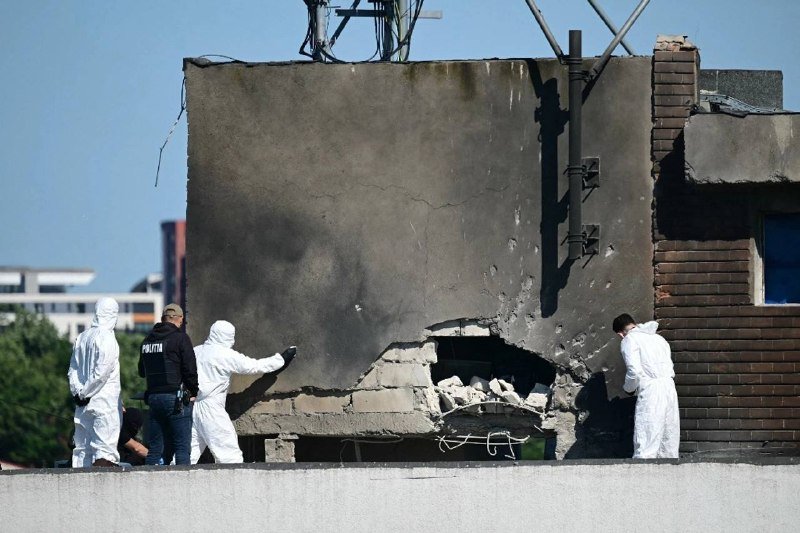
On the night of 28 May 2026, a Russian one-way attack drone struck an apartment building in Galați, in eastern Romania. Fire and rescue services rushed to the site. Several people were injured, at least some of them seriously, according to initial reports. Romanian authorities had issued an alert warning of the possibility of falling objects from surrounding airspace shortly before the impact. This is not a miscalculation run of the mill. It is a first.
No Russian drone has previously struck a NATO member's civilian infrastructure and produced confirmed casualties on Alliance soil. Galați changes that calculus. And it puts the alliance's founding collective defence clause — Article 5 — in concrete terms it has never before had to face.
The First Clause Has Never Been Tested
Article 5 of the North Atlantic Treaty holds that an armed attack on one member shall be considered an attack on all. The United States invoked it once, the morning of 12 September 2001, and it was honored in the breach, as the response was Afghanistan — not a strike on the territory of the attacking state. Romania on 28 May is a different and cleaner test case. A drone launched from Russian-held territory hit a residential building in a NATO country, wounded civilians, and was not the product of Ukrainian air defence debris falling across the border. It was aimed.
The alliance has been remarkably consistent over three years of war in saying it will not be dragged in directly. That discipline has been load-bearing for managing escalation risk. But it was calibrated for a war that stayed across the line. Galați moves the line.
The Silence So Far Is Telling
As of the overnight hours of 28 May, no NATO spokesperson had issued a formal Article 5 consultation notice. No heads of state had briefed from capitals. The official record shows acknowledgements from OSINT monitoring feeds and Romanian emergency services — not from Brussels. This is the posture of an alliance still absorbing what happened, not yet ready to answer the question the strike poses.
That hesitation is understandable in narrow terms: the moment an alliance formally acknowledges an Article 5 trigger, it is on the clock to act. The political cost of inaction then becomes visible and symmetric. The smarter instinct, for now, is to assess. But the longer the formal silence runs, the more it starts to look like strategic ambiguity rather than strategic patience. Those are not the same thing.
Ukraine has borne the costs of ambiguity for three years. Romania began bearing them on the night shift.
Escalation Is the Point
The Russian calculation here is not hard to read — it is hostile, but coherent. The aim is not territorial conquest in Moldova or Romania. The aim is to impose cost on the West for supporting Ukraine, to test where the threshold is, and to find the threshold is wherever the West allows it to be. Strikes inside Russia normalised over time. Strikes on Ukrainian military targets inside Ukraine normalised over time. Cross-border incidents involving debris and fragments normalised over time. Each normalisation was a data point collected: how much further can this go before the response changes register.
Galați is not debris. It is the next register. And if the response does not change register, the next register after that is already written.
The pattern — the slow, incremental ratcheting of what is tolerated — is not unique to this conflict. What is unique is that the target is a NATO member and the target knows it. Romania did notask to be part of this experiment. It is a frontline state by geography, a NATO member by democratic choice, and on the night of 28 May it became a war zone by Russian decision.
What the Alliance Owes Romania Now
Romania has been among the most consistent NATO members on the question of support for Ukraine. It has hosted Patriot batteries. It has kept its flank rotated and its defense budget above two percent of GDP. It has made itself useful to the alliance in precisely the ways a frontline democracy should. On 28 May, that loyalty was repaid with blood on Romanian soil.
The alliance that Romania has backed now owes it an answer: does another inch matter, and if it does, what shape will the response take? The question is not whether Article 5 will eventually be invoked — it will, if Russia continues — but whether it is invoked now, at the clear and present moment, or waits until the clear and present moment has passed and the normalisation is complete. Waiting has costs. So does acting. The asymmetry between them is that one of those costs is paid by Ukraine's friends. The other is paid by the alliance's credibility.
Galați is on the map now. The question is whether what it means is answered at the site of the impact, or managed away from it.
Wire provenance
This editorial synthesis draws on the following public wire/social posts:
- https://twitter.com/sentdefender/status/2060150419993600355
- https://twitter.com/sentdefender/status/2060150419993600355
- https://t.me/wfwitness