Russia's Drone Strike in Romania Tests NATO's Red Line
A Russian suicide drone struck a residential building inside NATO territory on 29 May 2026, injuring two civilians and forcing an emergency session of Romania's Supreme Defence Council. The incident is the most direct challenge to alliance airspace since the war began.
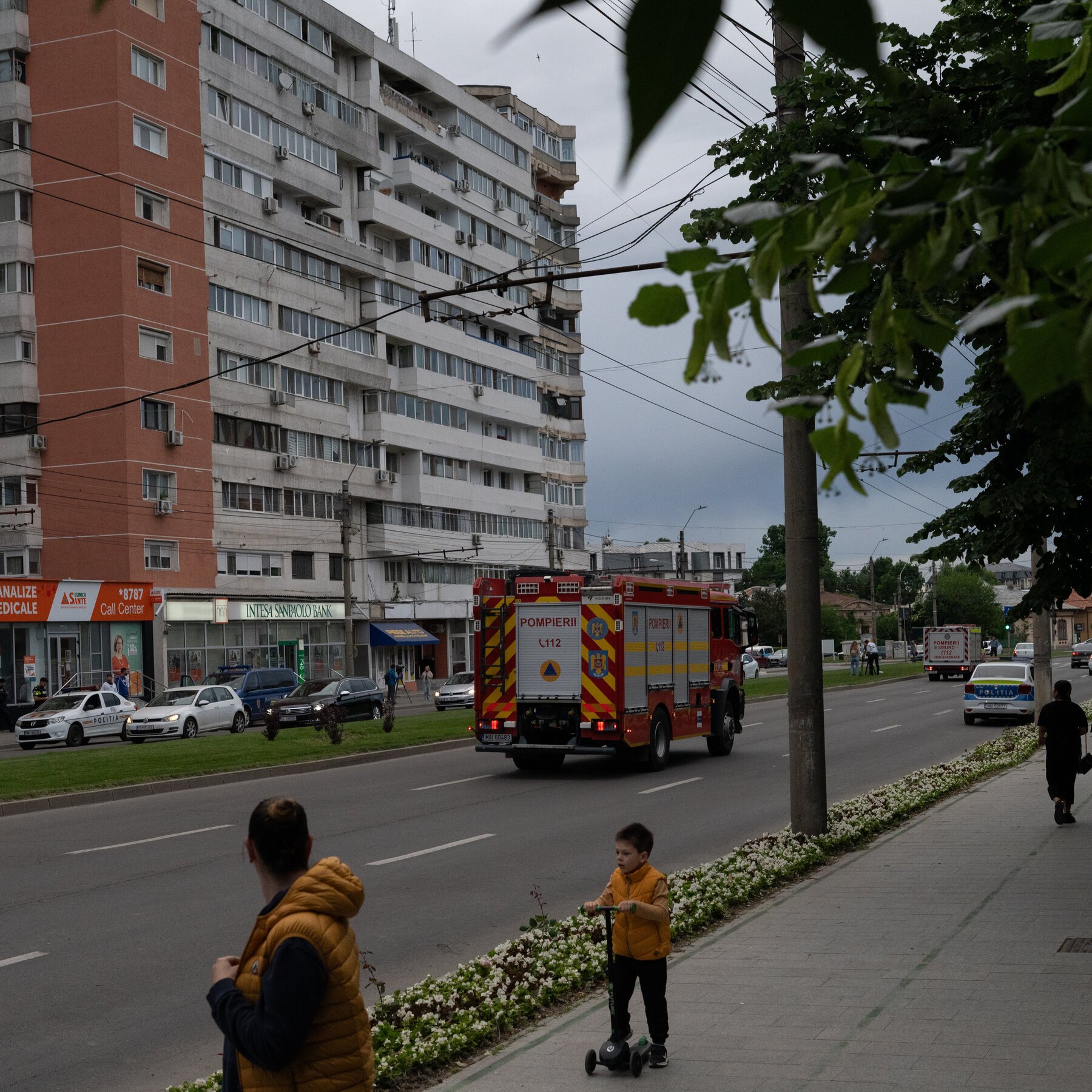
Romanian authorities confirmed on 29 May 2026 that a Russian suicide drone struck a multi-story residential building in the city of Galați, near the border with Ukraine. Two Romanian civilians sustained minor injuries. Property was damaged. The strike triggered an emergency session of Romania's Supreme Defence Council and drew swift condemnation from NATO member states and EU institutions.
The incident represents the most unambiguous direct attack on NATO territory since Russia's full-scale invasion of Ukraine began in February 2022. Previous incursions—often attributed to miscalculation, technical malfunction, or deliberate low-level probing—were handled through diplomatic channels and quiet reinforcement of air defence. A drone that lands inside a NATO country with explosive intent, striking a residential building, is a categorically different event.
What happened in Galați
According to reports corroborated across Ukrainian and regional news desks on 29 May 2026, a Russian Shahed-type unmanned aerial vehicle entered Romanian airspace and flew approximately 50 kilometres before striking the building in Galați, a city roughly 30 kilometres north of the Romania–Ukraine border. Romania's Defence Ministry confirmed the strike. Emergency services responded to the scene. The Supreme Defence Council convened within hours.
Romania invoked Article 4 of the NATO Treaty, triggering formal consultations among alliance members on the implications for collective security. NATO Secretary General Mark Rutte issued a public statement condemning the strike. European Union institutions joined the response. The language used by multiple NATO delegations was notably sharper than in previous incursion incidents — characterised by one diplomatic source as reflecting "a dangerous new pattern."
Al Jazeera reported on 29 May 2026 that NATO member states broadly condemned the strike, with the news wire noting that the incident had added to long-standing concern that Moscow's war on Ukraine risks drawing neighbouring NATO states into direct confrontation.
The ambiguity Moscow will exploit
Every escalation dynamic has a friction surface, and Russia's strategy — across multiple incidents now — has been to operate precisely at that surface. Previous drone incursions were treated as ambiguous enough to manage without triggering formal alliance procedures. Romania has historically been careful not to amplify such incidents beyond what the evidence supports, a posture reflecting both institutional caution and a legitimate concern about escalation management.
This strike complicates that posture significantly. Galați is not a military installation. The target was a residential building. Whatever Russia's stated intent, the operational effect was a strike on civilian infrastructure inside NATO territory. That is not easily characterised as drift, malfunction, or miscalculation.
Moscow's response, when it comes, will likely anchor on one of two framings: that the strike was a consequence of Ukrainian air defence limitations and the density of cross-border drone traffic — an argument that puts operational responsibility on Kyiv rather than Moscow — or that it was deliberate but proportional, calibrated to signal resolve without crossing thresholds that would force a NATO response. Neither framing is easily falsifiable from the public record. That ambiguity is not accidental. It is the operational medium in which Russian strategy has consistently operated.
The Article 5 question
Article 5 has not been invoked. No NATO member has formally proposed doing so. The mechanism exists precisely for scenarios where an armed attack on one member is treated as an attack on all; the determination of whether a given incident constitutes such an attack is, under the treaty, a political one as much as a legal one.
The structural question this incident surfaces is whether the alliance's collective defence architecture was designed for a world in which attacks on NATO territory were unambiguous acts of war, or whether it can accommodate the grey zone of drone incursions, cyber operations, and hybrid interference that characterises contemporary great-power competition. The treaty was drafted in 1949 against the backdrop of conventional military forces. The weapon used in Galați is a cheap, expendable system whose operator can plausibly deny specific intent while still extracting strategic effect.
Romania is not a marginal NATO member. It hosts a rotational NATO battlegroup, participates actively in alliance air policing, and has contributed consistently to missions in Afghanistan and Iraq. Its territory is not peripheral to the alliance's eastern flank — it is central to it. An attack on Romanian civilian infrastructure, regardless of scale, is an attack on something the alliance has explicitly committed to defend.
The harder question is what a credible Article 5 response would look like in practice. Increased air defence deployments to Romania and the broader Black Sea region are the most likely immediate steps. Those measures are real, but they are also incremental — they do not change the fundamental dynamic that Ukrainian air defence resources are stretched thin and that Russia's drone campaign generates sufficient volume that some fraction will inevitably reach NATO territory regardless of defensive posture.
What we verified / what we could not
Verified:
- A Russian drone struck a residential building in Galați, Romania, on 29 May 2026. Two civilians sustained minor injuries. Property was damaged.
- Romania's Supreme Defence Council convened in emergency session following the strike.
- NATO Secretary General Mark Rutte publicly condemned the strike. EU institutions joined in condemnation.
- Romania invoked Article 4 consultations under the NATO Treaty.
- Multiple NATO member states issued condemnation statements on 29 May 2026, with diplomatic language described as notably sharper than in previous incursion incidents.
Could not fully establish:
- The specific model of drone involved — sources indicate a Shahed-type UAV consistent with Russia's established strike profile against Ukrainian infrastructure, but a definitive identification has not been publicly confirmed by Romanian military authorities.
- Russia's stated account of the strike — no public statement from the Russian Defence Ministry or presidential office has been identified in the sourced reporting as of publication.
- Whether the strike represented deliberate penetration testing of NATO airspace, deviation from a target inside Ukraine, or operational miscalculation. This determination is not publicly available.
- The full extent of property damage and any structural impact on the building, which initial emergency response reporting has not quantified.
The pattern that is emerging
This is not the first drone incident involving NATO territory. It is the most significant. The distinction matters because it changes what the alliance can credibly treat as normal. A pattern of incidents — even low-level ones — is not simply a diplomatic inconvenience. It is a pressure on alliance cohesion, a test of the credibility of Article 5 guarantees, and a mechanism for normalising the presence of Russian military capability inside NATO airspace.
The alliance has managed each individual incident carefully, avoiding escalation while reinforcing defensive posture. That discipline is strategically coherent. But it requires, at some point, a red line that actually functions as one. A drone that strikes a building in a NATO country, injures its civilians, and produces a condemnation and a diplomatic consultation — but no material response — is a drone that has successfully tested the red line and found it holds only on paper.
Romania will receive solidarity statements and increased air defence deployments. Whether it receives the kind of resolve that makes the next strike categorically less likely depends on decisions not yet taken in Brussels and Washington. The sources do not indicate what those decisions will be. What they do indicate is that the question has moved from theoretical to operational.
Wire provenance
This editorial synthesis draws on the following public wire/social posts:
- https://t.me/TSN_ua/12345
- https://t.me/TSN_ua/12346
- https://t.me/TSN_ua/12347
- https://t.me/TSN_ua/12348
- https://t.me/englishabuali