Russian Drone Strikes Inside NATO Territory for First Time, Injuring Civilians in Romania
A Russian drone impacted inside Romanian territory on May 29, 2026, injuring residents in the eastern town of Galati, in what appears to be the first confirmed physical strike on a NATO member state since Russia's full-scale invasion of Ukraine began.
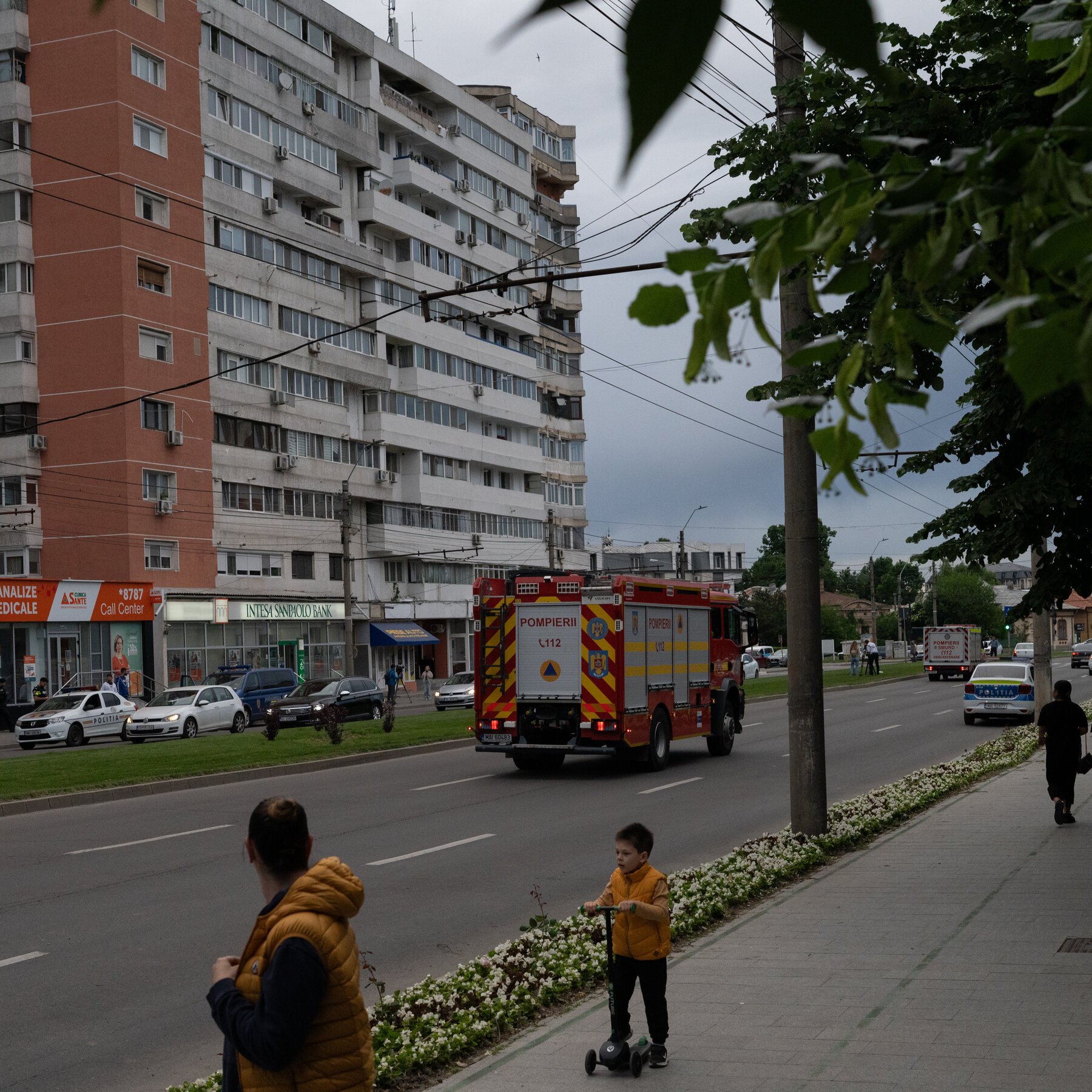
Romanian authorities confirmed late on May 28, 2026, that a suspected Russian drone struck an apartment building in the eastern town of Galati, injuring several residents and triggering a fire that emergency services extinguished. The incident represents the first confirmed physical impact of a Russian weapon inside NATO territory since Russia's full-scale invasion of Ukraine began in February 2022.
The attack, reported across multiple independent monitoring channels, occurred in a residential area close to the Ukraine-Romania border. Romanian civil protection and emergency responders were dispatched to the scene, where the drone caused structural damage and wounded an unconfirmed number of civilians. Local media reported that the fire had been brought under control, though the full extent of injuries and material damage remained unclear as of the early hours of May 29, 2026.
Romanian authorities issued air raid alerts to residents in the border region shortly before the impact was reported, according to accounts verified through open-source monitoring feeds. The timing suggests that Romanian military and civilian alert systems detected the incoming object and attempted to warn the population, though the strike nonetheless occurred before an interception could be confirmed.
A Threshold Crossed
Previous incidents involving Russian military assets near NATO airspace have tested Alliance cohesion without resulting in direct physical damage to a member state's territory. Russian drones and missiles have transited near or over NATO borders during strikes on Ukrainian infrastructure, and Alliance aircraft have scrambled repeatedly to intercept aircraft operating in proximity to member-state airspace. Until now, however, no Russian weapon had landed inside a NATO country with confirmed physical consequences.
Galati sits approximately 20 kilometers from the Ukrainian border city of Izmail, which has been a frequent target of Russian drone and missile strikes in recent months. The town is separated from active combat by the Danube River, which has served as a de facto boundary between Ukrainian defensive positions and Romanian territory. That a drone traveled sufficient distance inland to strike a multi-story residential building marks a meaningful change in the operational calculus.
NATO's collective defense clause, Article 5 of the Washington Treaty, commits each member state to treat an armed attack on one as an attack on all. The threshold for triggering that commitment has never required physical damage to a NATO country—earlier incidents involving Russian overflights or electronic interference have been treated as sufficiently grave without meeting that bar. A confirmed impact inside Alliance territory, with civilian casualties, narrows the range of acceptable Allied responses and removes one layer of plausible deniability that previous near-misses retained.
Romanian officials have not yet formally invoked Article 5 procedures, and the Alliance had not issued a public statement as of early May 29, 2026. The pace of any formal response will depend on whether Romanian and Allied intelligence assessments confirm the drone's origin and attribution without ambiguity.
Attribution and the Question of Intent
Open-source analysts tracking the incident noted that the drone's trajectory, apparent size, and the pattern of damage were consistent with the Iranian-designed Shahed drones that Russia has employed extensively against Ukrainian civilian and infrastructure targets. Russia's state apparatus has not issued a statement acknowledging the strike, and no Russian military channel had claimed the impact as of the time of reporting.
Three interpretations have emerged in early commentary. The first holds that the strike was deliberate—a deliberate extension of Russian strike operations into NATO territory, either as a test of Alliance resolve or as a punitive signal to Romania for its hosting of Allied military equipment and its participation in NATO's eastern flank posture. The second interprets the impact as an operational failure: a drone that lost navigation accuracy or suffered a guidance error during a strike mission against Izmail, deviating from its planned route and crossing into Romanian airspace. The third considers the possibility of a false-flag or misattribution scenario, though this explanation has found limited traction among analysts given the consistency of the physical evidence.
Russia's operational pattern in Ukraine has included a documented history of drone and missile deviations from intended flight paths, several of which have landed in Moldova and Romania over the past two years without causing the level of damage seen in the Galati strike. Whether this incident represents an escalation in operational behavior or simply the upper end of a pattern of imprecision remains a central question for Allied investigators.
The Structural Context: NATO's Eastern Flank Under Pressure
Romania has been among the most consistent advocates within NATO for maintaining a robust forward presence along the Alliance's eastern flank. The country hosts a multinational NATO battlegroup, has invested significantly in defense infrastructure along the Black Sea coast, and has served as a critical transit point for Western military aid flowing into Ukraine. These roles have made Romania a logical target for Russian pressure campaigns, which have included disinformation operations, cyber intrusions, and sustained overflights designed to test Romanian and Allied air defenses.
The Galati strike arrives at a moment when the Alliance's cohesion around continued support for Ukraine is under renewed strain. Several member states have moderated their aid commitments, and debates over the long-term sustainability of the current support framework have intensified. A Russian strike inside NATO territory with confirmed civilian harm reframes those debates, injecting a concrete material dimension that abstract discussions of burden-sharing cannot easily accommodate.
Western military analysts have long warned that the longer Russia's war in Ukraine continues without a decisive outcome, the greater the likelihood of operational spillover into neighboring NATO states. The physical laws of drone and missile flight, combined with the geography of southeastern Europe, create conditions in which border communities face a compounding risk. Galati is not a military base. It is a border town of approximately 50,000 people. The strike targeted not a weapons depot or a command facility, but an apartment building. The pattern of risk has shifted from theoretical to immediate.
What Happens Next
The immediate next steps involve Allied intelligence verification—confirming the drone's origin, flight path, and the cause of its deviation from Ukrainian airspace. NATO's North Atlantic Council is expected to convene for consultations if Romanian authorities formally request them, and the Alliance's Secretary General is likely to issue a statement that calibrates solidarity with Romania against the risk of escalation.
The longer-term question is whether this incident changes the operational environment permanently or functions as a discrete shock absorbed by existing diplomatic and military mechanisms. Russia's pattern has been to push against thresholds incrementally, testing each one before moving to the next. A single confirmed impact with casualties may be absorbed. A second, or a third, would make absorption considerably more difficult for the Alliance to credibly claim.
Romanian residents in the border region will now face a changed threat environment regardless of what the Alliance decides at the institutional level. The strike has demonstrated that Russian drones can reach civilian infrastructure inside Romania. The question of whether a second strike follows is not primarily a question of military technology. It is a question of political calculation in Moscow, and of the deterrent signal the Alliance sends in the coming days.
This report was compiled from open-source monitoring feeds including rnintel, GeoPWatch, and Middle_East_Spectator, cross-referenced against available imagery from the incident scene. Monexus will update this report as Romanian authorities and NATO issue formal statements.
Wire provenance
This editorial synthesis draws on the following public wire/social posts:
- https://t.me/rnintel
- https://t.me/GeoPWatch
- https://t.me/Middle_East_Spectator
- https://t.me/Middle_East_Spectator
- https://t.me/rnintel