Trump's Iran Deal Is Dead. The Question Is Who Pays for the Funeral.
Trump has spent weeks searching for an exit from the Iran confrontation. Tehran keeps declining to give him one — and he keeps declining to act on his own threats. That asymmetry is now the story.
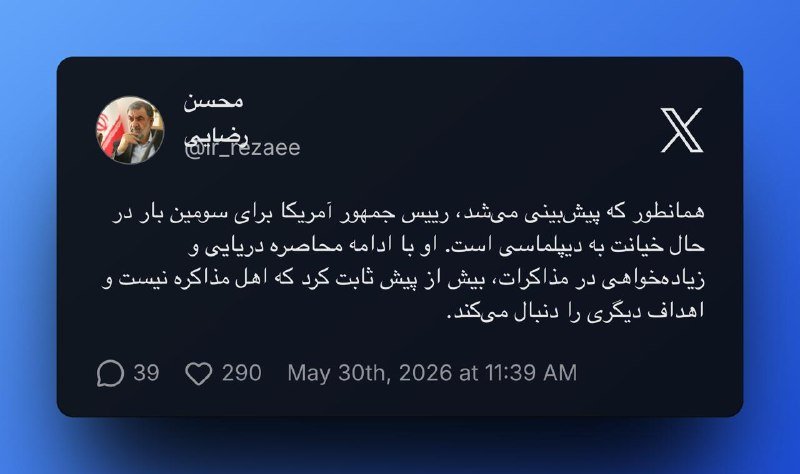
Donald Trump has been hunting for a deal with Iran for weeks. Iran has been hunting for something else entirely: for him to show his hand.
According to reporting by The Atlantic published on 29 May 2026, there is currently no path to a negotiated agreement between the two sides. The assessment is stark: Trump's inability to close the gap with Tehran does not stem from a lack of effort. He has been looking for an exit — seriously and repeatedly. The problem is that Tehran has been systematically refusing to meet him there, and he has been systematically declining to escalate in response.
Russian-aligned military commentary, cited on 29 May 2026, described the dynamic in even blunter terms: Iran has "called his bluff every time," and the White House is unwilling to respond with the kind of credible pressure that might actually change Tehran's calculus. That framing may be self-interested — it comes from a source with a geopolitical stake in continued US-Iranian friction — but it aligns with what the public record shows. When a senior US official issues a red line and the other side walks up to it, and nothing follows, the red line was never a red line. Iran has worked this out. The administration has not found a way to correct the impression.
The Bluff Economy
There is a particular hazard in public diplomacy that the current White House appears to have internalized in a distorted way: the belief that rhetorical pressure, economic sanctions, and the visible deployment of military assets can substitute for the willingness to actually use them. This is not a new problem in US foreign policy. But the Trump administration's particular variant — maximum pressure without the credibility of follow-through — has produced a predictable outcome: the other side stops believing the pressure is real, and then stops taking the pressure seriously at all.
Iran's calculus is not irrational. It has watched the United States announce a "maximum pressure" campaign, decline to launch strikes after multiple incidents that in previous administrations would have triggered a response, and cycle through a series of public demands that it then walks back or softens under the weight of diplomatic inconvenience. That pattern does not signal strength. It signals an administration that wants to be seen as tough more than it wants to be tough. Tehran has correctly identified which priority wins.
The structural problem for the US side is not simply that Iran is recalcitrant. It is that the US has spent the last several years — across two distinct administrations — treating the nuclear file as both a pressure point and a prestige item. When the JCPOA was abandoned in 2018, the stated goal was a "better" deal. When negotiations restarted under this administration, the stated goal shifted again. The inconsistency matters. It signals to Tehran that the US is solving for domestic optics more than for verifiable constraints on Iran's nuclear programme.
Tehran's Leverage Is Structural, Not Just Tactical
It would be a mistake to read Iran's negotiating posture as purely tactical — a matter of waiting Trump out until he either offers concessions or loses interest. There is a deeper calculation at work. Iran has spent the past eight years developing its nuclear knowledge base under constraints that, while real, were never complete. The breakout time — the period required to produce weapons-grade material — has been compressed significantly since 2018. That development would have happened regardless of the diplomatic framework; Iran has its own security architecture to protect, and its leaders have watched what happens to states that give up nuclear programmes under international pressure and then face regime-change-adjacent threats from the same powers that pushed for disarmament.
That structural reality means Iran does not need a deal to survive. It needs a deal only if the costs of no-deal become unsustainable. Right now, the costs of no-deal are real but manageable. Iran faces sanctions, diplomatic isolation, and periodic military incidents. It does not face a concerted US military campaign — and it knows it. That asymmetry is not going to change unless something external intervenes: a significant regional incident, a shift in the calculus of Gulf state partners, or a change in the composition of the US administration that produces a more credible threat.
None of those triggers appear imminent. Which means the current equilibrium — talks that produce no agreement, pressure that produces no escalation, and a nuclear programme that quietly continues advancing — is likely to persist.
The Credibility Deficit Has a Half-Life
The most durable cost of the failed negotiation attempt is not the immediate diplomatic failure. It is what it signals to other actors in the region and beyond. The United States has told Japan, South Korea, and NATO allies that it will use economic leverage to prevent adversarial states from developing nuclear weapons. It has told China that it will maintain a presence in the Western Pacific. It has told Gulf states that it will stand between them and Iranian aggression.
Each time the administration draws a line that Iran crosses without consequence, the credibility of those commitments decays — not because allies doubt US capability, but because they now have evidence that the will to use that capability is conditional on domestic political comfort. That is a different kind of signal. It is one that adversaries study carefully and that allies quietly factor into their own hedging strategies.
There is still time for this trajectory to shift. Deals get done when one side's costs exceed its resistance, and the pressure cycle may yet reach a threshold. But as of 29 May 2026, the assessment from multiple vantage points is that the pressure cycle has not reached that threshold — and that the administration has not yet found a credible path to making it do so. That is not a story about bad faith. It is a story about miscalculation running in both directions, with consequences that will outlast this particular negotiation attempt.
The deal is not dead because Trump does not want it. It is dead because neither side has found a reason to offer what the other side needs. In diplomacy, that is the most common outcome — and the most consequential one.
Monexus has been tracking the Iran nuclear file since 2015. This desk's coverage has consistently foregrounded the structural constraints on both sides rather than treating diplomatic failure as a product of personal incompetence or bad faith on either side.
Wire provenance
This editorial synthesis draws on the following public wire/social posts:
- https://t.me/Two_Majors/4821