Trump's Iran Nuclear Overture Meets Tehran's Denial — What's Actually on the Table
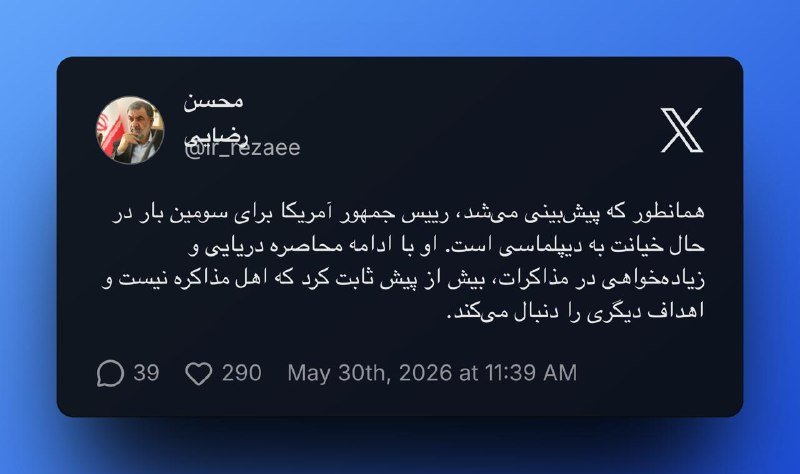
The White House and the Islamic Republic are reading from different scripts — and that may be the point.
On the afternoon of 29 May 2026, President Donald Trump spent approximately two hours in the White House situation room reviewing what his administration described as a near-final agreement with Iran, according to reporting by The New York Times. The administration believes the two sides are close. Iranian state media, meanwhile, offered a categorically different assessment: no agreement exists.
Fars News Agency, citing well-informed sources, issued a flat denial of the American president's public claims. The head of the Iranian parliament's national security commission added that the text circulating as a draft memorandum is one-sided and that Iran has not yet transmitted any formal response to the 14-point framework reportedly under discussion.
What the Draft Contains — and Who Is Saying So
The contours of the American proposal have begun to emerge, largely through Iranian state channels rather than American ones. According to details published by Fars News and corroborated across regional wire services, the draft framework includes approximately $12 billion in unfrozen Iranian assets being released as part of a sanctions-relief package. In exchange, Iran would be required to submit to enhanced nuclear monitoring and accept constraints on its enrichment programme.
Trump himself laid out the administration's non-negotiable parameters in a post published on his social media platform on 29 May. Iran, he wrote, must agree it will never possess nuclear weapons or a nuclear bomb. The Strait of Hormuz — through which roughly one-fifth of the world's oil flows — must remain open and secure.
The release of frozen funds and the Hormuz guarantee form the structural core of what Washington is offering Tehran: financial breathing room and a de-escalation of maritime tension in exchange for verifiable limits on the nuclear programme. Whether those terms are negotiable is precisely what remains unanswered.
The Gap Between the Two Narratives
The discrepancy between the American framing of near-agreement and the Iranian framing of non-existence is not simply a diplomatic miscommunication. It is a structurally functional gap that serves distinct domestic and geopolitical purposes for both capitals.
For Washington, announcing proximity to a deal accomplishes several things simultaneously: it signals seriousness to regional allies — particularly Israel and the Gulf states — that the nuclear question is being managed; it creates market-facing reassurance that a supply-side shock is being averted; and it puts pressure on Tehran by suggesting the moment of agreement is near, which may be useful leverage in last-stage haggling.
For Tehran, denial serves a different set of interests. Acknowledging active negotiations, let alone near-agreement, invites immediate blowback from the Islamic Republic's most hardline institutions — the Revolutionary Guard, the parliament's security committee, and the supreme leader's inner circle. Iranian state media's insistence that the draft text is one-sided communicates to a domestic audience that Iran is not capitulating, while potentially leaving room for a future, revised acknowledgement if the final terms prove more palatable.
The head of Iran's national security commission has been among the most vocal critics of the terms reportedly on the table. His objections — that the memorandum is imbalanced and that Iran has sent no formal reply — suggest that even if a framework is eventually reached, ratification through Iranian domestic institutions will be contested and uncertain.
What Remains Contested
The sources examined for this article present a consistent picture of asymmetric communication rather than coordinated negotiation. The New York Times reports an American administration that believes it is close; Iranian state media reports a country that says it is not there.
Several material questions remain open. The precise scope of any nuclear monitoring regime — whether it includes snap inspections, IAEA access to military sites, and the timeline for sanctions removal — is not specified in the available draft summaries. The $12 billion in unfrozen assets appears to represent only a fraction of the total frozen Iranian sovereign assets estimated to be held abroad; the broader question of full asset release has not been resolved. The status of Iran's regional proxy network — which Washington has at times sought to address within any accord and at other times separated into a parallel track — does not appear in the draft memorandum's reported 14 points.
Whether the two sides are engaged in a genuine negotiation with a negotiable gap, or whether they are performing a diplomatic exercise for domestic and international audiences while the substantive positions remain far apart, cannot be determined from the available evidence. The next 72 hours will likely clarify whether the gap is closable — or whether the competing narratives reflect an irreconcilable set of demands that no final text could simultaneously satisfy.
The Strait of Hormuz is not going anywhere. Neither, it seems, is the distance between these two governments.
Monexus published this article at approximately 20:00 UTC on 29 May 2026. The wire services covering the situation room meeting and the Iranian parliamentary response ran parallel framings throughout the day; this piece has attempted to hold both in view rather than resolve the discrepancy in favour of either capital's preferred narrative.
Wire provenance
This editorial synthesis draws on the following public wire/social posts:
- https://t.me/wfwitness/18942
- https://t.me/GeoPWatch/15231
- https://t.me/GeoPWatch/15229
- https://t.me/englishabuali/9841
- https://t.me/DDGeopolitics/12487
- https://t.me/englishabuali/9839