Hezbollah Releases Footage of Southern Lebanon Operations as Drone Strikes Test Northern Israeli Defenses
Hezbollah military media published video on 30 May showing operations targeting Israeli armor and personnel in southern Lebanon on 27 May, as cross-border drone activity intensified along the northern frontier.
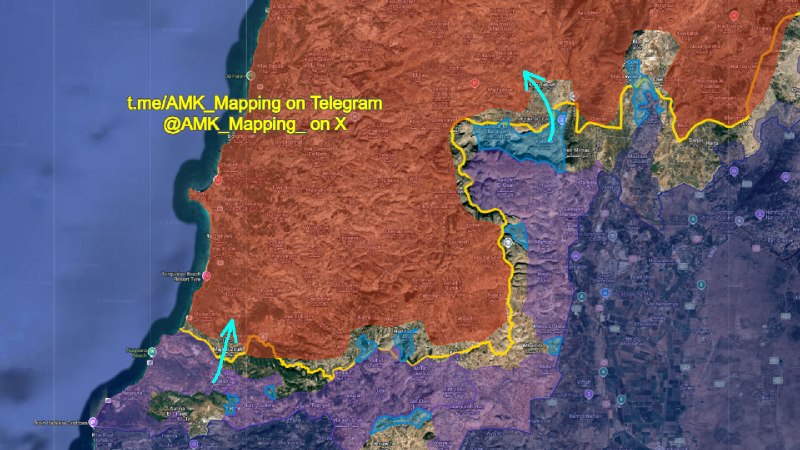
Hezbollah military media published video footage on 30 May showing its fighters targeting an Israeli Merkava tank and a gathering of Israeli armored vehicles and soldiers along the southern outskirts of Zawtar al-Sharqiya in southern Lebanon. The footage, dated 27 May 2026, arrived as cross-border drone activity tested Israeli air defenses across the northern frontier.
The timing of the release—three days after the recorded operations—reflects a pattern familiar to analysts tracking the group's communications strategy: battlefield footage is typically processed, assessed, and released at a pace that serves Hezbollah's broader messaging objectives. The IDF confirmed on 30 May that it had intercepted two drones along the northern border while a third impacted in Israeli territory, near the same operational window as the southern Lebanon operations shown in the video.
The Operations Documented in the Footage
Hezbollah's military media wing released two separate pieces of footage on 30 May. The first showed fighters targeting a Merkava main battle tank on the southern outskirts of Zawtar al-Sharqiya. The second depicted what Hezbollah described as a gathering of Israeli armored vehicles and soldiers in the same area. Both operations were dated 27 May 2026, placing them within a sustained period of cross-border exchanges that has placed northern Israeli communities under persistent pressure.
The IDF acknowledged the drone incursions without providing detailed assessment of the southern Lebanon incidents shown in the footage. Israeli military spokespersons have previously characterized Hezbollah operations along the Lebanon frontier as attempts to probe defenses and generate propaganda value, while Israeli ground forces have conducted regular patrols and limited operations in border areas. The footage's technical detail—showing what appears to be a direct hit on a Merkava tank—underscores the risk calculus facing Israeli commanders operating in exposed positions near the frontier.
What the IDF Confirmed and What Remains Contested
The IDF's acknowledgment on 30 May covered drone activity along the northern border rather than the specific engagements documented in Hezbollah's footage. Military officials stated that two drones were intercepted while a third impacted in Israeli territory, near the northern border area. This account aligns with the timeline of the southern Lebanon operations but does not directly corroborate the tank strike or the personnel gathering attack shown in the video.
Hezbollah's framing characterizes both operations as successful engagements by the Islamic resistance against what it terms "invading Israeli army" forces in Lebanese territory. The group has consistently described its operations along the frontier as defensive responses to Israeli incursions, a narrative that frames its strikes as lawful resistance rather than acts of aggression. Independent verification of battlefield claims on both sides remains difficult given the operational environment and restricted access for outside observers.
The Merkava tank has been a symbol of Israeli military capability for decades, and a confirmed strike on one near the frontier would carry significant operational and psychological weight. Israeli military assessments of specific engagements are typically released after internal review, meaning the IDF's account of the 27 May operations may follow at a later date.
The Pattern: Video-Release Timing and Escalation Dynamics
The three-day gap between the recorded operations and their release is not unusual in Hezbollah's communications practice. The group has developed a sophisticated media operation that processes battlefield footage, prepares it for distribution across multiple platforms, and releases it at moments calculated to maximize impact. This approach serves multiple functions: it allows time for verification and quality control, it creates a rolling archive of operations that can be assembled into compilation materials, and it enables Hezbollah to control the narrative around specific engagements.
The simultaneous release of footage targeting both a tank and a larger force of soldiers suggests an effort to demonstrate range and precision. Drone-assisted targeting has become a standard feature of Hezbollah's operational toolkit since the 2006 war, and the group has steadily expanded its surveillance and strike capabilities along the frontier. Israeli defense officials have acknowledged that Hezbollah maintains an extensive network of observation posts, sensors, and strike assets positioned to monitor and engage Israeli forces operating near the border.
For Israeli communities along the northern frontier, the footage release adds to an already tense security environment. The drone incursions acknowledged by the IDF on 30 May represent a direct challenge to Israeli air defenses and a reminder that the frontier remains active even when headline-grabbing events focus attention elsewhere.
Stakes and Forward Trajectory
The footage release and the parallel drone activity frame a pattern that neither side has been able to arrest. Hezbollah continues to demonstrate reach and precision along a frontier that has seen sustained exchanges since October 2023, while Israeli forces maintain pressure through patrols, strikes, and air operations. The Biden administration and European diplomatic actors have repeatedly called for restraint, but the operational tempo has not moderated in ways that would suggest imminent de-escalation.
The stakes are asymmetric but high for both sides. For Hezbollah, successful strikes validate its deterrence posture and reinforce its standing as the primary resistance actor in Lebanon. For Israel, the ability to intercept most incoming drones while acknowledging that some penetrate represents a managed but imperfect defense—one that costs nothing if it works and everything if it does not. The Merkava footage, if confirmed, would suggest that the ground threat remains live even as air defenses improve.
International diplomatic efforts to broker a ceasefire along the Lebanon frontier have produced no durable arrangement, and both sides appear to be managing a conflict of attrition that serves strategic purposes beyond the immediate battlefield. The footage released on 30 May is likely to feature in Hezbollah's communications for weeks to come, underscoring a point the group has made repeatedly: the northern frontier is not quiet, and it will not become so on anyone's timeline but their own.
This publication's coverage of Hezbollah military communications reflects standard wire practice: Iranian state-adjacent outlets are cited with explicit sourcing caveats, and the operational claims in the footage have not been independently verified by Monexus.
Wire provenance
This editorial synthesis draws on the following public wire/social posts:
- https://t.me/FarsNewsInt/84982
- https://t.me/AMK_Mapping/72491
- https://t.me/FarsNewsInt/84980
- https://t.me/thecradlemedia/48921
- https://t.me/presstv/117423
- https://t.me/wfwitness/58192