Hezbollah Video Shows Merkava Strike as Israeli Ground Operations Expand Into Southern Lebanon
Hezbollah military media released footage on 30 May 2026 of what it described as the targeting of an Israeli Merkava tank on 27 May near Zawtar al-Sharqiyah, as Israeli forces extended ground operations deeper into southern Lebanon.
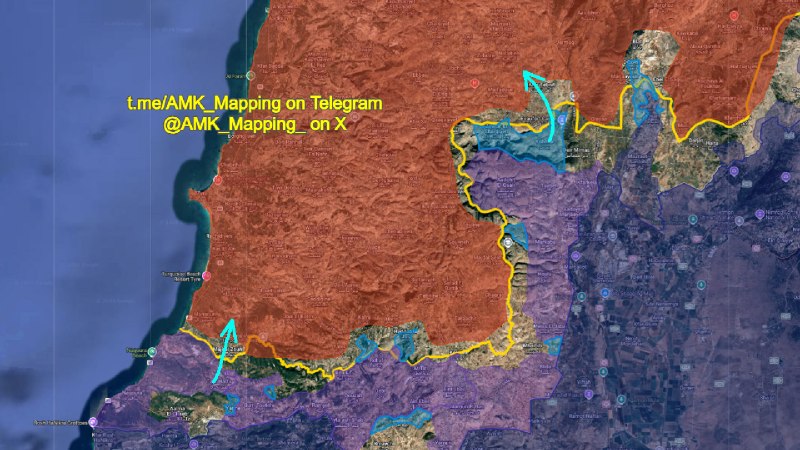
Hezbollah military media published footage on 30 May 2026 showing what it described as the targeting of an Israeli Merkava tank on 27 May near the southern Lebanese town of Zawtar al-Sharqiyah — footage released the same day as Israeli forces confirmed an expansion of ground operations deeper into southern Lebanon. Separate footage published by Hezbollah showed the launch of rockets and mortars towards Israeli positions in the town of Zawtar El Charqiyeh, also in southern Lebanon. The timing places the attacks within an intensifying phase of cross-border hostilities that has seen both sides exchange fire with increased frequency over recent weeks.
The footage, released via the group's official military media channels on Telegram, shows what Hezbollah identifies as a strike on the Merkava tank on the southern outskirts of Zawtar al-Sharqiyah. A second video documented what the group described as the deployment of rockets and mortars targeting Israeli Defense Forces positions in Zawtar El Charqiyeh. IDF statements confirmed on 30 May that ground operations had expanded, though the military did not comment specifically on the incidents near Zawtar al-Sharqiyah. The release of combat footage is a documented feature of Hezbollah's communication strategy during periods of heightened confrontation, timed to coincide with operational claims and domestic political communication.
Hezbollah's military communications operate within a structured media apparatus that publishes battlefield documentation in near-real time. The videos released on 30 May were attributed to the group's Mujahideen units, using language consistent with previous releases. According to Iranian state-affiliated broadcaster PressTV, which carried the footage on its Telegram channel, the operation targeted Israeli forces "on the southern outskirts of Zawtar al-Sharqiya in southern Lebanon." Fars News International, an Iranian state-linked news agency, similarly reported the footage as evidence of what it termed an "Islamic resistance" operation. These characterizations reflect the framing used by Tehran-aligned media, which presents Hezbollah's activities as part of a unified regional resistance axis. That framing should be noted alongside the footage itself, which remains the verifiable material at the centre of these reports.
The footage cannot be independently verified by this publication. The images circulated via Hezbollah-affiliated Telegram channels and were subsequently reported by Iran-state-adjacent outlets without independent confirmation from Western wire services or IDF spokespeople as of publication. Social media analysis of geolocation data and visual confirmation techniques remain the primary tools available to outside observers, and those assessments have not yet produced a consensus confirmation in the public domain. What is clear is that the footage exists, was released on the dates stated, and depicts equipment consistent with the Merkava tank series. Whether the depicted strike resulted in crew casualties or disablement cannot be determined from the images alone. The IDF has not issued a public casualty report connected to the date and location described in the Hezbollah footage.
The timing of the release is itself significant. Hezbollah distributed the material hours after the IDF announced an expansion of ground operations in southern Lebanon — a sequence that serves both military and communicative purposes. Documented patterns of Hezbollah media releases suggest the group times footage drops to reinforce domestic messaging, signal capabilities to adversaries, and shape international perception of the battlefield balance. For audiences in Lebanon and across the Shia political world, the release functions as evidence of effective resistance. For Israeli audiences, it underscores the ongoing costs of an operation that the IDF describes as necessary but which generates domestic pressure as casualties accumulate.
The broader context is a conflict that has no diplomatic endpoint currently in sight. A ceasefire framework remains absent, and the ground operation — framed by Israel as a limited incursion aimed at degrading Hezbollah's infrastructure near the border — continues to generate casualties on both sides. Israel has characterised the operation as defensive and proportionate, aimed at eliminating rocket-launch capability. Hezbollah, drawing on its own framing of resistance doctrine, presents the same territory as sovereign Lebanese soil under occupation by a foreign military. Neither characterisation is neutral, and media coverage of the conflict routinely reflects the vantage point of the outlet and the institutional frameworks through which it operates.
For Lebanon, the human stakes are immediate and severe. Civilian infrastructure in southern Lebanon has sustained documented damage; the United Nations and aid organisations have repeatedly flagged humanitarian concerns in communities caught between Israeli ground operations and Hezbollah's continued presence in the same areas. For Israel, the operational challenge is a force that is experienced, dug in, and capable of anti-armour strikes at close range. The Merkava tank — a symbol of Israeli military self-reliance — is specifically designed to protect crew survivability, and footage targeting one carries symbolic weight alongside its tactical implications.
What the footage cannot tell readers is whether the operation succeeded in its stated military objective, whether the IDF's expanded ground push has altered the tactical balance, or whether diplomatic back-channels are operating in parallel to the fighting. Those questions remain open. The video documents an attack. Its larger significance will depend on events that are still unfolding.
Monexus has framed this article around the verifiable material in the Hezbollah release and the IDF's confirmed ground expansion, noting the provenance of the footage through Iranian state-adjacent channels without treating that framing as neutral. Western wire outlets have not independently confirmed the specific incidents as of publication.
Wire provenance
This editorial synthesis draws on the following public wire/social posts:
- https://t.me/wfwitness/18432
- https://t.me/wfwitness/18434
- https://t.me/presstv/98231
- https://t.me/FarsNewsInt/55712
- https://t.me/AMK_Mapping/88391