Southern Lebanon Burns Again — And the World Watches Without flinching
Israeli warplanes struck at least five towns across southern Lebanon on 30 May, according to Lebanese security sources. The pattern of attacks — spreading across three districts within ninety minutes — raises hard questions about the direction of the conflict that Western coverage has largely declined to ask.
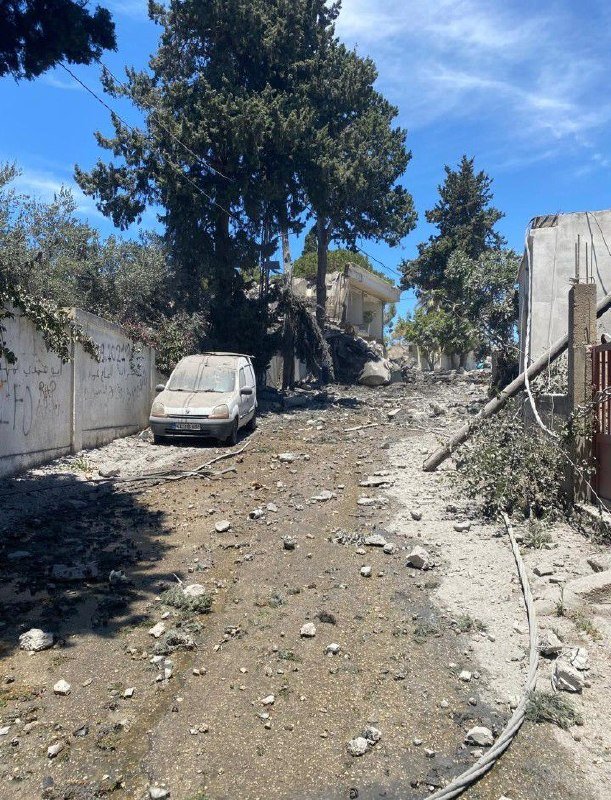
At midday on 30 May 2026, Israeli warplanes struck the town of Mahmoudiya near Al-Aishiya in the Jezzine district of southern Lebanon. Within the hour, two more rounds of strikes had hit Toulin and Balat in the Marjayoun district, and Kafardounin in the Bint Jbeil district — all according to Lebanese security sources cited by Al Alam Arabic. Five towns. Three districts. Ninety minutes. There is no other word for it: this is a barrage.
The wires carried the dispatches. Reuters and AP ran itemised strike tallies. The IDF spokesperson confirmed operations without elaborating on targets. Western headlines described the sequence as "cross-border strikes" or "exchanges" — language that treats two sides as equally proximate to a dispute and equally responsible for resolving it. That framing is not false, exactly. It is simply incomplete in a way that matters.
A pattern the wires record but do not quite name
The strikes on 30 May did not occur in isolation. Lebanese security sources reported multi-target operations spanning Jezzine in the west to Bint Jbeil near the eastern border — a geographic spread that reflects either unusually broad operational planning or an attempt to demonstrate reach. Neither reading is comfortable. Reporting from regional outlets, including Al Jazeera English and Al Mayadeen, described the strikes as part of what officials characterised as a sustained effort to degrade Hezbollah-adjacent infrastructure following months of intermittent exchanges since the November 2024 ceasefire framework began to fray.
Coverage in Western outlets leaned heavily on official Israeli statements and on unnamed Western officials briefed on the operations. Lebanon's own institutional channels — the Lebanese army, the Internal Security Forces, official state media — were cited in the breach. Civilian impact, where reported, appeared in secondary paragraphs. The absence is structural: without a named Israeli official or a Western diplomatic source to carry the lead, civilian harm does not lead in the English-language wire. The IDF said targets were struck. The framing followed.
That is not a conspiracy. It is a set of editorial defaults that produce a consistent tilt — one that a thoughtful reader can correct with effort, but that a casual reader will absorb without noticing. The result is a picture in which Israeli operations are presented as moves in a game, while the towns being hit are presented as coordinates rather than communities.
The ceasefire that was always a placeholder
The November 2024 ceasefire agreement between Israel and Hezbollah was never designed to resolve the underlying tensions along the Blue Line. It was designed to stop the shooting. It succeeded, partially, for roughly fourteen months. But as the political conditions in both Israel and Lebanon shifted — coalition instability in Jerusalem, fiscal strain and political paralysis in Beirut — the ceasefire's thin architecture became increasingly exposed.
The strikes reported on 30 May are not the first since early 2026. Sources tracking cross-border exchanges have logged an uptick in frequency over the preceding eight weeks. Each incident has been described by one side as a response to the previous one, creating a chain of justification that is logically coherent and strategically hollow. Nothing is resolved. Nothing is escalated to the point that outside powers intervene. The cycle simply continues, with each round slightly larger than the last.
This is the structure of a conflict that has entered its grinding phase — the point where neither party can achieve its stated objectives through military means, but neither party can credibly declare the objectives obsolete. Israel cannot dismantle Hezbollah's northern capability through sporadic strikes. Hezbollah cannot compel a political settlement through continued resistance. Both know this. The strikes continue anyway, because stopping without a political cover is read as weakness, and weakness invites the next escalation.
Who bears the cost — and who controls the frame
The immediate weight of these strikes falls on communities in south Lebanon that have been evacuated, partially resettled, and evacuated again across multiple cycles of conflict. Jezzine, Marjayoun, and Bint Jbeil are not strategic assets in any conventional sense. They are towns where people live. The infrastructure damage — to roads, to local markets, to the modest healthcare facilities serving rural populations — accumulates in ways that do not show up in strike tallies but accumulate across years of intermittent conflict.
The international response, as reported across wire services, consisted of calls for restraint from the United States and European foreign ministries, and a statement from the UN Interim Force in Lebanon expressing concern. These are not mechanisms of prevention. They are mechanisms of documentation. The world records that something happened, calls for it to stop, and waits for the next dispatch.
There is a secondary cost in the informational register. Lebanon's media environment — already strained by the country's protracted economic collapse — depends heavily on wire service copy and international coverage to fill its pages. When that coverage leads with official statements and treats Lebanese civilian impact as a secondary variable, the story that Lebanese audiences receive about their own communities is filtered through a lens calibrated for Western editorial priorities. The towns being struck are not unnamed, but they are unnamed in the way that matters: as locations, not as places where people are living through another chapter of a conflict they did not choose.
The questions the coverage should be asking
The strikes on 30 May 2026 are significant not because they are unprecedented — they are not — but because they represent a moment at which the conflict's trajectory has become legible again. The ceasefire is no longer functioning as a constraint. The frequency of operations has increased. The geographic spread has widened. The diplomatic channels that might provide off-ramps are, by most accounts, not being actively used.
Western coverage has largely reported these facts. What it has not done is ask what they mean in aggregate. A strike in Jezzine is a data point. Five strikes across three districts in ninety minutes is a trend. The question is whether the trend is heading toward a political settlement, toward a broader exchange that both sides have reason to avoid, or toward a grinding normalisation of conflict that neither side formally endorses but both have implicitly accepted as the baseline.
The wire services will continue to report each strike. The foreign ministries will continue to call for restraint. The IDF will continue to brief on operations. And in the towns of southern Lebanon, people will continue to hear the sound of aircraft overhead and count the distance to the nearest shelter.
The world has grown accustomed to this rhythm. That familiarity is itself a kind of editorial judgment — one that this publication thinks warrants examination.
This publication's coverage of cross-border strikes in southern Lebanon relies on regional Lebanese and Arab-language sources as primary inputs. Western wire services provided corroboration on operational scope. The picture is incomplete by design: both the scale and the stated rationale of the strikes remain contested, and civilian impact reporting lags significantly behind the military dispatches. Monexus will continue to track developments and pursue independent corroboration of casualty figures and target assessments.
Wire provenance
This editorial synthesis draws on the following public wire/social posts:
- https://t.me/alalamarabic/184321
- https://t.me/alalamarabic/184320
- https://t.me/alalamarabic/184319