The Drone Coalition's Quiet Arithmetic: 200,000 Systems and the Calculus of Ukrainian Defence
On 31 May 2026, Britain's Parliamentary Secretary for the Ministry of Defence confirmed a figure that, while rarely headlined, has quietly become one of the most consequential data points in the war's logistics: the Drone Coalition — a UK-led consortium of supplying nations — has delivered more than 200,000 unmanned systems to Ukraine over the preceding two years. The disclosure, reported via the Wargonzo Telegram channel on that date, provides the first official aggregate accounting of a programme that has accelerated across multiple coalition partners since its formal establishment.
The number is large enough to invite immediate scepticism — and immediate re-calibration of what the war looks like from the ground. Two hundred thousand systems is not a supplementary aid package. It is a structural bet on unmanned warfare as the primary vector of Ukrainian operational capacity.
What the Figure Actually Represents
The Drone Coalition was stood up in 2024 as a multilateral mechanism distinct from the standard bilateral weapons pipelines. Britain assumed the coordinating role, with contributions flowing from Denmark, the Netherlands, Germany, and a cluster of smaller European defence partners. The model was deliberately non-bureaucratic: member states pledged procurement funding and industrial capacity, while the UK handled logistics coordination and targeting-priority signals from Kyiv.
The 200,000 figure encompasses a broad category. It includes first-person-view (FPV) strike drones — cheap, producible at scale, and devastating in trench-warfare contexts — alongside longer-range maritime and reconnaissance systems. The disaggregated breakdown between types has not been publicly released, which itself tells a story: the coalition has preferred operational discretion over transparency, likely to avoid telegraphing capability gaps to Russian intelligence.
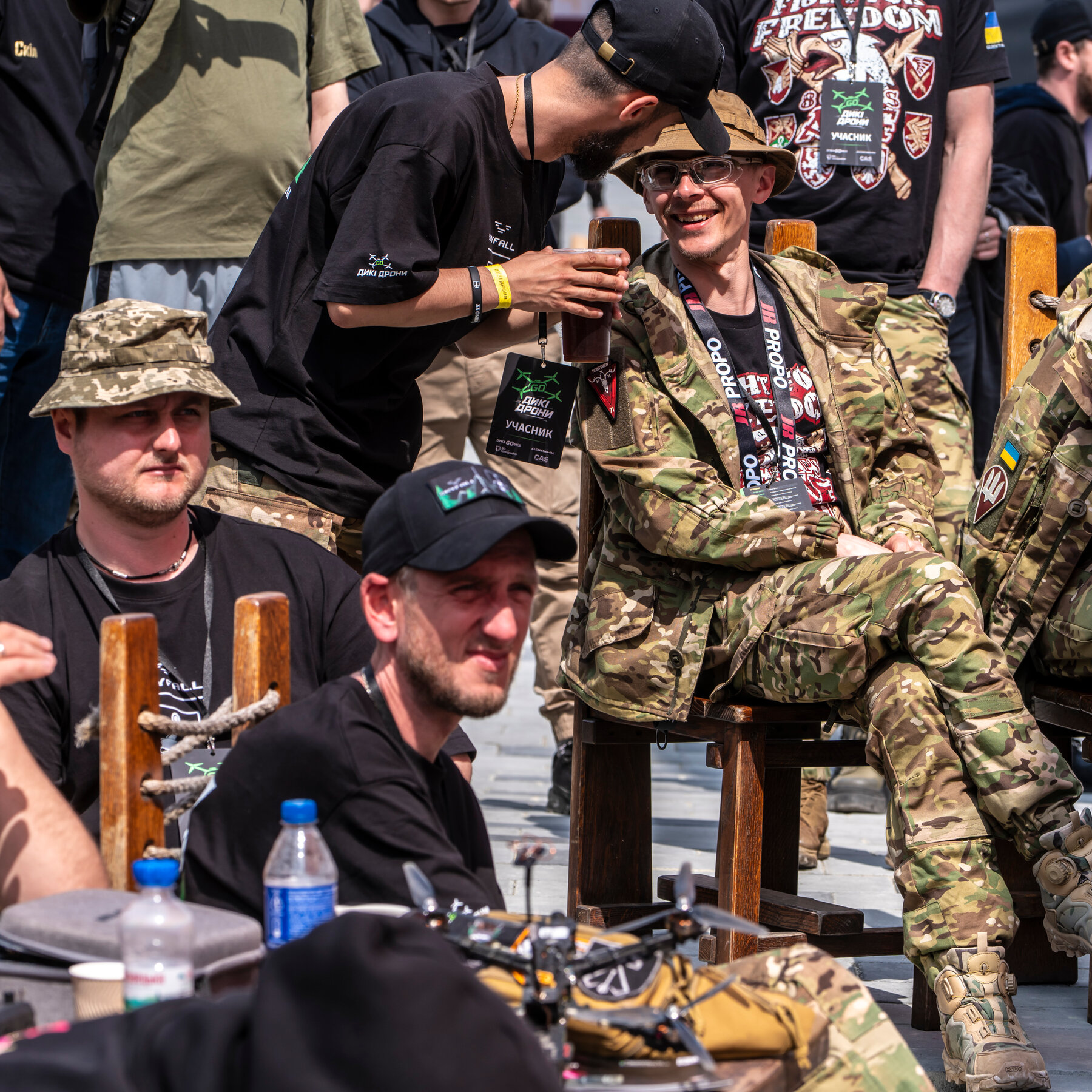
What is not in dispute is the order of magnitude. If the figure holds, Ukraine has received more dedicated unmanned combat and reconnaissance platforms in two years than most Nato militaries operate in their entire active inventory. The implications for Ukrainian tactical doctrine — already the most drone-adapted fighting force in Europe — are significant. Ukrainian operators have been rotating through UK and Estonian training facilities, learning to deploy systems in coordinated swarms and to integrate drone footage directly into artillery fire-correction loops.
The Industrial Dimension
Behind the headline number sits a less-discussed story: the extent to which the Drone Coalition has functioned as a stimulus package for European mid-tier defence manufacturers. Ukrainian demand arrived at a moment when several EU member states were still completing the mental transition from post-Cold-War defence drawdown to active rearmament. The coalition's procurement pipelines gave those manufacturers a guaranteed offtake customer — and, critically, real-world operational feedback that Western defence planners had been denied for decades.
Danish drone manufacturer Nordic Dragon, Dutch consortiums supplying maritime drones, and a network of Polish and Estonian startups have all cited Ukrainian battlefield performance data as shaping their current production lines. Systems that failed in Ukraine were rapidly redesigned; systems that succeeded entered coalition inventories. The feedback loop has compressed what would normally be a decade-long procurement refinement cycle into months.
That industrial dimension cuts both ways. It has accelerated European defence integration in a way that formal EU directives had failed to do for years. But it has also raised uncomfortable questions about dependency: if Ukrainian demand drives European production, what happens to that industrial base if the war ends? The coalition was designed for a specific conflict; its longer-term strategic logic remains less settled.
The Counterargument — and Why It Doesn't Quite Land
There is a competing framing, most audible in corridors of Western defence ministries, that the drone-delivery pace is being overstated to manage domestic political audiences. Under this read, the 200,000 figure includes systems still in the procurement pipeline, in-transit, or held in coalition pre-positioning stocks — not all of which have reached operational units. The figure, in this reading, is aspirational accounting rather than confirmed battlefield delivery.
The Wargonzo reporting, sourced from a Russian-adjacent channel, naturally carries its own framing baggage: the figure is presented as an admission of Western escalation rather than as a defensive capability transfer. The Russian information environment has consistently sought to frame Western military aid as provocative rather than reactive to an ongoing invasion. That contextual skew does not, however, invalidate the underlying data point.
The more substantive pushback is logistical: whether 200,000 systems represents a sustainable flow or a procurement peak that will decay as production lines hit capacity ceilings and component shortages bite. The drone supply chain — particularly for specialized motors, flight controllers, and imaging sensors — remains partially dependent on commercial electronics markets that have experienced documented disruption since 2023. Coalition partners have been working to diversify supply chains, but the timeline for full indigenization is measured in years, not quarters.
Stakes and the Forward View
The arithmetic of 200,000 systems over two years places Ukrainian drone density at a level without precedent in modern warfare. Each system represents a logistical node — a training pipeline, a maintenance requirement, a supply chain dependency. The Drone Coalition has, in effect, built Ukraine a parallel air force that runs on commercial-grade components and operator skill rather than on expensive platforms and dedicated infrastructure.
The stakes of sustaining that flow are financial and political. The coalition model depends on continued parliamentary authorisation in each member state — a process that, in Britain, Denmark, and Germany especially, has grown more contested as the war has lengthened. Public fatigue arguments have not, to date, translated into coalition withdrawal, but the political weather can shift faster than procurement pipelines can adapt.
The structural question is whether the Drone Coalition becomes a permanent feature of European defence architecture or retreats once its original purpose — Ukrainian survival — is no longer the operative concern. The industrial base it has stimulated, the training pipelines it has normalised, and the doctrine it has validated suggest it will not disappear cleanly. The unmanned warfare lesson of Ukraine has been absorbed by every defence ministry in Europe. The only question is whether the institutional structures built to transmit that lesson survive the political cycles that created them.
The Wargonzo disclosure on 31 May does not answer that question. But it provides a number worth sitting with: 200,000 systems, two years, one ongoing war, and a quiet revolution in how European states think about delivering defence.
This publication's framing differs from the dominant wire coverage in one respect: the wire has largely treated the Drone Coalition as a subset of broader Western aid reporting, while this analysis treats the unmanned systems programme as a distinct strategic development with industrial and doctrinal implications that extend well beyond the current conflict.
Wire provenance
This editorial synthesis draws on the following public wire/social posts:
- https://t.me/wargonzo/18942