Iran's Parliament Speaker Reaffirms Hard Line on Nuclear Talks After Re-Election
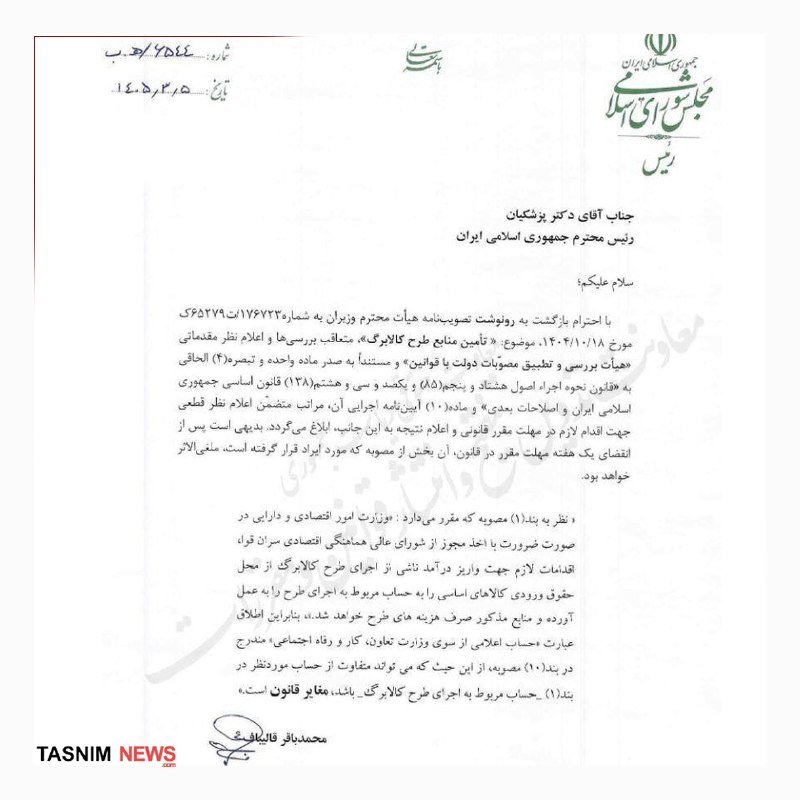
Mohammad Baqer Qalibaf was re-elected Speaker of Iran's Islamic Consultative Assembly on 31 May 2026, and within hours of the vote, he delivered a statement that left little room for diplomatic ambiguity. Tehran, he said, would not accept any agreement that did not produce tangible results. The remarks were carried by Iranian state-aligned outlets and immediately drew attention in Western capitals still navigating the uncertain terrain of nuclear diplomacy with the Islamic Republic.
The re-election of Qalibaf — a figure long associated with the conservative establishment and with a portfolio that includes responsibility for the parliament's foreign policy committee — signals continuity rather than recalibration in Tehran's legislative posture. That the statement came within the same news cycle as his formal re-confirmation suggests it was deliberate: an opening position staked before any new round of talks could take shape.
The Tangible-Results Demand
Qalibaf's condition — "tangible results" before any agreement is binding — maps onto a demand Iranian negotiators have pressed across multiple rounds of talks since the original Joint Comprehensive Plan of Action began to fray. The phrasing matters because it shifts the burden of proof. Tehran is not simply asking for sanctions relief in exchange for nuclear constraints; it is insisting that whatever relief materialises must be immediate, verifiable, and felt by ordinary Iranians whose daily lives have been shaped by years of Western financial restrictions.
The framing is also a rebuttal of what Iranian officials have long characterised as bad-faith sequencing: Western proposals that ask Iran to constrain its programme first, with sanctions relief deferred to a later stage and contingent on compliance checks that Tehran argues are designed to be failed. Qalibaf's demand for tangible results is, in the Iranian reading, a demand for a different order of operations — economic relief that arrives before or alongside nuclear concessions, not after a probationary period.
The Iranian Parliament Speaker cast the current moment in explicitly confrontational terms. Iran, he said, was pushing back the enemy in what he described as a "history-making" war. The language is significant: it elevates the current standoff beyond a tactical dispute over enrichment percentages or sanctions categories and frames it as a civilisational contest in which economic pressure and propaganda are the enemy's primary instruments of coercion.
Economic Pressure as Primary Weapon
According to remarks carried by Iranian state media on 31 May 2026, Qalibaf identified economic pressure and media propaganda as the twin tools the enemy — a term routinely applied to the United States and its allies in Iranian official discourse — was deploying to compensate for its inability to achieve military objectives. The characterisation is one Tehran has repeated throughout the sanctions era, but its placement in a statement issued immediately after a parliamentary re-election makes it a foundational claim for whatever negotiating posture the new parliament session will adopt.
The structural logic is straightforward: if economic pressure is the primary threat, then sanctions relief is the primary objective. Nuclear concessions, in this framing, are not a gift Iran offers in exchange for normalisation — they are leverage Iran holds, to be exchanged for something it actually needs. This is not a novel Iranian negotiating position, but Qalibaf's re-election gives it renewed institutional weight.
Western analysts have long argued that Iran entered the nuclear talks of 2021–2023 with an asymmetric advantage: time. The assumption was that sanctions would bite harder on Tehran than any temporary enrichment pause would hurt the United States and its partners. Whether that assumption still holds depends on factors the sources reviewed here do not directly address — including the current state of Iran's oil exports, the effectiveness of secondary sanctions enforcement, and the degree to which the Trump administration's maximum-pressure posture has been moderated since its initial return to office.
The Broader Diplomatic Context
The statement arrives at a moment when several diplomatic tracks involving Iran are either active or being quietly maintained. Nuclear talks with the United States have produced no publicly confirmed breakthrough, though informal channels have reportedly remained open. The European parties to the original JCPOA — France, Germany, and the United Kingdom — have continued to signal support for a renewed agreement, though their leverage to deliver Iranian sanctions relief has always been contingent on American cooperation. Meanwhile, the geopolitical landscape has grown more complex: the ongoing Ukraine conflict has reshuffled the calculus of several Western partners, and the broader realignment of the Global South has given Tehran additional diplomatic cover.
Qalibaf's statement does not specify which agreements he is referring to — the nuclear talks, regional security arrangements, or some combination. That ambiguity is itself a negotiating tool. By refusing to define "tangible results" precisely, Tehran preserves the ability to declare any future offer insufficient without having to articulate in advance what would satisfy it.
The sources reviewed here do not indicate any formal response from Washington or the European capitals as of 31 May 2026. The silence is not surprising — the norm in diplomatic practice is to allow opening statements to settle before responding — but it leaves open the question of whether the re-election statement will be treated as a negotiating position to be engaged or a rhetorical gesture to be noted and set aside.
What Remains Uncertain
The sources do not specify the vote margin by which Qalibaf was re-elected, nor do they indicate whether any significant bloc within the parliament opposed his candidacy. The composition of the new parliament session — whether it contains a stronger or weaker conservative majority than its predecessor — is not addressed in the material reviewed here. Those details would illuminate whether the hardline statement reflects a parliamentary consensus or a position staked by a speaker with a more contested mandate.
The sources also do not clarify whether Qalibaf's remarks reflect coordination with the executive branch — specifically with the office of the President, which holds its own authority over foreign policy and nuclear negotiations. Iranian constitutional arrangements give both the President and the Parliament Speaker institutional roles in foreign affairs, and the relationship between those two centres of power has varied depending on the political configuration of any given session.
Finally, the sources do not indicate whether any new negotiating round is imminent, or whether Western capitals have signalled any willingness to reconsider the sequencing that Iran has rejected. The statement from Tehran is an opening position. Whether it is an opening that leads somewhere depends on responses not yet in the public record.
This publication's coverage of Iranian official statements proceeds from the premise that such statements are newsworthy and are reported here as claims made by named officials in named institutional roles. The framing of Iran as a party in a "history-making war" reflects the language used by Iranian officials; it does not reflect a judgment by Monexus about the nature of the conflict. Where Western government or independent assessments of Iranian nuclear compliance exist, they are incorporated where evidence warrants.
Wire provenance
This editorial synthesis draws on the following public wire/social posts:
- https://t.me/TheCradleMedia/
- https://t.me/thecradlemedia/
- https://t.me/presstv/
- https://t.me/DDGeopolitics/