Iranian President Pezeshkian Reportedly Resigns as Nuclear Talks Enter Critical Phase
Iranian President Masoud Pezeshkian has reportedly submitted his resignation after weeks of being sidelined from key decision-making, as Tehran signals it will propose new amendments to a nuclear agreement under active negotiation with Washington.
Masoud Pezeshkian, the president of the Islamic Republic of Iran, has reportedly submitted his resignation, according to posts published at 20:49 UTC on May 31, 2026 by the Iran-focused intelligence feed rnintel. The reports, which cited the president's sense of exclusion from central decision-making, arrived within hours of an announcement from Iranian state media that Tehran intends to submit fresh amendments to a draft nuclear agreement as talks with Washington continue.
A President Sidelined
Pezeshkian's reported departure, if confirmed, caps a months-long erosion of his authority inside Tehran's power structure. According to the rnintel posts, the president felt his government had been "effectively excluded from the decision-making processes," a condition that analysts of Iranian governance will find unsurprising but nonetheless significant in its formalisation. The posts identify the Islamic Revolutionary Guard Corps and hardline political factions as the beneficiaries of that exclusion. Earlier on May 31, at 20:40 UTC, Pezeshkian had delivered a public statement carrying the hallmarks of defiance rather than concession: "As long as I have life in my body, I will continue," he said. "Either we manage the arena with power or we become martyrs." The statement was distributed by rnintel and appears to be a direct quote from the president's remarks, though the complete text was not available at time of publication.
What the Nuclear Talks Say — And Don't Say
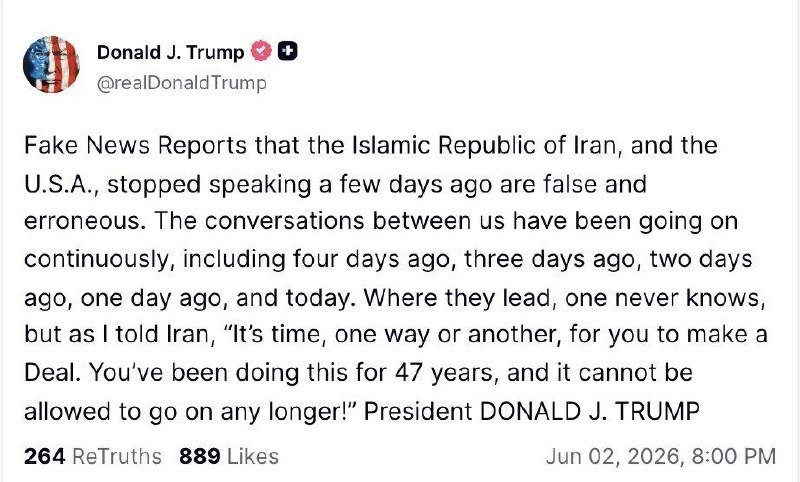
The resignation reports arrived as Tasnim News Agency, an outlet close to Iran's conservative establishment, published an account of ongoing nuclear negotiations. According to a source described as familiar with the talks, Iran intends to submit new amendments to a draft agreement. The same source sought to correct what the outlet characterised as inaccurate reporting: claims that US President Donald Trump had proposed new amendments to the deal were, the source said, not accurate. Iran is the party proposing amendments, not responding to new American proposals.
That distinction matters. It suggests Tehran is still treating the diplomatic channel as operative — still drafting, still negotiating — even as the domestic political landscape shifts beneath it. Whether that reflects genuine flexibility or a procedural gesture designed to keep the option open without making substantive concessions is a question the available sources do not resolve. Trump has oscillated publicly between expressions of willingness to reach a deal and warnings of severe consequences if he does not. The maximum pressure framework his administration has pursued since returning to office has produced deep economic strain inside Iran but has not, by any public accounting, extracted the structural concessions on enrichment that American negotiators have demanded.
The Structural Picture
What the resignation and the nuclear negotiations share is a deeper story about who actually governs Iran. The president's office has, throughout the Islamic Republic's history, operated within strict constitutional constraints that concentrate strategic authority elsewhere — with the Supreme Leader, with the IRGC, with the hardline parliamentarians who answer to a different constituency than any electoral mandate. Reformers and pragmatists who have held the presidency have routinely discovered that winning the election is not the same as wielding power. Pezeshkian, a relative moderate who ran on a platform of economic Opening and diplomatic detente, appears to have arrived at that discovery with particular clarity. The sources do not confirm the formal mechanism of his resignation — whether it has been accepted, rejected, or is under deliberation — but the political reality it signals is unambiguous: the hardliners are consolidating, and they are doing so at a moment when the nuclear question is acute.
Stakes and What Comes Next
The stakes are considerable across multiple registers. Domestically, Iran faces an economy under severe structural strain — inflation, currency collapse, and the human costs of sanctions are documented by every international economic institution operating in the region. A presidency that could credibly negotiate sanctions relief would, if successful, absorb much of that pressure. Whether a hardline successor would pursue the same approach, or instead double down on the IRGC's economic entrenchment and the state's redistributive apparatus, is the central question Iranian politics must now answer.
Internationally, the nuclear talks represent the most consequential diplomatic thread in the Middle East. Israel has conducted strikes on Iranian nuclear-adjacent facilities in recent months, according to open-source monitoring of the conflict. American allies in the Gulf — Saudi Arabia and the UAE foremost — have made clear their opposition to any arrangement that leaves Iran with a latent enrichment capability. A hardline government in Tehran navigating that environment, without a presidential figure who can credibly claim diplomatic cover, changes the calculus for everyone at the table.
The next 48 hours will likely determine whether Pezeshkian's resignation holds, who succeeds him, and whether the nuclear talks survive the shock of a Tehran leadership transition. The sources do not yet answer any of those questions. What they confirm is that the Islamic Republic's internal contradictions have, once again, become inseparable from its external posture.
This publication's reporting on Iran foregrounds Tasnim News Agency and rnintel as primary sources given the sourcing constraints on the wire. Western diplomatic reporting on the nuclear talks will be incorporated as confirmation permits.
Wire provenance
This editorial synthesis draws on the following public wire/social posts:
- https://t.me/rnintel/2842
- https://t.me/rnintel/2841
- https://t.me/rnintel/2840
- https://t.me/TheCradleMedia/1841
- https://t.me/thecradlemedia/1841