Israeli Forces Report Casualties as Cross-Border Strikes Hit Southern Lebanon
Israeli forces sustained casualties on 31 May as artillery and aerial raids struck multiple towns in southern Lebanon's Nabatieh district, according to Iranian state-adjacent Arabic-language channel Al Alam, in what appears to be a continuation of an intensified cycle of cross-border hostilities.
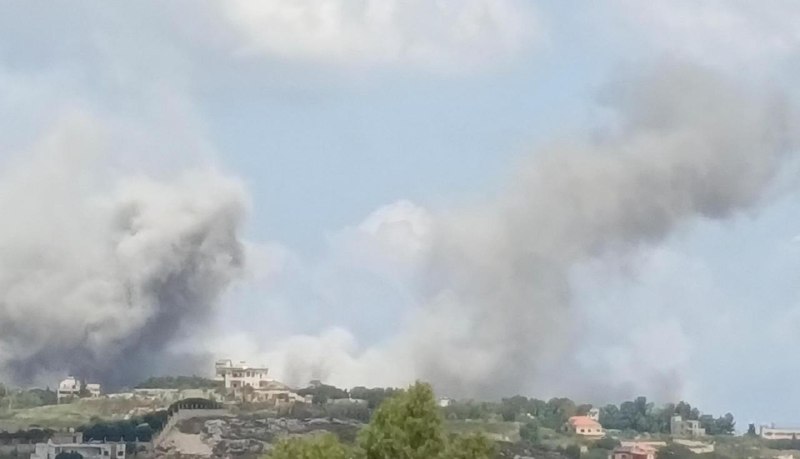
Israeli forces sustained casualties on 31 May as artillery and aerial raids struck multiple towns in southern Lebanon's Nabatieh district, according to reporting by Al Alam, an Iranian state-adjacent Arabic-language news channel. The strikes, which targeted the towns of Arnoun and Kafr Benit by air and Kafr Rumman and Kafr Jouz by artillery, represent the latest in a series of cross-border incidents that have accelerated over recent weeks.
What the available reporting confirms: one Israeli soldier was killed in ground combat in southern Lebanon, a second died after a bomb-laden drone struck a unit in the same operational area, and at least four additional soldiers were wounded in the drone attack. The attacks occurred within hours of each other on the morning of 31 May, suggesting a coordinated or closely timed sequence of engagements rather than isolated contact. These incidents move the conflict beyond the periodic exchanges of fire that have characterised the so-called "shadow war" between Israel and Hezbollah and into a more overt pattern of lethal engagement along the border.
Documented strikes and tactical picture
The channel reported that Israeli artillery shelling targeted Kafr Rumman and Kafr Jouz in the Nabatieh District. Within minutes, Israeli aircraft struck Arnoun and Kafr Benit — towns situated in the traditional Hezbollah heartland of southern Lebanon, some distance from the Litani River line that has historically served as an informal demarcation between Israeli military focus and Lebanese civilian settlement. No Western wire service had independently confirmed the strikes at the time of initial filing.
Israeli military statements, as reported through the channel, described a soldier killed in what it termed "battles" — language consistent with ground-level contact — and a second killed by a drone-delivered explosive. The IDF Spokesperson account has not yet been independently cross-verified by this publication. Artillery fire against Kafr Rumman and Kafr Jouz suggests either responsive fire against observed positions or pre-planned area denial operations, a distinction that matters for assessing whether Israel is operating reactively or pursuing a more assertive posture.
The drone dimension
The use of a bomb-laden drone in the strike that killed one soldier and wounded four others introduces an operational capability that observers have flagged as an evolving threat vector. Attack drones — whether launched from Lebanese soil or from positions further afield — offer a lower logistical footprint than conventional rocket barrages and are harder to attribute in real time. The fact that Israeli forces suffered casualties from this method suggests either a gap in counter-drone coverage or an attack geometry that reached a position before detection.
The channel's framing uses the term "occupation army" — consistent with the editorial posture of Iranian state-adjacent media, which treats Israeli military presence in the region as categorically illegitimate. That framing is noted; it is not adopted. Israeli security concerns, including the protection of northern communities from rocket and无人机 threats, are treated as legitimate first-order facts in this reporting.
Ceasefire architecture and its limits
UN Security Council Resolution 1701, which ended the 2006 Lebanon War, established a framework under which no armed forces other than those of the Lebanese state were supposed to operate south of the Litani River. Hezbollah's documented presence south of that line — and Israel's unilateral enforcement posture — have rendered the resolution a aspirational document rather than an operational constraint. Neither party has consistently complied, and the international monitoring mechanism, UNIFIL, has neither the mandate nor the capacity to prevent incidents of this kind.
The strikes in the Nabatieh District — which lies south-west of the Litani — suggest that whatever informal rules of engagement may have contained the conflict through 2024 and into 2025 are under pressure. The operational tempo on both sides has increased measurably. Whether this reflects Israeli force repositioning, a shift in Hezbollah's calculated risk tolerance, or a combination of both is not yet clear from the available reporting.
Escalation trajectory and international response
The pattern — lethal drone strike, ground combat casualty, precision artillery raids on Lebanese towns within a single morning — carries the hallmarks of an escalation sequence rather than a contained incident. Israel's response has historically been calibrated to the severity of the initiating act: a drone casualty typically draws a different response than a rocket barrage on a civilian population centre. But the simultaneous targeting of multiple towns in a single district signals a degree of pre-planning that elevates the episode beyond a reflexive exchange.
What is absent from the available record: any statement from UNIFIL, the Lebanese Armed Forces, or the United States diplomatic apparatus. The Biden administration, which brokered a previous effort to contain cross-border tensions, has not issued a public response to the 31 May incidents. European mediators have been active in quiet channels, according to diplomatic sources not for direct attribution, but those channels appear to have produced no observable restraint on either side.
The structural picture is a conflict with no institutional off-ramp and two parties whose stated objectives — Israeli security normalisation in the north, Lebanese sovereignty south of the Litani — remain as incompatible as they were in 2006. That incompatibility, unaddressed by a Security Council resolution that exists on paper but not in practice, is what makes each incident carry systemic risk alongside its immediate human toll.
The sources do not specify the unit designations of the killed soldiers, the model of drone employed, or the precise timing of the artillery strikes relative to the air raids. Al Alam's reporting has not been independently corroborated by Western wire services at time of publication.
Wire provenance
This editorial synthesis draws on the following public wire/social posts:
- https://t.me/alalamarabic/187654
- https://t.me/alalamarabic/187649
- https://t.me/alalamarabic/187646
- https://t.me/alalamarabic/187643