Five Workers Killed in Explosion at Hanwha Aerospace Plant in Daejeon
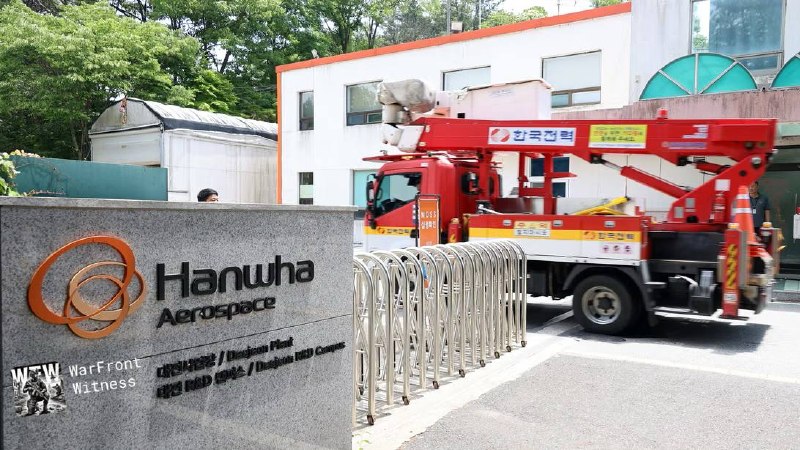
Five workers were killed and two others injured on Monday when an explosion and fire struck a Hanwha Aerospace manufacturing complex in Daejeon, South Korea. Officials confirmed that one of the injured workers remained in care as of Monday evening. The incident has prompted an investigation by South Korean workplace safety authorities into the cause of the blast at one of the country's most strategically significant defense manufacturers.
Hanwha Aerospace is the manufacturing arm of the Hanwha Group conglomerate, South Korea's oldest and one of its most consequential industrial families. The company produces rocket engines, aircraft structural components, unmanned systems, and precision-munition parts across a network of domestic facilities. Its products include engine components for the KF-21 Boramae fighter programme and propulsion systems used across South Korean military platforms. It has also moved aggressively into the global defense export market, supplying artillery systems and armoured vehicles to European buyers and positioning itself as a tier-one supplier to NATO-adjacent procurement chains. The Daejeon site, in particular, has served as a centre for high-precision aerospace manufacturing.
What caused Monday's explosion remains under formal investigation by South Korea's Ministry of Employment and Labour and its Occupational Safety and Health Agency. Initial reports described an explosion and fire in a production area, but the precise trigger — mechanical failure, a chemical reaction, or another factor — had not been publicly identified as of Monday evening. The Daejeon Fire Department confirmed the fire had been brought under control. Investigators will examine maintenance records, storage protocols for hazardous materials, and whether existing safety procedures were followed.
The Daejeon incident arrives at a moment of intensifying pressure across South Korea's defense manufacturing sector. Since Russia's full-scale invasion of Ukraine in February 2022, demand for artillery ammunition, armored systems, and precision-munition components has reshaped the commercial calculus for manufacturers like Hanwha. South Korean defense exports — primarily 155mm artillery shells and K9 self-propelled howitzers — have surged to customers including Poland, the United States, and multiple NATO members. Hanwha Aerospace has been a primary beneficiary, with production schedules extended and throughput targets raised across its facilities. The geopolitical environment has simultaneously increased the sensitivity of the work being done at these plants and the pressure to maintain delivery timelines.
South Korea's Industrial Safety and Health Act classifies aerospace component manufacturing as requiring heightened hazard controls given the presence of flammable materials, pressure systems, and high-energy processes. Workplace safety experts note that the combination of elevated production targets and aging infrastructure at some domestic facilities creates conditions where safety margins can be compressed. The industry has expanded significantly in recent years, but the pace of workforce expansion and training has not always kept pace with the growth in demand.
The deaths at Daejeon follow a series of industrial accidents at South Korean manufacturing facilities in recent years, some of which prompted legislative responses and increased regulatory oversight. The exact circumstances of Monday's blast — and whether systemic failures or individual negligence played a role — will be central to the official inquiry. That process typically takes weeks or months before findings are made public. For the families of the five workers killed, that timeline will feel painfully slow.
What remains unclear from the available accounts is the precise scope of the Daejeon facility's production at the time of the incident — whether it was operating at normal capacity or under enhanced schedules linked to export demand. Neither Hanwha Aerospace nor the Daejeon fire authorities had provided a breakdown of who the workers were, their roles, or whether any were contract employees. Those details, when they emerge, will shape the public and regulatory response to a tragedy that sits at the intersection of South Korea's industrial ambitions and its obligations to the people who make those ambitions possible.
The five workers killed at Hanwha Aerospace's Daejeon plant on Monday were doing work that matters to South Korea's place in the world. That makes their deaths not just a workplace tragedy but a question with implications for how a country with global ambitions manages the human cost of its own manufacturing ambitions.
This publication covered the Hanwha Daejeon incident primarily through South Korean wire reports. English-language outlets framed the story as an industrial accident; Korean-language coverage from the initial hours was more detailed on emergency response operations. The gap between those two framings — hazard event versus structural failure — reflects a tension that any serious coverage of the official inquiry will need to hold.
Wire provenance
This editorial synthesis draws on the following public wire/social posts:
- https://t.me/wfwitness/17628
- https://t.me/NikkeiAsia/17628
- https://t.me/nikkeiasia/17628