IDF Issues Evacuation Orders for Beirut's Dahieh District as Cross-Border Tensions Escalate
Israeli military orders residents of Beirut's Hezbollah-aligned southern suburbs to evacuate within hours of the announcement, reviving fears of a direct assault on a district that has survived previous cycles of Israeli warning.
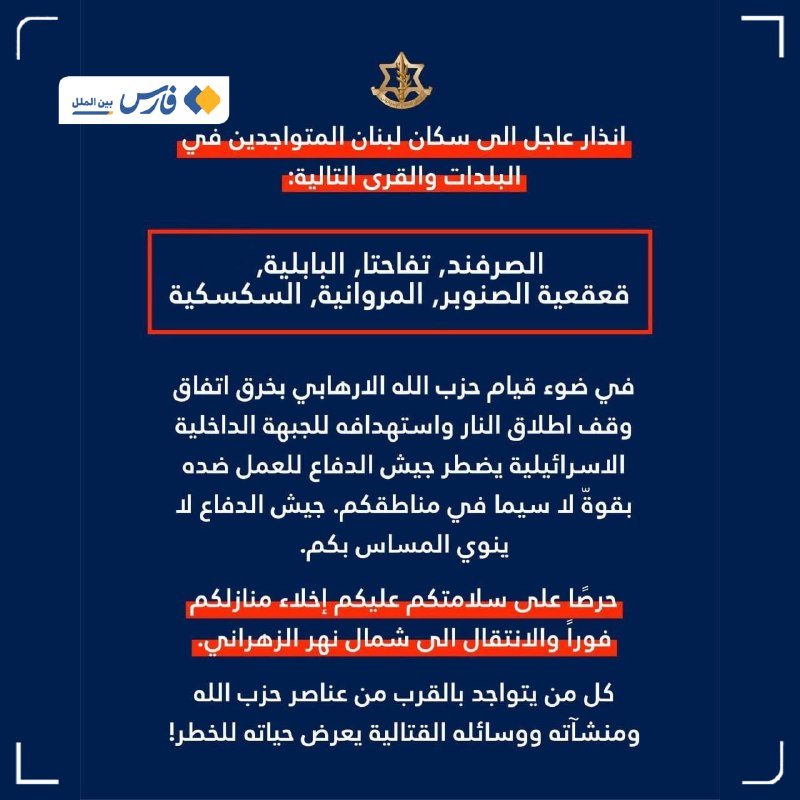
The Israeli Defence Forces Arabic-language spokesperson on 1 June 2026 issued evacuation orders targeting residents of Beirut's southern suburbs — the Dahieh district — instructing civilians to leave within hours of the announcement. The IDF framed the directive as a humanitarian measure to protect non-combatants ahead of planned military operations. Hezbollah, whose political and military infrastructure is concentrated in the district, had not issued a formal response at time of publication.
The order revives a scenario that Israeli officials have signalled repeatedly since the Gaza war expanded: direct confrontation with Hezbollah-held territory in Lebanon, on terms set by Israel rather than by ceasefire frameworks. What the IDF presented as a protective measure is, in practice, a countdown — the logic being that any civilian who fails to leave becomes, by the military's own definition, part of the operational calculus.
The Order and Its Immediate Context
The IDF Arabic spokesperson's announcement, issued at approximately 13:55 UTC on 1 June 2026, named the Dahieh — a densely populated expanse of southern Beirut that has served as Hezbollah's primary urban base for decades — as the target zone. The statement gave residents a narrow window to evacuate before Israeli air or artillery operations commenced. The IDF described the district as a military stronghold and said all individuals present in the area were to be considered combatants unless they departed.
The order came days after a series of Israeli strikes inside Lebanon's eastern Beqaa valley, which killed at least one person and destroyed what the IDF described as a weapons-storage facility. Those strikes were themselves framed as responses to Hezbollah movements along the ceasefire line — a line established under the November 2025 agreement that halted open warfare between the two sides but left fundamental disputes about enforcement unresolved. Cross-border incidents have persisted throughout 2026, with both sides periodically accusing the other of violations, though neither has formally withdrawn from the ceasefire's terms.
The Dahieh has been subjected to Israeli evacuation warnings before. In October 2024 and again in early 2025, the IDF Arabic spokesperson issued similar directives ahead of operations that were later carried out. On both occasions, large-scale civilian displacement followed. The current order is the most direct targeting of the district in the post-ceasefire period and arrives against a backdrop of sustained Israeli operations along multiple fronts — in Gaza, in the West Bank, and now in Lebanon — which critics say have stretched the concept of evacuation warnings from a genuine protective measure into a routine instrument of urban warfare.
Hezbollah's Position and Iranian Alignment
Hezbollah has not publicly commented on the IDF order as of publication. The group, which fought a 14-month grinding exchange with Israel that ended in the November ceasefire, retains its military infrastructure in the Dahieh and has consistently maintained that it will not disarm as a condition of any political settlement. Tehran, Hezbollah's primary patron, has issued no direct statement on the current evacuation order, though Iranian state media covered the announcement and described it as part of an Israeli campaign to destabilise Lebanon.
The alignment matters. Hezbollah's military posture is not set in Beirut alone — it is calibrated in consultation with Iran's Revolutionary Guard Quds Force, which coordinates across the resistance axis that includes Hamas, Houthi forces in Yemen, and allied militias in Iraq and Syria. Any decision to escalate, hold fire, or absorb the Israeli warning will reflect a calculation made in Tehran as much as in the Dahieh. That structural dependency is what makes the current moment acutely sensitive: a misread of intent, on either side, could trigger a response chain that the ceasefire was designed to prevent.
Structural Frame: Evacuation Orders as Instruments of Control
The IDF's use of evacuation warnings is not new, but its normalisation — across Gaza, the West Bank, and now Lebanon — reflects a broader shift in how the Israeli military conducts urban warfare. The theoretical purpose is sound: warn civilians, give them time to leave, strike military targets with reduced civilian harm. The practical effect is different. Evacuation orders create a controlled information environment. The IDF declares an area a military zone, the civilians leave, and the subsequent strike — whatever its target — lands on ground where non-combatants are, by design, absent.
That sequence, repeated across multiple cycles, has a cumulative logic. Each evacuation empties a district further. Each emptied district becomes easier to strike. Each strike reinforces the message that staying is dangerous. The process is gradual enough that no single order constitutes a red line — and persistent enough that the cumulative displacement reshapes the urban and social geography of the targeted area in ways that go beyond anything the ceasefire addressed.
What the IDF calls protecting civilians, critics describe as manufactured depopulation. The evidence for the latter reading is not conclusive, but the pattern — repeated across multiple wars and multiple administrations — is difficult to dismiss as coincidental.
Stakes and Forward View
The immediate risk is escalation. Hezbollah has absorbed previous strikes without triggering a full rupture of the ceasefire. Whether it does so this time depends partly on the nature of what the IDF subsequently strikes — and on whether civilian harm, however technically avoidable, follows from the operation. Both sides have incentive to avoid a renewed full-scale war, which neither could sustain without significant cost. But the ceasefire was always a pause, not a resolution, and this evacuation order is the clearest signal yet that Israel intends to act on its own timeline rather than wait for diplomatic frameworks to produce a settlement.
The longer-term stakes concern the character of the ceasefire itself. The November 2025 agreement was negotiated under significant US and French pressure and was always fragile. It did not resolve the fundamental question of whether Hezbollah's military infrastructure would remain in place in southern Lebanon — the one issue that both Israel and Lebanon's government identified as the primary source of future conflict. An Israeli assault on the Dahieh, whether limited or extended, would answer that question by default, in Israel's favour, and without any political process that might have produced a different outcome.
What remains uncertain is whether the evacuation order is a preliminary to a specific strike — targeting a named facility or individual — or a broader signal that the IDF intends to degrade Hezbollah's presence in the Dahieh systematically over coming weeks. The sources do not specify. What is clear is that the order carries its own weight: a warning issued and not acted upon is still a demonstration of reach, and of willingness to use it.
This desk noted that Monexus's coverage of the IDF order led with the IDF's framing as reported by Middle East Eye, following the standard practice of leading with the official source of a military action. Wire coverage from the same hour by Reuters and AP carried similar language. The framing most differ was on Iranian state media, which contextualised the order within a wider Israeli regional campaign rather than treating it as a discrete Lebanese event.
Wire provenance
This editorial synthesis draws on the following public wire/social posts:
- https://t.me/GeoPWatch
- https://t.me/Middle_East_Spectator
- https://en.wikipedia.org/wiki/Dahieh
- https://en.wikipedia.org/wiki/2025_Lebanon_ceasefire