Trump Intervention Postpones Israeli Strike on Beirut Suburbs
Israel announced planned strikes on southern Beirut suburbs on 1 June 2026; a more-than-hour-long call between Donald Trump and Benjamin Netanyahu caused their postponement, raising questions about the durability of any de-escalation and the nature of Washington's still-formidable leverage over Israeli military decisions.
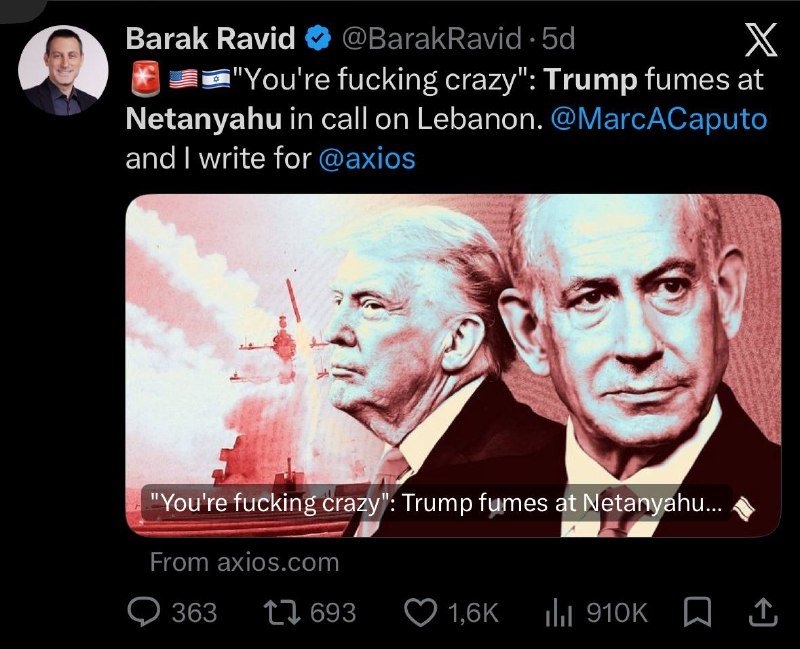
Israel postponed a planned strike on the southern suburbs of Beirut on 1 June 2026, hours after announcing it, following a phone call that lasted more than an hour between United States President Donald Trump and Israeli Prime Minister Benjamin Netanyahu. The sequence — strike announced, diplomatic intervention, strike shelved — landed against the backdrop of the G7 summit in Canada, a timing that appeared more coincidental than choreographed. The immediate military flashpoint passed, but the underlying tensions that produced it remain intact.
The episode is notable not for its resolution but for the mechanism that produced it. Trump's demonstrated ability to move Netanyahu on a live military decision is not new — it happened in the first Trump term, and Netanyahu acknowledged it openly. What the 1 June call adds is a data point for assessing whether that leverage has degraded, expanded, or simply migrated into a different register. The answer is not yet clear, but the episode rewards close attention to what was said publicly and what the structure of the intervention reveals about the US-Israel relationship in its current form.
Immediate context: a strike announced, then paused
Israeli military and political officials had signalled imminent action against the southern suburbs of Beirut — an area controlled by Hezbollah and a recurring target of Israeli operations since the October 2023 escalation. The announcement itself was not unusual; Israeli officials routinely telegraph military timelines, sometimes as pressure, sometimes as preparation. What was different on 1 June was the speed with which the timeline reversed.
According to IntelSlava, an open-source intelligence outlet tracking Middle East military developments, Israel postponed the planned strike following the phone call with Trump. The call had begun as an emergency consultation and extended well beyond the length of a courtesy check-in. According to Amit Segal, an Israeli political correspondent with consistent access to government sources, the conversation between Trump and Netanyahu lasted more than an hour. That duration matters: standard diplomatic calls between allies rarely run that long unless substance — not choreography — is driving them.
What the call reveals about US leverage
Trump framed the outcome in characteristically transactional terms. Speaking after the call, he described it as fruitful and said Netanyahu had given assurances that no Israeli forces would enter Beirut and that units already in transit had been recalled. The public statement presented the result as voluntary Israeli restraint — a concession made by a sovereign government to a friendly interlocutor.
That framing obscures what the call's length and urgency suggest: genuine pressure applied, or at minimum, a genuine risk of consequences being spelled out. Trump administration officials have signalled consistently that trade policy — specifically the tariff regime — functions as a lever across a wider range of foreign-policy conversations than any previous White House has openly acknowledged. Whether that lever was explicitly deployed on 1 June cannot be confirmed from public sources, but the call's extended duration and the abruptness of the Israeli reversal make a bare request for de-escalation an insufficient explanation.
The question of whether US leverage over Israeli military decisions has fundamentally changed since 2019 or 2020 — when Netanyahu's close relationship with Trump was a defining feature of the bilateral relationship — is worth examining directly. The prevailing assumption in some policy circles is that it has. The record suggests otherwise, at least in crisis moments when Washington chooses to engage.
Structural frame: managing a client state's worst impulses
The pattern here is legible. A regional ally with a stated security doctrine that permits expansive use of force announces a military action. The United States, which has provided the material and diplomatic cover that makes such actions sustainable, intervenes to delay or reshape that action when the costs of proceeding appear to outweigh the benefits — at that particular moment, for that particular audience, against that particular backdrop of concurrent diplomatic events.
This is not a new structure. It has characterised US relationships with allies across the Middle East for decades. The frequency with which it produces restraint rather than continuation is, however, variable — and that variability is itself a policy instrument. When restraint occurs, it is cited as evidence of American influence. When it does not, it is typically explained away as a function of irreducible security logic on the ground.
What is worth noting is the gap between the public framing — Trump's post-call characterisation of a voluntary Israeli concession — and the structural reality: the US president intervened to prevent a strike on a foreign capital. That intervention produced a result. Whether the result is durable is a separate question, and one the available sources do not resolve.
Stakes and forward view
The stakes of the postponed strike, had it proceeded, were not limited to Beirut. A strike on the southern suburbs of Lebanon's capital, following the destruction already visited on Gaza and the exchanges of fire along the Israel-Lebanon border, would have carried a meaningful risk of escalation into a broader regional conflict — one with direct Iranian involvement a live contingency in every war-gaming scenario produced by Western defence analysts over the past two years.
Postponement does not remove that risk. It defers it, and it puts the question of whether and when the strike proceeds back into the hands of Israeli decision-makers who, absent continued external pressure, have shown limited inclination to exercise patience on their own. The southern suburbs of Beirut remain a named target. Hezbollah's posture along the border remains unchanged. The diplomatic architecture that might provide a genuine off-ramp — a ceasefire framework with enforceable terms, a regional security arrangement with credible guarantors — remains, as of publication, absent from public discussion.
The call on 1 June 2026 bought time. Whether the G7 summit produced any follow-on commitments, whether the Trump administration's pressure reflects a consistent policy or an episodic preference, and whether Israel uses the pause to recalculate or to regroup for a later operation are questions the sources consulted for this article do not answer. Monexus will continue to monitor developments in the Israel-Lebanon theatre as they unfold.
This publication covered the postponement as a concrete diplomatic result; the wire services led with the call itself and the Trump-Netanyahu relationship framing. The distinction matters because a call is not an outcome, and the sources consulted suggest the outcome — at least for now — is real, even if its durability remains unproven.
Wire provenance
This editorial synthesis draws on the following public wire/social posts:
- https://t.me/alalamarabic/124389
- https://t.me/alalamarabic/124388
- https://t.me/amitsegal/5821
- https://t.me/intelslava/29342
- https://t.me/osintlive/48210