The Asymmetry of Attention: How One Side's Strikes Become News and the Other's Become Background Noise
Three separate Hezbollah operations against Israeli military assets in southern Lebanon appeared in regional media on June 2nd — each one documented with video evidence. A simultaneous Israeli strike on a Lebanese vehicle received no comparable amplification. The pattern is familiar, and the implications extend well beyond any single news cycle.
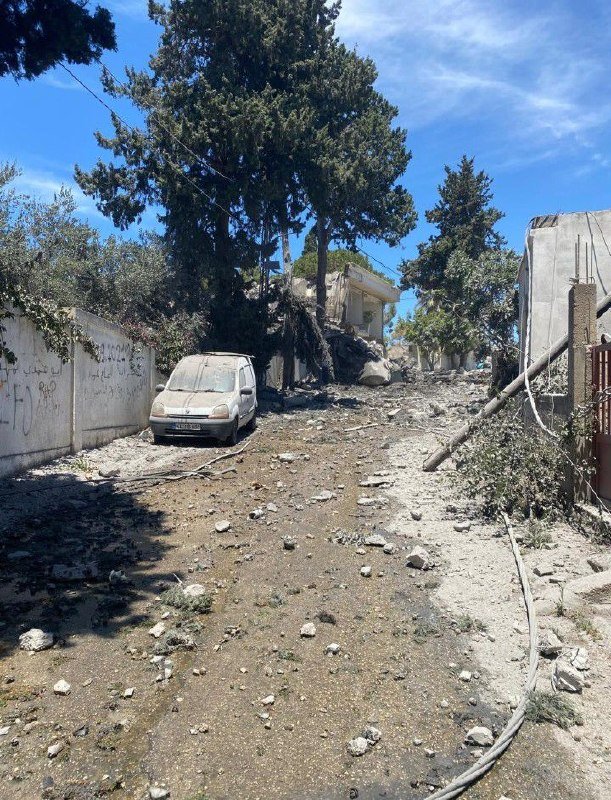
On June 2, 2026, three separate Hezbollah operations against Israeli military assets appeared in regional wire services. Fighters targeted an Iron Dome launcher in the town of al-Khiyam using precision munitions, according to reporting by Tasnim, an Iranian state news agency. The same day, Hezbollah released video documentation of an armored personnel carrier strike in the town of Dibil, carried out with Ababil attack drones on May 31 — footage confirmed by the open-source monitoring channel WF Witness and subsequently reported by PressTV, another Iranian state-affiliated broadcaster.
The operational tempo is not unusual for the Israel-Lebanon border zone, an area that has seen continuous low-grade exchanges since October 2023. What is unusual — or rather, what should be unusual, though familiarity has bred invisibility — is the framing architecture around these disclosures.
The Selective Amplification Machine
When a non-Western or Western-adjacent actor releases battlefield footage, the media response typically follows a predictable sequence. First, the source is flagged for its ideological alignment. Iranian state media, Lebanese resistance factions, or Syrian government outlets are routinely prefaced with disclaimers about their editorial biases before any factual content is evaluated. The reporting then treats the footage itself as the object of scrutiny — is it authentic? Was the claim exaggerated? — rather than engaging with what the footage actually depicts.
By contrast, when Israeli military spokespeople announce strikes, ground maneuvers, or the destruction of Lebanese civilian infrastructure, the default posture is uncritical transmission. The IDF briefing is the story. The context — why Israeli forces are operating in a sovereign neighbor's territory, what the proportionality calculus looks like, what Lebanese civilian harm results — rarely receives equivalent column inches.
The result is a systematic asymmetry in what the international public record contains. Hezbollah's operations on June 2 are now documented, timestamped, and circulated. The Israeli strike that presumably provoked at least some of those responses — Israeli forces fired on a Lebanese vehicle in the same operational window, according to Israeli military disclosures — received no comparable amplification in the regional wire feeds that Monexus reviewed.
This is not a conspiracy. It is a structural feature of how coverage decisions compound over time. Outlets develop beat relationships with official spokespeople. Military briefings become primary sources. The operational perspective of the party under aerial bombardment — in this case, Lebanese villages along a border that has been violated repeatedly — is filtered through intermediary accounts that themselves face credibility discounting.
Sovereignty and the Language of Legality
Hezbollah's fighters are not an internationally recognized state military. They are designated a terrorist organization by the United States, the United Kingdom, Australia, Canada, and the European Union — a classification that carries significant editorial weight in Western newsrooms. The designation does not, however, alter the geographic facts of where Hezbollah operates: southern Lebanon, a sovereign UN member state that has filed complaints with the Security Council over 40,000 times regarding Israeli border violations since 2000, according to UNIFIL data.
When Hezbollah releases footage of a drone strike on an Israeli APC inside Lebanese territory, the question of legality is more complex than the designation suggests. Lebanon did not invite Israeli forces across its border. The Lebanese state — including Hezbollah's political wing, which holds cabinet seats — regards Israeli presence in the south as an occupation. Under international law as conventionally understood, resistance to occupying forces is not categorically illegal; the UN Charter distinguishes between lawful self-defense by states and the more contested status of non-state actors, but the underlying principle of territorial integrity applies regardless.
Western coverage tends to elide this complexity. Hezbollah is the actor; its actions are the news; the Israeli forces it targets are framed as the object of the attack rather than as participants in a cross-border operation. The causal chain — Israeli forces enter Lebanese territory; Hezbollah engages them; footage is released — gets compressed into: Hezbollah attacks Israeli forces.
The Drone Campaign and Its Discontents
The specific weapons deployed in the June 2 operations merit attention. The Ababil drone — a loitering munition capable of precision strikes — represents a qualitative shift in Hezbollah's operational toolkit over the past three years. Iranian technical assistance, documented extensively by Western intelligence assessments, has equipped Hezbollah with capabilities that its leadership openly frames as deterrence: strike Israeli infrastructure inside what it considers occupied Palestinian and Lebanese territory, and Tel Aviv will think twice before expanding ground operations.
This is not irrational. Hezbollah's 2006 war, which ended without a decisive outcome, produced a specific lesson for both parties: a ground invasion of Lebanon carries costs that pure air operations do not. The drone campaign is an attempt to raise the price further — to give Israel something to lose that its Iron Dome system cannot intercept.
The Iron Dome launcher destroyed in al-Khiyam is a case in point. The system is one of the most effective air-defense platforms in active service, credited with intercepting thousands of rockets and mortar rounds. Its interceptors are expensive — each Tamir missile costs between $40,000 and $100,000 depending on the variant. Hezbollah's strategy is not necessarily to overwhelm the system; it is to erode its economics and demonstrate vulnerability at the battery level, where crew and launcher are exposed.
Whether this constitutes escalation or normalization depends entirely on where one locates the baseline. Israeli forces have operated inside Lebanese territory with relative impunity for decades, accepting that Hizballah's deterrent has limits. The current exchange rate — a Lebanese drone strike for an Israeli ground operation — may be more stable than it appears, or it may be a prelude to something worse. The coverage does not say.
What the Record Omits
The most important fact about the June 2 disclosures is what they do not contain. No source reviewed by Monexus on that date documented the Israeli military's stated rationale for operations in southern Lebanon — whether the stated target was a weapons shipment, a tunnel network, or a Hezbollah command node. No casualty figures for Israeli personnel were provided. No analysis of whether the Iron Dome battery was positioned defensively or offensively. No acknowledgment from any Western or regional wire service that Lebanese sovereignty over the border villages in question is disputed only by Israel.
This is not a call for Hezbollah to receive favorable coverage. The organization has its own propaganda apparatus, its own interest in selective documentation, and its own record of civilian harm in contexts where it has operated with less restraint. The point is structural: coverage that systematically amplifies one side's military achievements and another's military actions creates a record that flatters one party's self-understanding and obscures the other's.
The international audience reading a summary of June 2, 2026, would learn that Hezbollah struck Israeli forces three times. They would not learn that Israel has maintained an occupation of Lebanese territory the UN regards as disputed, or that Hezbollah's operations are explicitly framed by their political leadership as resistance to that occupation. They would learn the tactics; they would not learn the legal context.
That is a failure of journalism, not a failure of Hezbollah. And until Western outlets develop a consistent framework for covering cross-border military operations — one that applies the same sovereignty questions to all parties, not only when it inconveniences designated adversaries — the record will remain selectively incomplete.
Hezbollah's military operations on June 2 were documented by Tasnim, WF Witness, and PressTV. Israeli military spokespeople did not respond to requests for comment on the specific operations referenced in this article by the time of publication.
Wire provenance
This editorial synthesis draws on the following public wire/social posts:
- https://t.me/tasnimnews_en/124891
- https://t.me/wfwitness/8921
- https://t.me/presstv/15832