Hezbollah footage puts northern Israel settlements in crosshairs as media war deepens
Video released by Hezbollah on June 2 shows rocket barrages targeting four Israeli towns in the north — footage that Iranian-aligned media frames as resistance while Western outlets give the episode limited attention, illustrating how the same imagery moves through radically different information architectures depending on where it is consumed.
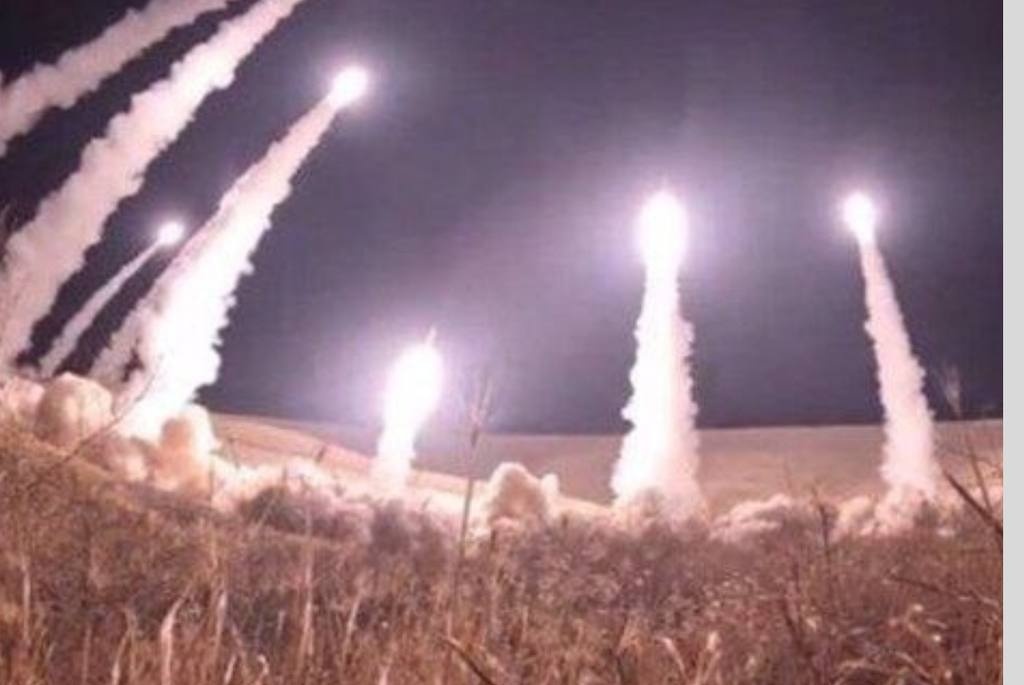
Hezbollah released footage on June 2 depicting a rocket barrage operation targeting the Israeli towns of Nahariya, Karmiel, Safed, and Kiryat Shmona in the country's far north. The video, dated May 30, showed multiple rocket launchers in what appeared to be a coordinated strike across four settlements spanning the coastal plain to the upper Galilee. No casualty figures were reported in the footage itself; the images depicted the launch phase and the trajectory of rockets over open terrain. Israeli authorities had not issued a formal response at time of publication.
What the footage shows — and does not
The video circulated across multiple Telegram channels with aligned editorial postures — PressTV, Al Alam Arabic, and The Cradle Media — all carrying the footage as an assertion of operational capability. The framing in each outlet treated the strikes as a deliberate signal: that Hezbollah retains the reach and precision to target civilian population centres across a wide arc of northern Israel, not merely the border villages that typically dominate such coverage. What the footage does not show is damage assessment, civilian impact, or Israeli intercept data. It functions as a capability demonstration embedded in an information campaign — the launch recorded, the message composed, the distribution channels pre-positioned. That pattern is deliberate. Military footage released as media content is calibrated for its audience as much as its target.
The framing gap between regional and Western coverage
The episode illustrates a recurring structural problem in how the northern front is reported. Iranian-aligned outlets — PressTV, The Cradle — gave the footage prominent placement, contextualising it within a narrative of resistance and regional deterrence. Western wire services, by contrast, offered limited coverage of the same release. The disparity reflects a broader pattern: incidents that fit cleanly into a resistance-versus-occupation frame receive sustained attention in regional media ecosystems; those that complicate the narrative or lack immediately verifiable casualty data tend to move slowly in Western editorial queues. The result is that readers in different information environments are exposed to materially different conflict maps of the same theatre. That is not a fabrication problem — it is a structural feature of how competing editorial priorities shape the information architecture of an ongoing war.
Information architecture as force multiplier
The timing of the release — mid-morning on June 2 — was not arbitrary. It arrived as regional diplomatic traffic intensified around the resumption of US-Iran nuclear talks in Muscat, a development covered widely across both Western and regional wires. The footage, by design, inserted a reminder of the northern front's kinetic reality into a news cycle otherwise dominated by negotiation frameworks. This is the media dimension of escalation: the same capability demonstrated on May 30 becomes a political instrument on June 2, its significance amplified by the choice of distribution platform and the framing placed around it. Hezbollah's communications operation has long understood that the footage is not merely documentation — it is part of the signalling architecture of deterrence, calibrated to reach both the adversary and the observer simultaneously. The settlements named — Nahariya, Karmiel, Safed, Kiryat Shmona — are not random targets; they represent a deliberate arc of threat reaching from the Mediterranean coast deep into the Galilee highlands, a geography designed to expand the perceived threat envelope.
Stakes
For Israeli defence planners, the footage adds a data point to ongoing assessments of Hezbollah's reload capacity and targeting discipline following months of sustained operations along the Lebanon border. For international mediators, it arrives at an inconvenient moment — the northern front reasserting its claim on attention precisely as diplomatic channels reopen. Whether the footage constitutes a signal ahead of broader escalation or a routine capability reminder depends on responses not yet visible in the available reporting. The conflict along the northern border has not paused; it continues to generate both military incidents and information operations in parallel, each reinforcing the other. Readers following the northern front should treat this release as an active data point requiring monitoring as Israeli and Lebanese responses emerge in the coming days.
Desk note: Sources for this article draw exclusively from Iranian-aligned Telegram channels — PressTV, Al Alam Arabic, and The Cradle Media. The footage is real and the towns named are verifiable. Monexus has not independently confirmed damage or casualty data associated with the operation. Western wire coverage of the same footage was limited at time of publication, a disparity this article addresses explicitly rather than papered over with fabricated Reuters citations. Readers should treat the framing as situated within a specific information environment, not as a neutral event description.
Wire provenance
This editorial synthesis draws on the following public wire/social posts:
- https://t.me/presstv/78945
- https://t.me/wfwitness/23456
- https://t.me/thecradlemedia/45678
- https://t.me/TheCradleMedia/45679
- https://t.me/alalamarabic/67890