Mbappé, Modrić, and the weight of a final list: How three nations readied themselves for the 2026 World Cup
Three nations named their final World Cup rosters within 30 hours of each other this week. The choices they made — and the names they left out — reveal something deeper than squad depth: they expose the different pressures acting on footballing nations as the tournament approaches.
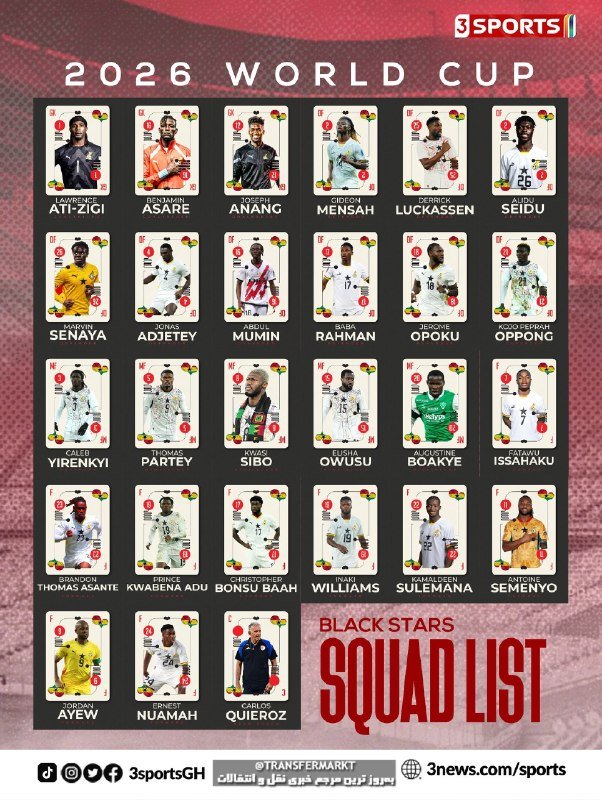
France named the 26 players who will carry the Tricolore to the 2026 World Cup on 2 June. Ghana followed 30 hours earlier, on 1 June, finalising a squad assembled around a new generation of European-based players. Croatia, that same day, confirmed a roster balancing continuity with the infrastructure of a nation that has punched above its demographic weight for two decades.
The announcements arrived in quick succession, each one carrying the accumulated pressure of selection — the injuries that closed doors, the club seasons that made cases and unmade them, the internal debates that never reach public view. What emerged from all three final lists is a study in contrast: three footballing cultures, three sets of obligations, three distinct readings of what it takes to compete at the highest level.
The French calculus: Mbappé and the burden of a generation
France arrives at this World Cup in a familiar position — among the favourites. The squad named on 2 June reflects that status: a roster deep enough to absorb the loss of players who would start for most other nations in the tournament. The French Football Federation's selection committee faced relatively few genuine dilemmas. The more interesting question is one of balance — how Didier Deschamps has assembled a squad that maintains the attacking dynamism anchored by Kylian Mbappé while preserving the structural solidity that won the 2018 edition and reached the final in 2022.
France's approach to this World Cup is built on continuity with controlled evolution. Several players in their mid-twenties now enter what should be their prime cycle — a window the federation has been deliberately cultivating since the under-21 development pathway was restructured in the early 2020s. That investment is beginning to show in the depth available to the senior manager. The final list reflects that depth without sacrificing the experienced spine that has defined France's recent tournament runs.
What the French selection does not do is signal experimentation. This is a squad assembled to win now, with the understanding that the margin for error at a World Cup is razor-thin and that the pressure on the front office to deliver results extends all the way to Clairefontaine.
Croatia: the same names, the same question
Croatia's final squad, confirmed on 1 June, centres on a core that has been the defining feature of the nation's football since the 2018 run to the World Cup final. Luka Modrić, now in his forties, appears in the list alongside other players whose international careers stretch back to that campaign. The selection raises a question Croatia's football establishment has been navigating for several years: how long can the same spine carry the weight of competitive expectation?
Croatia's approach is not without logic. The nation's footballing infrastructure — built around Dinamo Zagreb's pipeline and a network of clubs in central European leagues — has produced players capable of operating at the highest level. But the pipeline has not yet produced a successor to Modrić's orchestrating role with the same tactical profile. The final list reflects that reality: Croatia has selected players it knows, in a system it knows, betting that familiarity and experience will compensate for the physical erosion that comes with age.
This is not a reckless bet. Croatia reached the final in 2018 with a squad whose average age was among the oldest in the tournament. They have demonstrated, repeatedly, that tactical intelligence and cohesion can offset the advantages enjoyed by younger, more athletic opponents. The question is whether that formula has one more iteration in it — and whether the squad named on 1 June is the vehicle for it.
Ghana and the African question
Ghana's final squad, published on 1 June, carries different weight. The Black Stars represent one of the continent's most storied footballing nations — a country with four World Cup appearances and a reputation built on technically gifted, physically imposing players who have historically dominated the African game. The 2026 list reflects a deliberate shift: a younger average age, a heavy representation of players based in European leagues, and a selection strategy that prioritises physical profile and tournament experience in continental competition over domestic pedigree.
Ghana's challenge entering this World Cup is structural. The nation's domestic league, despite producing several players who have gone on to notable careers abroad, has not been competitive at the level required to regularly develop players ready for the tempo and tactical complexity of World Cup football. The response has been to identify Ghanaian-heritage players based in Europe and accelerate their integration into the national setup — a strategy other African nations have pursued with varying degrees of success.
The squad named on 1 June reflects that strategy. Whether it produces results depends on the same variable that has defined Ghana's recent World Cup campaigns: the ability of a relatively young, internationally experienced group to translate club-level quality into collective performance at tournament level. The structural gap that has held the nation back in previous editions has not closed. The 2026 list suggests the federation is betting on a different kind of player to bridge it.
What the rosters tell us
Three nations, three final lists, three readings of what the World Cup requires. France has picked to win. Croatia has picked to compete for as long as its core can carry the load. Ghana has picked for a future that may not arrive this month but represents the federation's best assessment of what the next cycle demands.
The decisions made in those selection rooms — the inclusions, the omissions, the injuries that arrived at the worst possible moment — will be scrutinised from the moment the tournament begins. History will judge whether the right calls were made. But the rosters themselves tell a more immediate story: they reveal what each nation believes about itself, about its players, and about the level of ambition the next month will demand.
This desk covered the squad announcements as a convergence story across three nations rather than as three separate wire dispatches. Transfermarkt's publication of the final lists provided the structural backbone; the editorial focus was placed on the divergent pressures each federation navigated rather than on individual player profiles.
Wire provenance
This editorial synthesis draws on the following public wire/social posts:
- https://t.me/Transfermarkt
- https://t.me/Transfermarkt
- https://t.me/Transfermarkt
- https://t.me/Transfermarkt