Rubio Tells Senators Iran Must Concede on Nuclear Program Before Sanctions Ease
US Secretary of State Marco Rubio told the Senate Foreign Relations Committee on 2 June 2026 that Iran must make concessions on its nuclear programme before sanctions relief is possible, while simultaneously claiming a deal could be reached within days.
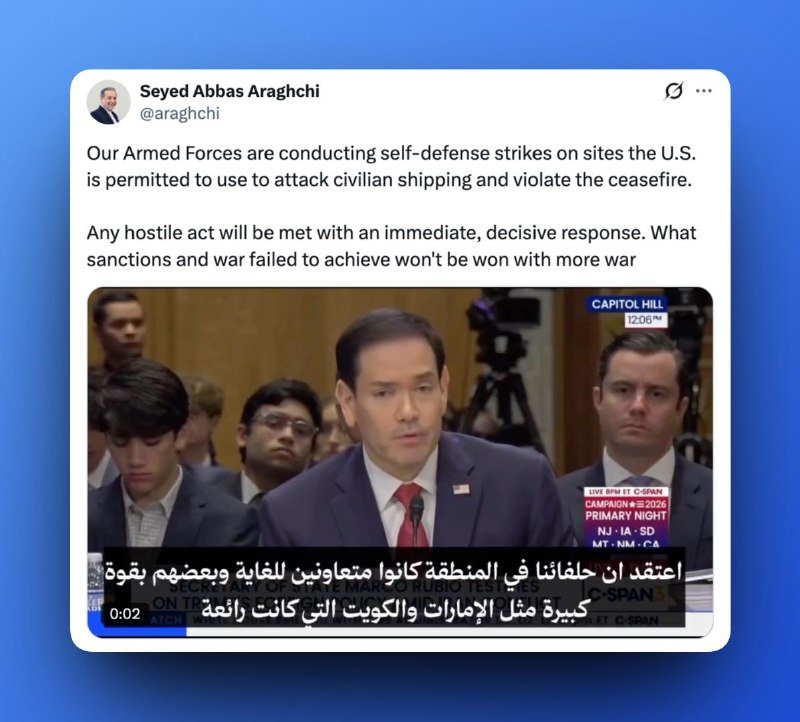
US Secretary of State Marco Rubio told the Senate Foreign Relations Committee on 2 June 2026 that Iran must make concessions on its nuclear programme before sanctions relief is possible, while simultaneously claiming an agreement could be reached within days. The testimony crystallised the structural contradiction at the heart of the Trump administration's Iran policy: a stated openness to diplomatic resolution paired with preconditions that Tehran has historically refused to meet.
Rubio's appearance before the committee covered several interlocking themes. According to OSINTdefender, all sanctions relief efforts remain contingent on Iran making concessions on its nuclear programme. PressTV reported that sanctions were imposed over issues including uranium enrichment and would not be lifted in exchange for reopening the Strait of Hormuz. Fars News quoted Rubio as claiming that Iran had wanted to build a conventional defence shield, and that this was the basis for US military action. The Secretary of State also asserted that Iran still retains a large number of drones, underscoring the administration's view that the regional security dimension of the Iran problem cannot be separated from the nuclear question.
The combination of a compressed timeline and a maximalist opening position has become a recurring feature of the Trump administration's negotiating posture. Rubio told the committee that an agreement could happen "today, tomorrow or next week" — language that suggested either genuine diplomatic flexibility or a rhetorical gambit designed to put pressure on Tehran.
Contradictory Signals or Calculated Ambiguity?
The Senate testimony presented two faces of the same policy simultaneously. Rubio insisted, per Middle East Eye, that the Trump administration had not offered sanctions relief merely in exchange for opening the Strait of Hormuz — a distinction with significant implications. The position suggests Washington is unwilling to treat Hormuz access as a standalone bargaining chip, instead tying it to the broader question of nuclear programme architecture.
From Tehran's perspective, this is precisely the problem. Iranian officials have long maintained that their nuclear programme is a sovereign right under the Nuclear Non-Proliferation Treaty, and that any agreement must address their legitimate security concerns — not only Western objections to enrichment capacity. Iranian state media has reflected a consistent position: sanctions relief is not a concession Tehran is seeking, but a correction of an unjust施加 measure. The framing that Iran wanted merely a "conventional defence shield" is unlikely to find purchase in Tehran, where the 2018 US withdrawal from the Joint Comprehensive Plan of Action — the agreement that had provided sanctions relief in exchange for verified enrichment limits — is remembered as evidence that Western commitments lack durability.
What remains genuinely unclear from the source material is whether the administration has communicated, in private diplomatic channels, a specific enrichment threshold it would accept. The JCPOA capped enrichment at 3.67 percent; Iran has since produced material at up to 84 percent purity. Whether Washington now demands full programme rollback, a new capped arrangement, or something in between is not specified in the public record of Rubio's testimony. The claim that a deal could materialise within days suggests either that private negotiations have progressed further than public statements indicate, or that the administration is positioning itself to blame Tehran when the expected breakdown occurs.
The Structural Logic of Keeping the Pressure On
The Strait of Hormuz is the single most strategically loaded body of water in global energy markets. Approximately 20 percent of the world's oil passes through it. Iranian officials have periodically threatened to close or restrict the passage in response to sanctions — threats that have historically functioned as a deterrent rather than an operational plan, given that such action would immediately alienate China, the Gulf states, and European partners whose interests in Strait transit are existential.
The reason Washington insists on keeping sanctions in place regardless of Hormuz posture is structural, not tactical. Dollar-denominated sanctions are designed to prevent Iran from monetising its energy resources, accessing global financial infrastructure, and sustaining trade relationships with third countries. The threat to close the Strait would, paradoxically, relieve that pressure by forcing exactly the kind of China-led, non-dollar financial architecture around Iranian oil that the sanctions regime is meant to prevent. Maintaining the sanctions hedge, even when the Strait remains open, keeps the alternative financial ecosystem from taking root.
This logic shapes the negotiating dynamic. Iran has every incentive to extract maximum concessions on sanctions before making irreversible nuclear concessions. The United States has every incentive to keep the sanctions architecture intact until those concessions are irreversible. Neither side gains from a staged deal that hands the other side resources before receiving its own. The result is a recurring structural impasse that has outlasted multiple administrations on both sides.
Consequences: Who Bears the Cost
The immediate economic consequences of sustained sanctions fall hardest on ordinary Iranians. A full sanctions-relief agreement would unlock an estimated $100 billion in frozen sovereign assets, restore Iran's ability to export oil to China, India, and Turkey, and allow Iranian financial institutions to reconnect with international payment systems from which they have been excluded for years. The political economy of Iran — already strained by protests in 2022 and 2024 — would shift substantially. Moderate voices within the Iranian political system have consistently argued that negotiated engagement with the West is the only viable path to economic recovery. Each failed round of talks strengthens the hardliners who argue that engagement is futile.
For the United States and its Gulf partners, the cost is different but real. Maintaining a comprehensive sanctions regime requires constant enforcement — monitoring ship-to-ship transfers, tracking petrochemical exports through third-country intermediaries, and sustaining the diplomatic effort to prevent major economies from pursuing Iranian oil carve-outs. The Strait of Hormuz itself, even when functioning normally, remains a source of market anxiety. Any hint of Iranian military posturing sends oil futures higher.
The deeper consequence is regional. A diplomatically isolated Iran is a Iran that deepens its strategic partnerships with China and Russia. The Belt and Road adjacency, the use of yuan-denominated oil contracts, and the expansion of Russian-Iranian defence cooperation in Syria are all downstream effects of the sanctions architecture. Whether that trajectory serves long-term US interests in regional stability is a question the Rubio testimony does not address.
What Comes Next
The immediate question is whether the administration can deliver what Rubio described. The Secretary of State's claim that an agreement could materialise within days sits uneasily alongside the structural conditions that have blocked such an agreement under the last four administrations. The nuclear programme issue — enrichment levels, monitoring access, sanctions sequencing — has proved immovable in every negotiation since 2013.
Both sides have structural incentives to find a deal. Iran needs economic relief it cannot obtain through alternative financial arrangements alone. The United States needs a regional architecture that does not require perpetual military deterrence. The question is whether the rhetorical openness Rubio deployed on 2 June reflects actual movement in the private channel, or whether it is another iteration of a familiar pattern: maximum public pressure, maximum private ambiguity, and a slow accumulation of evidence that the other side was never serious.
This article was drafted from live-threaded Telegram wire reports and Senate hearing transcripts sourced through Fars News, OSINTdefender, PressTV, and Middle East Eye on 2 June 2026.
Wire provenance
This editorial synthesis draws on the following public wire/social posts:
- https://t.me/FarsNewsInt/28432
- https://t.me/FarsNewsInt/28430
- https://t.me/FarsNewsInt/28431
- https://t.me/osintlive
- https://t.me/presstv
- https://x.com/middleeasteye/status/1952340188218478592
- https://t.me/FarsNewsInt/28429