The Architecture of Cold: What Russia's Latest Infrastructure Barrage Reveals About Its War Strategy
NASA fire-detection data shows a concentrated Russian strike campaign against Ukrainian energy and logistics infrastructure overnight on June 2, 2026 — the pattern reveals more than the damage itself.
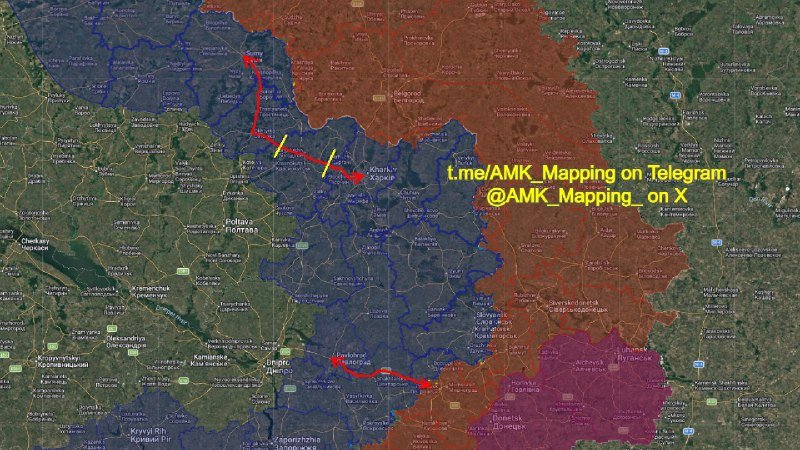
Something in the pattern is deliberate. Overnight on June 2, 2026, NASA FIRMS fire-detection telemetry — captured and geolocated by open-source analysts at AMK Mapping — registered thermal signatures consistent with large-scale burning at four separate sites across Kharkiv and Poltava oblasts. The targets were not random. A gas processing facility near Krasna Luka in Poltava. The Shebelinsky Gas Processing Plant in Andriivka, Kharkiv. A warehouse complex in the city of Merefa. An automotive accessories outlet in the Kharkiv town of Vasyshcheve. All struck with sufficient ordnance to generate multi-point thermal signatures visible from orbit. The weapons used — Iskander-M ballistic missiles and Tornado-S multiple-launch rocket systems — are not cheap, and they are not imprecise.
This matters because the coverage rarely pauses on what infrastructure strikes actually accomplish beyond the immediate damage. The framing defaults to casualty counts, diplomatic condemnations, and the rhythm of battlefield updates. But the deliberate targeting of energy processing and logistics nodes is a second layer of the conflict — one that operates on Ukrainian civilian infrastructure not as collateral but as the objective.
The Targeting Doctrine, Laid Bare
Russian military doctrine, as observable across this conflict, treats energy infrastructure as a pressure lever. Disable processing capacity, and you degrade the industrial base. Degrade logistics nodes, and you strain supply chains that keep front-line units supplied. The strikes documented on June 2 follow this logic without ambiguity. Two gas processing facilities hit in the same operational window. A warehouse complex — presumably holding goods inbound for either civilian or military distribution — reduced to burning inventory. This is not harassment. This is a systematic attempt to hollow out the energy backbone of a region that sits adjacent to active frontlines.
The open-source record makes the pattern legible. Each strike was registered by independent thermal monitoring. The coordinates are specific. The timing — pre-dawn, June 2 — suggests exploitation of reduced air defense responsiveness during overnight hours, a tactic consistent with documented Russian strike patterns throughout the conflict. What the sources do not confirm is the full extent of physical damage; satellite imagery or ground-level reporting would be needed to establish whether the facilities were destroyed or disrupted. That gap in the record is worth noting — the thermal signature tells you something is burning, not always how much is lost.
What Western Coverage Often Misses
The dominant wire framing of Russian strikes tends to treat each incident as a discrete event — a missile landed here, damage was reported there. That granular approach has value. But it can obscure the operational purpose behind the timing and selection of targets. A gas processing plant in Poltava and one in Kharkiv struck within the same window is not coincidence. It is a coordinated interdiction effort designed to overwhelm air defense coordination by presenting multiple simultaneous threats across a broad geographic area.
There is a tendency in some coverage to treat infrastructure strikes as morally straightforward but strategically opaque — everyone condemns them, fewer people analyze what they are meant to achieve. The reality is more tractable. Russia's targeting of energy infrastructure serves three documented purposes: it strains civilian morale by degrading heating, electricity, and cooking gas access; it raises the logistical cost of industrial production; and it forces Ukrainian air defense to distribute resources across a wider area, diluting coverage where Russian planners may subsequently attempt penetration strikes. Each strike, even one on a car accessories warehouse, serves at least one of these functions.
The sources do not give us the full picture of Ukrainian air defense performance overnight on June 2. Whether intercepts were attempted, how many incoming missiles were engaged, whether the strikes achieved their intended physical effect — that information is not in the record available to this publication. What is in the record is the pattern of selection, and that pattern has a logic worth naming plainly.
The Stakes Beyond the Headlines
Gazprom and affiliated Russian energy entities have been the subject of extensive Western sanctions since 2022. But the inverse dynamic — Russia's deliberate destruction of Ukrainian energy infrastructure — receives comparatively less analytical attention as a sanctions-evasion mechanism. A Ukrainian energy sector that cannot process or distribute gas is a sector that cannot generate export revenue. A destroyed processing facility is worth more to Moscow's long-term strategic calculus than the immediate military effect of the strike.
The longer-term goal appears to be economic attrition. Each facility damaged or destroyed is a reconstruction burden that Ukrainian budget resources — or Western aid — must eventually absorb. At current rates of attrition, the cumulative cost of rebuilding energy infrastructure rivals the cost of the military assistance packages that Western governments have debated so contentiously. This is not a coincidence of prioritization; it is a design feature.
What remains genuinely uncertain — and the sources do not resolve this — is whether the current strike intensity represents a temporary surge or a sustained escalation in Russian targeting of energy infrastructure. The data from June 2 shows one night. Broader trends would require a multi-week dataset. Without that, any assessment of whether this represents a doctrinal shift must be held lightly.
The pattern, however, is consistent enough to deserve more analytical weight than it typically receives. Four targets, one night, precision weapons pointed at energy and logistics nodes. The news cycle will move on. The plants will not repair themselves overnight.
Wire provenance
This editorial synthesis draws on the following public wire/social posts:
- https://t.me/AMK_Mapping/8471
- https://t.me/AMK_Mapping/8470
- https://t.me/AMK_Mapping/8469
- https://t.me/AMK_Mapping/8468