Russia Launches Sustained Ballistic Barrage Against Kyiv as City Enters Partial Blackout
Russian forces launched at least 17 ballistic missiles at Kyiv overnight on June 1, striking residential buildings in two districts and knocking parts of the capital into partial blackout — the most intensive single-night attack on the city since early 2026.
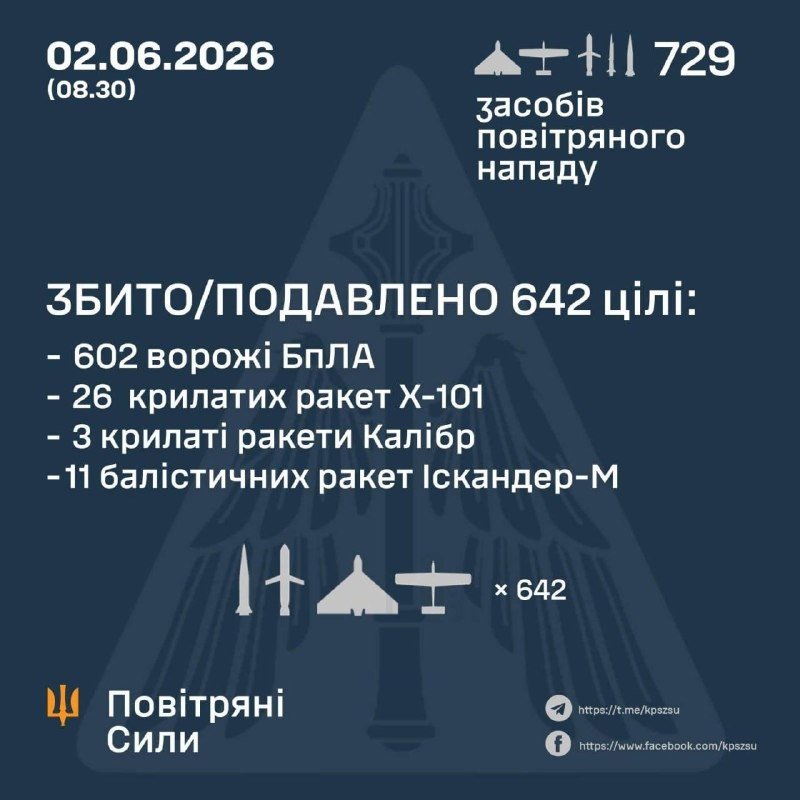
At least 17 ballistic missiles struck Kyiv overnight on June 1, puncturing apartment buildings in two districts and plunging parts of the Ukrainian capital into partial blackout, according to multiple Kyiv-based monitoring channels and emergency services reports confirmed by 23:51 UTC.
The attack — one of the most sustained single-night barrages against the city since Russia's full-scale invasion — targeted the Solomianskyi and Solomensky districts with impacts reported across residential blocks, triggering fires and emergency response operations. Fragments from intercepted warheads struck at least two multi-story buildings, with rescue workers deploying to both sites. Civilians in the capital were warned to seek shelter from approximately 23:14 UTC onward as the city registered its first ballistic descent alerts of the night.
The strikes sent the capital's power grid into emergency strain. By 23:26 UTC, reporting indicated that partial blackouts were underway across several districts, with downed power lines and grid damage consistent with direct hits on transformer infrastructure. Ukrainian air defense had engaged the incoming projectiles, but multiple missiles penetrated the city's layered air defense network — a pattern that has grown more frequent as Russia shifts to massed ballistic volleys designed to overwhelm intercept capacity.
The overnight assault came amid heightened Russian targeting of Ukrainian energy infrastructure. Since late 2025, Moscow has systematically struck substations, thermal power plants, and hydroelectric facilities across Kharkiv, Odesa, and Kyiv oblasts, seeking to degrade civilian morale and industrial capacity through winter-period grid disruption. June strikes, while less thermally punishing than winter attacks, continue the same logic: erode Ukrainian utility resilience, divert air defense resources, and demonstrate that no part of the country operates beyond Russian reach.
Ukrainian President Volodymyr Zelenskyy's office has yet to issue a formal post-strike briefing as of the time of this report; updates are expected throughout June 2. The Ukrainian General Staff confirmed ongoing air defense operations against multiple missile types but did not release casualty figures in its initial public communications. Regional emergency services reported that triage and evacuation operations were underway in affected districts.
Russia's Ministry of Defense had not published an official strike assessment as of 00:42 UTC on June 2. Russian state media have historically framed attacks on Ukrainian urban centers as precision strikes against military-adjacent infrastructure — a framing Kyiv and its Western partners have consistently rejected as falsified justification for attacks on civilian residential zones. Independent OSINT analysts tracking the strikes documented multiple impact sites in populated areas, including at least one building whose proximity to any military installation, per available satellite imagery, remains unclear.
The pattern of sustained overnight strikes against Kyiv marks a return to the city's most intensive attack cycles of late 2025, when waves of Kinzhal and Iskander ballistic missiles targeted the capital over consecutive nights. Western military analysts have attributed the tactical shift to Russia's attempt to keep Ukrainian air defense systems committed to capital defense, thereby reducing coverage over battlefield zones in Donetsk, Zaporizhzhia, and Kharkiv oblasts.
The strikes also arrive amid ongoing negotiations over continued Western military support. The United States has continued weapons transfers under existing authorisations, but future packages remain contingent on congressional appropriations debates. European partners — particularly Germany, France, and the United Kingdom — have pledged sustained support, though domestic political pressure in several donor states has introduced uncertainty into long-term supply guarantees. A sustained Russian strike campaign against Ukrainian cities serves, among other effects, to remind Western publics that the conflict has not settled into a stable stalemate, and that support decisions carry operational consequences for frontline cities.
Ukrainian energy officials have not disclosed estimated restoration timelines as of early June 2. Grid operators typically prioritise lines serving critical infrastructure — hospitals, command facilities, water pumping stations — before addressing residential distribution. The partial blackout in Kyiv mirrors similar grid incidents following strikes on Dnipro and Kharkiv in prior months, where repair timelines extended from days to over a week depending on transformer damage severity.
Residents in affected districts reported sheltering in basement corridors through the night, with emergency alert applications cycling repeated descent warnings as new volleys entered Ukrainian airspace. The capital's civilian population, now entering its fourth year of consistent air raid exposure, has developed layered response routines; but medical workers and local officials warn that cumulative psychological strain from repeated barrages compounds physical damage in ways that do not appear in casualty tallies.
The immediate test for Kyiv's response apparatus is grid restoration and casualty accounting. The longer question — one that Western analysts have tracked since Russia's 2024 shift toward strategic infrastructure targeting — is whether Russia can degrade Ukrainian national energy capacity to the point where civilian economic activity and troop morale both deteriorate. That outcome has not materialised despite eighteen months of targeted strikes; but neither have Ukrainian energy systems fully recovered, leaving cities like Kyiv structurally more vulnerable to each successive barrage.
Whether the overnight attack signals a new intensified strike cycle, or a single high-profile night in an ongoing campaign, will depend on Russian targeting patterns over the coming week. The indicators to watch: whether strikes resume on June 2 night, whether ballistic launches from Crimea or Russian territory increase in frequency, and whether Ukrainian air defense command signals strain on intercept stockpiles. For now, Kyiv enters June 2 with a scarred power grid, at least two heavily damaged residential structures, and a city that has not yet received a complete accounting of the night's human cost.
Wire provenance
This editorial synthesis draws on the following public wire/social posts:
- https://t.me/BellumActaNews
- https://t.me/BellumActaNews
- https://t.me/Tsaplienko
- https://t.me/war_monitor
- https://t.me/uniannet
- https://t.me/operativnoZSU
- https://t.me/vanek_nikolaev