Trump's Iran Comments Put the Oil Question Back at the Centre of the War
A single exchange at 18:37 UTC — the president volunteering that the US would rebuild Iran and "get half their oil" — reorders the politics of an active war around the most extractive logic imaginable.
The thirty-second clip, distributed at 18:37 UTC on 9 June 2026 by the open-source intelligence account that aggregates presidential remarks, contained the most consequential line of the day. Asked whether the United States would help rebuild Iran after the war, Donald Trump replied in a single word: "Yeah." Then the caveat. "But we'll get half their oil."
In the same sequence of remarks the president framed the contest in openly coercive terms — "the one with power wins, and the U.S. has all the power" — and warned of a future in which the US would "wipe out an entire infrastructure of a nation" if "people are stupid." A separate post, timestamped the same hour, asserted that Iran had been responsible for downing a US Apache helicopter overnight and that Washington would respond. The framing is unambiguous: this is now a war in which the post-conflict settlement is being negotiated, in real time, around the volume of crude that Iran will be allowed to export and to whom.
What was actually said, and what it signals
The exchange is short enough to quote cleanly. The question — whether the US would help rebuild Iran — produced an unqualified yes. The follow-up specified a 50 percent share of Iranian oil in return. The earlier formulation about wiping out "an entire infrastructure" was attached to a hypothetical in which restraint failed. Read together, the two statements describe a US negotiating position in which reconstruction aid is contingent on extraction rights, and in which the threat of total infrastructural collapse remains live. Neither claim is hedged.
The signal to oil markets, to Gulf neighbours, and to Iran's own factional politics is therefore not subtle. The United States is not positioning itself as an external guarantor of Iranian sovereignty; it is positioning itself as the principal commercial counterparty of a future Iranian state. The structural read is that Washington has decided the post-war settlement in Iran is an oil settlement, and that everything else — nuclear constraints, missile programmes, regional alliances — is being sequenced behind that.
The counter-narrative from Tehran
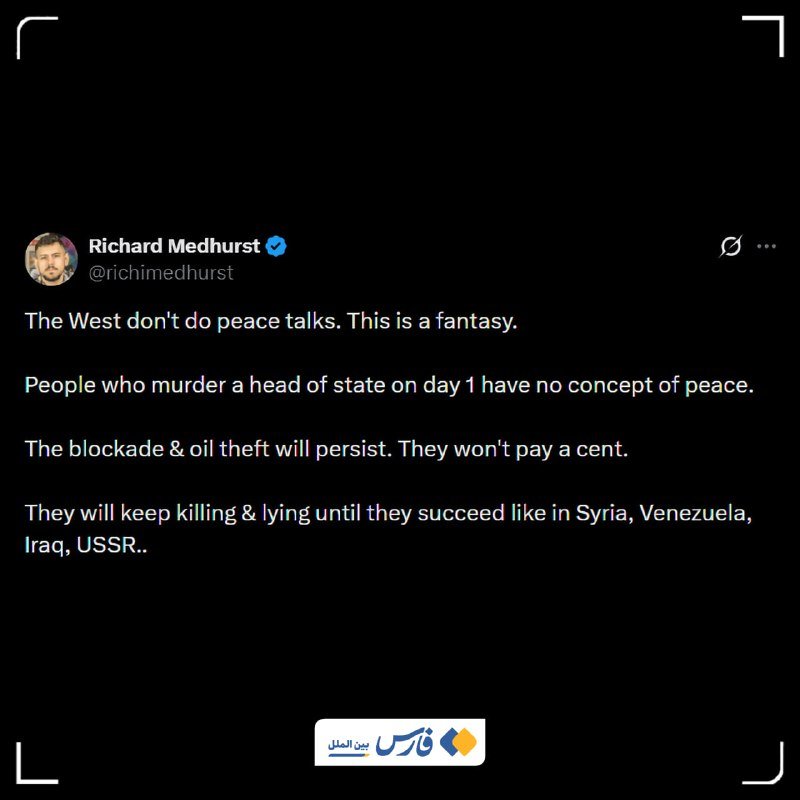
Tehran's response came quickly, in the same hour. Foreign Minister Araghchi, quoted by the same open-source channel at 18:37 UTC, framed the issue as a sovereignty question: "Foreign forces in proximity to our territory are at constant risk on account of their own human errors, plain accidents, or potential actions." The line is calibrated for two audiences at once — a domestic one that wants to hear the war cabinet unflinching, and a regional one that includes the bases and naval assets now deployed in Iran's near abroad. The implicit message to Washington is that any future arrangement requiring American boots on the ground, or American fingers on Iranian valves, will be contested not only politically but operationally.
That framing is self-interested, and it is also structurally serious. A 50 percent oil concession is the kind of demand that has historically been rejected by the Iranian state across the political spectrum, from the Shah's negotiations with the consortium in the 1950s to the post-JCPOA disputes over licensing. The current regime's insistence that foreign forces are at risk is, in that longer view, a warning that the political cost inside Iran of accepting such terms may be higher than the cost of continued war.
Why the oil frame is the structural frame
Strip the rhetoric away and the question the US is putting on the table is straightforward. Who sells Iran's crude? Through which terminals, to which buyers, under whose insurance, with whose dollars clearing? In a global oil market that is already repriced around a Middle East risk premium, the difference between Iranian oil flowing and Iranian oil off the market runs into the high single digits of millions of barrels per day. The companies that handle that flow — the trading houses, the shippers, the refineries in Asia that are structurally short Iranian heavy crude — have more to say about the eventual settlement than most foreign ministries. The president's line about half the oil is a way of telling those counterparties, in advance, who will be writing the contracts.
The precedent is not theoretical. Iraq's oil sector after 2003 was reorganised around foreign service contracts that gave international oil companies long-duration access to production in exchange for technical rehabilitation. Libya's post-2011 settlement has been an extended argument over who controls the National Oil Corporation. Venezuela's sanctions architecture is, at root, an argument over who is permitted to lift, refine, and sell the country's crude. In each case the politics of the oil settled, and the wider politics of the state settled after it. The pattern matters because it suggests that "rebuild Iran" is not a humanitarian project; it is a corporate governance project for the country's hydrocarbon sector.
Stakes, and what remains uncertain
If the trajectory holds, the winners are clear: US oil majors and service companies positioned to win post-conflict contracts, Gulf partners who want Iranian exports disciplined, and a White House that can claim a tangible economic return from a war whose strategic justification was non-proliferation. The losers are the Iranian state, which loses fiscal autonomy; Iranian consumers, who will pay for reconstruction in the currency terms set by Washington; and the broader non-aligned customer base for Iranian crude, in particular Chinese and Indian refiners that have absorbed discounted barrels and will now compete for them on worse terms.
What the open record does not yet show is whether the 50 percent figure is a negotiating opening, a red line, or simply a remark. The Iranian side has not, in the material available at 18:37 UTC on 9 June, accepted or rejected it on those terms; it has rejected the underlying premise of foreign presence. The downing of the Apache is a separate data point that, if confirmed, will harden the military track before the commercial track can settle. The next seventy-two hours will tell whether "half their oil" is the policy of the United States or a soundbite this publication should treat with the usual caution that all such remarks deserve in the first hours of their circulation.
Wire provenance
This editorial synthesis draws on the following public wire/social posts:
- https://t.me/s/osintlive
- https://t.me/s/osintlive
- https://t.me/s/osintlive
- https://t.me/s/osintlive
- https://t.me/s/osintlive