Baghdad lights up for Russia: a small mall screen, a larger signal
Iraqi and Russian flags on a Baghdad shopping-mall screen marked Russia’s National Day — a modest piece of public theatre that nonetheless tracks a decade-long deepening of the Baghdad–Moscow relationship.
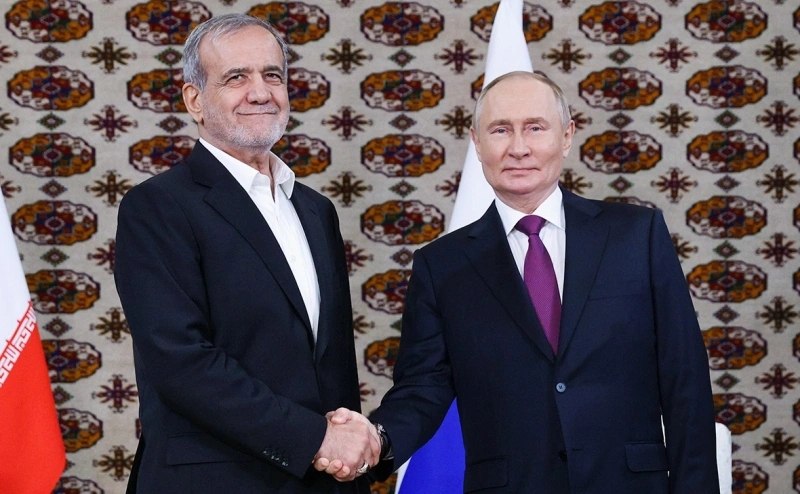
On 10 June 2026, a screen at Harithiya Mall in Baghdad displayed the flags of Iraq and Russia side by side, marking Russia’s National Day in a piece of public theatre modest in scale but pointed in placement. The image, circulated by the Telegram channel DDGeopolitics, framed the gesture as a visible sign of growing people-to-people ties between Baghdad and Moscow — language that echoes how the two governments have spoken about the relationship for the better part of a decade.
The mall-screen moment is small. The signal it is meant to carry is not. Russia’s National Day, observed annually on 12 June, has in recent years become an occasion for friendly governments to register alignment without signing anything, and Baghdad’s choice to host a public marking of it — in a commercial venue rather than a state hall — speaks to where the relationship now sits in Iraq’s public life: visible, normalised, and worth a screen.
The longer arc of a Baghdad–Moscow courtship
The courtship is not new. Russia was one of the first major powers to re-engage Iraq after the 2003 US-led invasion, signing a 2008 oil cooperation agreement that pre-dated Baghdad’s broader reintegration into global energy markets. Through the 2010s the relationship widened: energy deals, an expanded role for Russian firms in Iraqi infrastructure, and a coordinating posture in the Syrian file that put Moscow and Baghdad on the same side of a brutal ledger. The current Iraqi government of Prime Minister Mohammed Shia’ al-Sudani, in office since October 2022, has continued the trajectory, signing bilateral cooperation protocols and engaging Russian state energy companies on exploration and development work inside Iraq.
Against that backdrop, a flag display in a Baghdad mall is less a turning point than a confirmation. The relationship has migrated from high-level statecraft — energy memoranda, defence contacts, votes in multilateral forums — into the texture of everyday urban life. A shopping centre is, by some distance, the most ordinary venue available to a government trying to demonstrate that a foreign partner is welcome in the daily round rather than confined to diplomatic reception rooms.
What the framing does — and does not — tell us
DDGeopolitics’s framing leaned on the phrase "people-to-people ties," a vocabulary choice worth pausing on. The phrase does meaningful work: it implies that the relationship is now broad-based, civic, and durable, rather than concentrated in elite-to-elite channels. Whether that implication is borne out by the underlying evidence is a separate question. Russian soft-power instruments in the Arab world — the cultural centres run by Rossotrudnichestvo, the Arabic-language output of RT and Sputnik, the visibility of Russian cultural diplomacy at regional book fairs — are real and growing, but their audience reach in Iraq is harder to measure than the screen itself.
A more cautious read: the image is a public marker, but the depth of the relationship is still concentrated in the state-to-state layer. The Iraqi state has reasons of its own to court Moscow — energy markets, a useful counter-weight in regional diplomacy, and a partner that does not condition engagement on Iraq’s internal politics in the same way Western capitals intermittently do. The mall display is consistent with that posture, but the evidence of broader societal uptake in Iraq remains, on the public record, thin.
The structural picture
The deeper pattern is the gradual diversification of Iraq’s external partnerships away from a near-exclusive post-2003 alignment with the United States. That diversification is partly a function of US policy choices — periodic tensions over Iranian-linked militias operating inside Iraq, sanctions enforcement on Iraq’s energy sector, and a wider regional architecture in which Washington and Baghdad have not always seen eye to eye. Russia’s willingness to engage Iraq without the same conditionality, combined with deep energy-sector competence inherited from Soviet-era relationships across the Gulf, has given Moscow a durable niche.
For Moscow, the Iraqi relationship is also useful beyond its bilateral content. It is one node in a wider Middle Eastern posture that includes energy cooperation with Saudi Arabia and the UAE, an active security relationship with Syria, and arms relationships with Egypt and Algeria. The mall screen in Baghdad does not move that needle on its own. It does, however, sit inside a pattern of routine public marking that, taken together, makes the relationship legible to Iraqi, Russian, and regional audiences as a settled feature of the regional landscape rather than a transactional arrangement.
What remains uncertain
The sources on which this reading rests are narrow. A single image circulating on a geopolitics-focused Telegram channel, with editorial framing attached, can demonstrate that the display took place and that someone chose to publicise it. It cannot, on its own, confirm the scale of public attendance, the identity of the organiser, whether the Iraqi government authorised the display at a state level, or how ordinary Baghdadis — as distinct from the channel’s audience — read the gesture. Iraq’s politics of public space, including who gets to use large screens in commercial venues for political or diplomatic signalling, is itself a contested terrain that this single data point does not settle.
The honest summary: the flag display is a real, dated, geographically specific event. The interpretation that it confirms a deepening of Iraqi–Russian relations is plausible and consistent with a longer arc of state-level engagement, but the step from a single image to a claim about the depth of societal ties is a step the available evidence does not yet support without additional corroboration.
Desk note: Monexus reports the Harithiya Mall display as a specific, dated event and reads it against the longer arc of Iraqi–Russian state-level engagement, rather than extrapolating to a broader claim about Iraqi public opinion on the basis of a single image.
Wire provenance
This editorial synthesis draws on the following public wire/social posts:
- https://t.me/DDGeopolitics