Araghchi's four-pillar doctrine: Tehran's new line on how wars end
Tehran's foreign minister claims victory after a 40-day conflict and says negotiations only work when backed by force. The doctrine, not the deal, is the story.
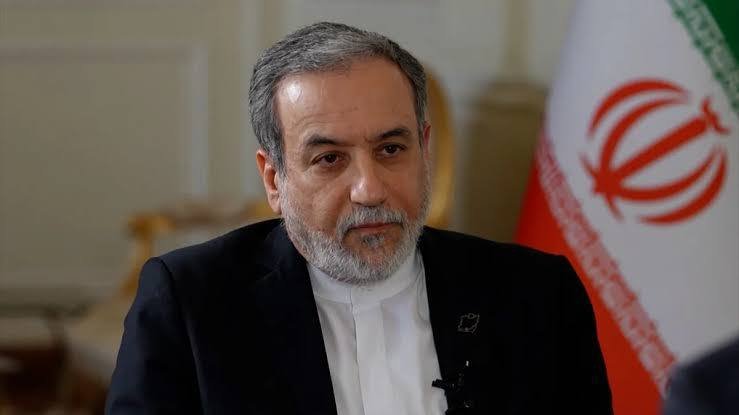
Iran's foreign minister arrived at the podium on the evening of 12 June 2026 with a thesis, not a press release. Abbas Araghchi, speaking in a televised interview carried by Iranian outlets including Fars and Mehr News, declared that Iran had come out of its 40-day war "with more strength," that the enemy had miscalculated after the earlier 12-day war, and — most consequentially — that diplomacy only functions when it leans on hard power in the field. The interview, broken into short Telegram posts by Farsna and Mehr News between 19:08 and 19:12 UTC, sketched a doctrine that goes well beyond the talking points of a single news cycle.
This publication reads Araghchi's remarks as the clearest articulation yet of a "four-pillar" model that Tehran intends to apply to every negotiation that follows: field strength, diplomacy, media, and the street. Each pillar is supposed to point in the same direction. Dissent within that alignment is the enemy. The doctrine is the story; the war, by Tehran's own framing, is the precedent.
A 12-day war, a 40-day war, and the miscalculation claim
Araghchi's argument begins with a sequencing of the last two rounds of confrontation. The first, which Iranian officials call the "12-day war," ended on terms that Araghchi suggests the country's adversaries read as submission. The adversary, in his telling, "thought that after the 12-day war, he would be able to surrender Iran in the 40-day war." That expectation was disappointed, he said, by "fierce resistance from the people and the armed forces of Iran." The framing is significant. Tehran is not claiming a clean tactical win so much as a strategic refusal to break — the kind of outcome that, in Iranian official discourse, justifies the costs that follow.
The sequencing matters for the region's diplomatic calendar. By placing the two wars on a single timeline and naming the adversary in the singular, Araghchi narrows the negotiating universe. Any future interlocutor in Muscat, Doha, or Geneva is being told, in effect, that the field has already spoken. The two prior rounds of fighting function as the deposit; whatever is negotiated next is the withdrawal.
Diplomacy as the handmaiden of force
The most pointed sentence in the interview is also the most quotable: "The duty of diplomacy is to stabilize the achievements in the field. Negotiators rely on the power in the field." Araghchi returns to the formulation twice, once in the Farsna posts and again in the Mehr News thread, and pairs it with a denial that field and diplomacy are in tension. "There is no duality between the field and diplomacy and both move in the same direction." In plain prose: the negotiating table is downstream of the battlefield, and anyone arriving without that hierarchy understood is wasting everyone's time.
The doctrine inverts a habit common to Western commentary, which tends to treat Iranian diplomacy as evidence of relative moderation and Iranian force projection as evidence of the opposite. Araghchi's point is that both are parts of the same instrument. The 40-day war, in his telling, is what made the room at the table worth sitting in.
The two new pillars: media and the street
The novelty in the 12 June remarks is the addition of media and the street to the older field-and-diplomacy pair. "To these two pillars, the media and the street were added this time and four pillars moved together in the same direction," Araghchi said, per the Mehr News thread. The two new pillars are doing real work. Media, in the Iranian state-adjacent ecosystem of Fars, Mehr, Tasnim, and PressTV, sets the frame inside which the field is read; the street, in the official usage that follows the 2022–23 protests, signals domestic alignment behind the negotiating position.
The strategic effect is to fold information operations and population management into the diplomatic architecture. A Western counterpart arriving for talks is not merely negotiating with a foreign ministry. The counterpart is negotiating with a state that has spent months building an internal story in which compromise would itself read as defeat. That is a constraint the West's own domestic politics, with its own media and street dynamics, does not have an obvious answer to.
How to read the boast
Two reads are available, and honest analysis holds both. The first is the official read: Iran fought, did not break, and now negotiates from a position that the field made possible. In that frame, the four-pillar doctrine is a coherent operating manual and Araghchi is its translator. The second read is the skeptical one: a 40-day war leaves economic damage, infrastructure loss, and a population that has absorbed a great deal without an off-ramp in sight. The boast about foreign officials "not having known Iran like this" is easier to deliver on a state channel than to verify in a balance-of-payments statement. The sources carried by Farsna and Mehr News do not specify casualty figures, infrastructural damage, or the state of the nuclear file; readers should treat the unalloyed claim of victory as a framing instrument, not a balance sheet.
The honest reading is that both are true in different registers. The field has not been lost, and the field has not been won. What Araghchi is selling is the management of that ambiguity — a doctrine under which the absence of a clean win can still be presented as a precondition for the next deal.
What this means for the next negotiation
Stated plainly: the next round of talks, whenever it convenes, will arrive with Tehran in possession of a doctrine that constrains its own negotiators as much as it constrains the other side. Any Iranian diplomat offering a concession will be asked, at home, whether the field was strong enough to deserve the concession. That internal pressure does not foreclose a deal. It does, however, raise the floor on what a deal has to deliver in order to be sold as victory rather than surrender. Western negotiators who treat Iranian diplomacy as a separable track from Iranian force posture will, on Araghchi's own terms, have already lost the first move.
The doctrine is the news. The war was the rehearsal.
— Monexus framed this as a doctrine story rather than a victory story; the wire cycle is leaning on "Iran claims win" headlines, which understate the structural argument Araghchi is making about how future negotiations will be conducted.
Wire provenance
This editorial synthesis draws on the following public wire/social posts:
- https://t.me/farsna
- https://t.me/mehrnews
- https://t.me/farsna/2
- https://t.me/mehrnews/2