Araghchi frames Iran as unbroken after three 'wars' in 2025-26 — and asks what comes next
On Iranian state-affiliated outlets on 12 June 2026, Foreign Minister Araghchi told viewers the country had withstood a 12-day war, the 18th-19th unrest, and a 40-day war — and that the next phase of pressure was already on the calendar.
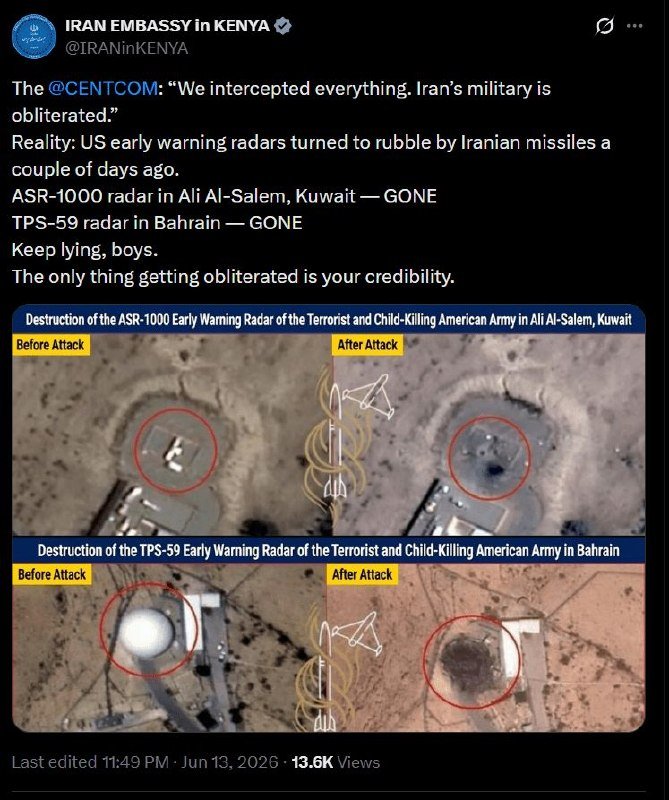
Iran's foreign minister used a Thursday evening prime-time slot on the state-linked Khabar channel to argue that the Islamic Republic had absorbed three distinct shocks in little over a year — and emerged intact in each. The framing matters because the third of those shocks, the so-called "40-day war" Araghchi named on air, is not a phrase Western wires have used, and his choice of language is itself a signal about how Tehran intends to narrate the next phase of confrontation with Israel and the United States.
The argument, stripped to its load-bearing claims, runs like this. The 12-day war is the June 2025 Israel-Iran exchange. The "18th and 19th riots" are the domestic protest cycle that closed 2025 and opened 2026. The "40-day war" is the more recent and still poorly documented round of strikes — Israeli and, by Iranian account, US-coordinated — that the Araghchi government now wants inside the same frame as the other two. Read together, the three are pitched not as discrete crises but as a single escalating test of national resilience, each one designed to break Iranian will and each one failing.
What Araghchi actually said, and where
The interview aired on Khabar, an Iranian state television network, in the evening of 12 June 2026 UTC. Three state-affiliated outlets carried the same quotation within a tight window: Tasnim News, Mehr News and Fars News all pushed the line — in Persian and in machine-translated English — that the "enemy" believed it could "surrender Iran" in a 40-day war after the 12-day war, and was defeated by the "fierce resistance of the people and armed forces of Iran." Tasnim's English wire rendered the formula as the enemy thinking it could "break Iran's resistance."
Two pieces of the address are worth pulling out. First, the word "surrender." It is not the vocabulary of deterrence; it is the vocabulary of a government telling its domestic audience that what was demanded of it was capitulation, not compromise. Second, the sequencing. The 12-day war comes first, the 18th-19th unrest second, the 40-day war third. The ordering is deliberate: it positions internal unrest as a continuation of external pressure rather than as an autonomous political fact, which is itself an editorial choice about how much room Iranian civil society gets in the official story.
A second Araghchi line, carried by Tasnim's English channel, was more direct: "The sent people failed the enemy." Read in context, "sent people" is the Iranian diplomatic register for negotiators and envoys — Araghchi himself has been the public face of Iran's nuclear diplomacy in earlier rounds. The line, in effect, concedes that the diplomatic track did not produce the result Tehran wanted, and re-credits the armed forces and the street for what he frames as the country's survival.
The framing the regime wants, and what it leaves out
There is a counter-narrative worth taking seriously, even inside a story dominated by Iranian state media. Western and Israeli outlets, where they have commented on the recent round, have generally characterised it as a calibrated strike campaign — Israeli operations hitting nuclear, missile and proxy infrastructure, with US logistical and intelligence backing — and have read Tehran's restraint not as a sign of strength but as a sign of a regime trying to avoid another full-scale war it cannot win. Under that reading, "fierce resistance" is the line on the broadcast; the lived experience is a network of decapitated scientific cadres, a degraded air-defence umbrella, and a missile programme that, in the open-source counts available, is materially smaller at the end of the 40-day war than at the start.
The honest version sits between the two. Iran's armed forces are not a fiction, and the country's capacity to absorb punishment and to project force through partners in Lebanon, Iraq and Yemen is real. The regime's domestic legitimacy, fragile as it is, did survive the 2025-26 protest cycle without the kind of organised military fracture that ended the 1979 revolution's predecessors. None of that is the same as winning a war, and Araghchi's carefully chosen word — "resistance," not "victory" — is consistent with a government that knows the difference.
The structural frame is also worth naming in plain prose. Iran is operating in an environment in which its principal adversaries — Israel and the United States — have spent fifteen months demonstrating a willingness to strike deep into Iranian territory with limited domestic-political cost at home, and in which the principal alternative track (negotiations, sanctions relief) has produced, in Araghchi's own telling, only failure. The interview is, among other things, a piece of bargaining: by asserting that the regime will not crack under further pressure, Tehran is trying to push the diplomatic cost of the next escalation back onto the other side.
Why the "40-day war" label is the story
The phrase does not yet have a fixed referent in English-language coverage. Iranian state media have used it to describe a discrete round of hostilities of roughly five to six weeks, beginning in the spring of 2026. That dating places the event after the public fallout from earlier negotiations, and during a period in which Iranian, Israeli and US officials have all, at various points, signalled that further strikes were under active consideration. Western outlets have tended to describe the same period in more cautious terms — "tensions," "an exchange," "a flare-up" — which avoids conceding the Iranian framing of a war at all.
The label is therefore not a description. It is a claim. By naming the event a "war," with a duration, Araghchi is doing three things at once: validating the sacrifices of those killed or displaced, normalising the idea that Iran is in a continuous state of conflict with Israel and the US, and locking in a precedent that future rounds will be measured against the same yardstick. The risk for Tehran is that if the next round produces outcomes the regime cannot plausibly call a survival, the same vocabulary will be used against it.
There is also a domestic-audience calculation. The "18th and 19th riots" line is the more politically sensitive of the three. By grouping the protest cycle inside a list of foreign-imposed wars, the foreign minister narrows the interpretive space available to anyone who might argue that the unrest was, primarily, a domestic political event. It is an old technique, deployed in many countries, but the execution here is unusually explicit.
Stakes, and what to watch
The immediate stakes are diplomatic. Iran's negotiating posture in any future round — whether on the nuclear file, on regional de-escalation, or on the still-unresolved question of prisoner exchanges — will be set in part by the story Araghchi told on Khabar. A government that has told its public it did not break is in a weaker position to make concessions that look like capitulation, and in a stronger position to make ones that look like the reward for endurance.
The medium-term stakes are about escalation ladders. If the "40-day war" becomes the canonical label, the next round, when it comes, will be measured against it. Israeli and US planners will be weighing whether a fourth shock can produce a different outcome, and Iranian planners will be weighing whether the country's air defences, missile inventory and partner network can absorb a fourth one. The interview is, in that sense, an opening bid in the next negotiation about whether there is a next negotiation.
What remains genuinely uncertain is the basic timeline and casualty ledger of the "40-day war" itself. The phrase exists, so far, primarily in Iranian state-affiliated reporting; Western and Israeli sources, where they have touched the same period, have used more circumspect language. Until independent verification of dates, scale and outcomes is on the record, the label is doing political work that the underlying facts have not yet been made to do.
Desk note: Monexus's Iran coverage follows the event-language of the actors involved while flagging the editorial work that language does. Where the Iranian state describes internal unrest as a foreign war, we name it unrest; where it names a strike campaign a war, we treat the label as a claim to be verified, not a fact to be adopted. Western framing of the same period is treated symmetrically — its circumlocutions are noted, not adopted.
Wire provenance
This editorial synthesis draws on the following public wire/social posts:
- https://t.me/tasnimnews_en
- https://t.me/tasnimnews_en
- https://t.me/mehrnews
- https://t.me/farsna
- https://t.me/tasnimnews_en