Ukrainian drones reach Tatarstan, hit TANECO and Nizhnekamskneftekhim on Russia Day
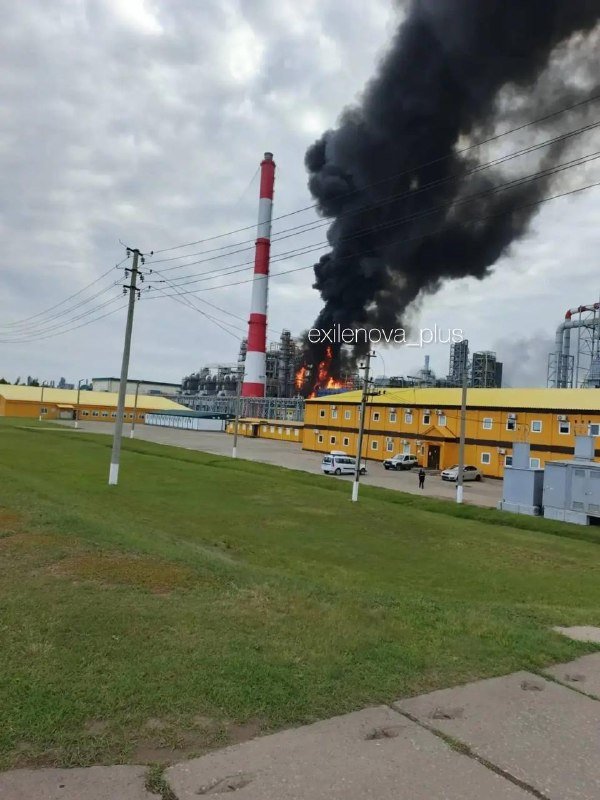
Overnight strikes on the night of 11–12 June 2026 set process units burning at two of Russia's most important downstream facilities — the TANECO refinery in Nizhnekamsk, Republic of Tatarstan, and the Nizhnekamskneftekhim petrochemical complex that sits next to it — and prompted local authorities to cancel Russia Day festivities across the city. The attacks were confirmed by Kyiv Post's official Telegram channel at 06:38 UTC on 12 June, citing video evidence of fires at both sites, and corroborated within minutes by the Ukrainian outlet UNIAN, the war correspondent Andriy Tsaplienko, and the OSINT aggregator intelslava. The range — more than 1,000 km of Russian airspace penetrated to reach the Volga–Kama industrial heartland — is now routine for Ukraine's long-range unmanned aviation, and the symbolic staging, on the holiday that celebrates the Russian Federation itself, is the kind of choice that says more about Kyiv's strategic signalling than about targeting logic alone.
The strikes matter less for any single tank of crude than for what they reveal about the trajectory of the war. Russia's downstream is no longer a sanctuary. The country that built its modern war economy on the assumption that oil and petrochemical revenue would be safe behind 800, 1,000, 1,300 km of buffer is now absorbing fire on a weekly basis at the very refineries that feed its diesel, jet fuel, and polymer exports. If the pattern holds, the price is paid not in headlines but in throughput — and throughput, over a year or two, is what funds the next round of mobilisation.
What was hit, and where
The two targets are functionally one industrial cluster on the left bank of the Kama River, roughly 1,000 km east-south-east of Moscow and a similar distance from the Ukrainian border. TANECO, formally the Nizhnekamsk refinery complex operated by Tatneft, is one of the most modern refineries in the Russian Federation and a major producer of diesel, kerosene, and vacuum gasoil for both domestic use and export. Nizhnekamskneftekhim, adjacent, is Russia's largest producer of synthetic rubbers and a leading European producer of polyolefins — the kind of facility that, in peacetime, no European sanctions lawyer would entertain striking. The attacks were timed to the early hours of Russia Day, a national holiday marking the 1990 declaration of sovereignty; in Nizhnekamsk, all festive events were cancelled after the strike, according to intelslava and UNIAN, both posting at 05:58 UTC.
Reporting from the war correspondent Noel Reports, posted to Telegram at 06:07 UTC on 12 June, described a process unit burning at TANECO after the drones reached the site; Kyiv Post's channel carried video evidence of fires at both the refinery and the petrochemical plant. Tsaplienko's brief post on the same hour struck a deliberately sardonic note: "the 'TANECO' oil complex in Russian Tatarstan is celebrating Russia Day." The four-source convergence — a Ukrainian outlet, a Ukrainian reporter, an independent OSINT feed, and a Western-aligned correspondent — is unusual only in its speed; it has become the standard pattern for late-2025 and 2026 reporting on long-range Ukrainian strikes.
Why Tatarstan, why now
The geography is the story. Until 2024, the dominant Russian doctrine of "depth defence" for critical infrastructure rested on the assumption that Ukrainian fixed-wing aircraft, propeller drones, and short-range loitering munitions could not reliably threaten the Volga region. The arrival in service of indigenously produced Ukrainian long-range strike UAVs, together with adapted airframes operating from forward staging areas inside Russian-occupied territory, has rendered that doctrine obsolete in increments. The 1,000-plus-kilometre penetrations are no longer exceptional events to be reported with surprise; they are a sustained operational pattern. The novelty on 12 June is the choice of target set. Strikes on TANECO and Nizhnekamskneftekhim are strikes on the modern, post-Soviet, high-value-added end of Russia's energy-industrial complex — not on a 1970s-era distillation unit in a peripheral oblast.
The counter-narrative, advanced on Russian state-aligned channels in the hours after the attack, frames the strikes as terrorism against civilian industrial sites and emphasises the disruption of Russia Day celebrations. The framing has a real constituency inside Russia, where polls consistently show broad public support for the war but also a strong cultural attachment to the holiday's symbolism. Whether that framing wins or loses in the Russian information space depends less on the facts of the strike than on the next round of retaliatory action Moscow announces, and on the question of whether Ukrainian propaganda services can keep the Tatarstan strikes in frame long enough for them to register in the wider Russian public mind.
The structural picture
The pattern over the past eighteen months is consistent. Russian refining throughput, already constrained by sanctions on Western process equipment and catalysts, has been progressively eroded by a campaign of long-range strikes that began in earnest in early 2024 and accelerated through 2025. Each individual strike is containable; the cumulative effect, measured in lost days of operation, deferred maintenance, and rerouted crude, is not. Ukraine's strategy is to compress Russia's options: force Moscow to choose between defending the front with fuel, defending the home front with fuel, or exporting fuel for hard currency. The 12 June strikes are best read as a tightening of that pressure on the petrochemical side of the ledger.
The broader structural frame is the gradual erosion of the assumption that distance equals security in Russian strategic thinking. For two decades, Russian military doctrine has rested on the depth of its territory as a force multiplier. The 1,000 km drone run to Tatarstan, executed on a national holiday, is a quiet repudiation of that assumption. It does not change the balance of the war on the ground, and it does not bring the front any closer to a Ukrainian victory on its own. What it does is to put a recurring line item on Russia's balance sheet — one more refinery cycle lost, one more petrochemical batch delayed, one more insurance premium raised for the next cargo of Russian product out of a Baltic or Black Sea port.
Stakes and what remains uncertain
The immediate stakes are operational: how long TANECO's damaged unit takes to return to service, whether Nizhnekamskneftekhim's polymer lines were affected, and whether the cumulative effect of strikes across May and June is enough to push Russian domestic diesel prices into politically uncomfortable territory before the autumn budget cycle. The medium-term stakes are strategic: whether the campaign can be sustained at a tempo high enough to matter, and whether Kyiv can be confident the strikes are degrading Russian export capacity faster than new capacity, however constrained, comes online.
What remains uncertain, on the evidence available in the hours after the strike, is the precise extent of the damage. Video circulating on Telegram at 06:38 UTC showed fires at both sites, and the reporter on the ground described "a process unit burning" — language consistent with a localised but serious hit. Neither the Ukrainian General Staff nor the Russian Ministry of Energy had issued a detailed damage assessment at the time of writing. Tatneft, the operator of TANECO, has not yet commented publicly on the strike. The OSINT community will, in the next 24 to 48 hours, attempt to corroborate the damage from satellite imagery and from independent video; until that work is complete, the conservative reading is that the strike caused real but not yet quantified damage to a high-value node in Russia's downstream.
What is not uncertain is that the war's pressure on Russia's industrial base is moving upstream, toward the modern, high-margin, sanctions-resistant end of the energy complex. That is the story of 12 June, and it is a story that will run for as long as the long-range drones can fly.
Desk note: Monexus treats Ukraine as the invaded party and the source framework for the war as Kyiv-aligned wires and reporters — Kyiv Post, UNIAN, the intelslava OSINT feed, and named war correspondents — with Russian state-adjacent counter-claims noted for context but not foregrounded. Where the available sourcing is preliminary, as on the 12 June Tatarstan strikes, the piece flags the uncertainty rather than asserting a damage figure the sources do not support.
Wire provenance
This editorial synthesis draws on the following public wire/social posts:
- https://t.me/Kyivpost_official
- https://t.me/noel_reports
- https://t.me/intelslava
- https://t.me/Tsaplienko
- https://t.me/uniannet