Hezbollah's southern Lebanon footage isn't a story about rockets — it's a story about who gets to define a battlefield
Five clips from one Telegram channel on a single Friday night show rockets, FPV drones, and a Namer strike. The footage is the message — and the question is what it does to the public map of the war.
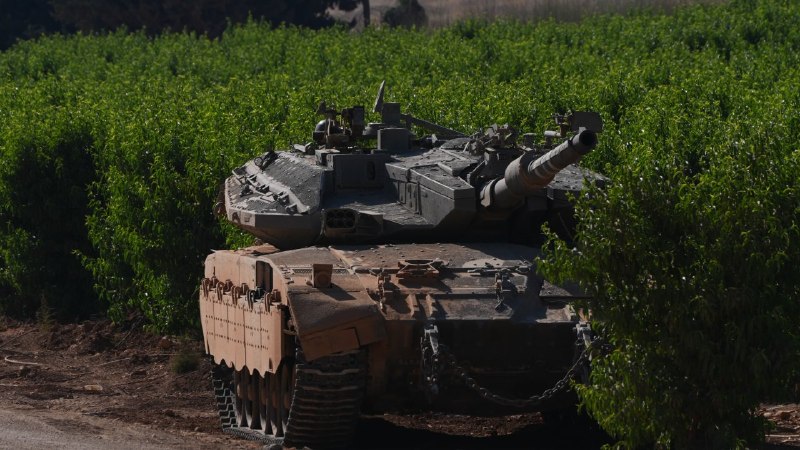
On the evening of 13 June 2026, between 21:11 and 21:30 UTC, the Telegram channel AMK_Mapping reposted five pieces of combat footage attributed to Hezbollah. Read in isolation, the clips are tactical: 122mm Grad rockets, Arash-1 artillery rockets, FPV drone strikes on an IDF command-and-control node in the town of Yohmor, further FPV strikes on Israeli communications equipment and a supply truck, an FPV hit on a Namer armoured personnel carrier, and a two-rocket launch toward IDF positions near Beaufort Castle. All of it sits on the Israeli-Lebanese frontier, north of the Litani River. Taken together, the sequence is something more deliberate: a press operation, released inside a single ninety-minute window, choreographed for the camera as much as for the launcher.
That distinction matters. Western wire reporting on the Israel-Lebanon front has largely converged on an Israeli-source-first template — IDF Spokesperson briefings, Hebrew media, the casualty figures those institutions put into circulation. Hezbollah's combat-media wing operates on a parallel track, broadcasting its own version of the same afternoon to Arabic-language audiences and to a global left-wing public that has spent the war reblogging its releases. The contest over the southern Lebanon front is, at this point, a contest over whose pixels are load-bearing in the reader's mental map of the war.
What the clips actually show
The technical content of the five posts is narrow. The two rocket-launch items — at 21:11 and 21:30 UTC — frame the Beaufort Castle area in southern Lebanon as an active launch belt, with Grad 122mm and the locally produced Arash-1 rocket both featured. The Arash-1 is significant only because it is Hezbollah's own artillery rocket: its repeated use in the footage is a soft-branding exercise as much as a strike. The three FPV-drone items — 21:13, 21:16, and 21:19 UTC — all centre on the town of Yohmor, also north of the Litani, and claim hits on a Namer APC, a command-and-control installation, and a communications and logistics stack respectively. The Namer strike, if the geolocation holds, is the only material claim in the set with strategic weight: the Namer is a heavily armoured IFV used to extract wounded under fire, and a confirmed loss would have an effect on Israeli casualty flow that goes beyond the platform itself.
It is the simultaneity, though, that does the rhetorical work. A Namer strike, a comms-and-truck strike, and a C2 strike in one village, in one hour, on the same channel, with the rockets framed around them — that is not a tactical release pattern. It is a narrative release pattern.
Why the southern Litani axis is the only stage that matters
The Litani River, since the early weeks of the war, has been the operative boundary inside which Israeli ground operations have been conducted and beyond which Hezbollah has claimed an autonomous strike zone. Every one of the five clips sits north of that line. The Israeli press frame — Haaretz, Ynet, the Times of Israel — tends to treat the Litani frontier as a slow-grind clearing operation in which Hezbollah infrastructure is being dismantled piecemeal. The Hezbollah frame, of which these clips are a clean example, treats the same ground as a contested battlefield in which the IDF bleeds slowly and visibly, with the damage to Namer vehicles, command nodes, and supply lines as receipts.
The two frames are not necessarily contradictory. A clearing operation can be both producing Israeli territorial gain and producing Israeli materiel loss. What they are, however, is asymmetric. Israeli wire reporting is filtered through IDF briefings and therefore through the IDF's interest in minimising platform loss; Hezbollah combat-media is filtered through its own interest in maximising the perception of it. A reader who only watches one feed will see a war the other feed says is not happening.
The structural point, without the textbook
Media ecosystems in long wars eventually settle into a duopoly of competing first drafts: the belligerent state's official narrative on one side, the non-state armed group's combat-media arm on the other, with mainstream wire services acting as a thin layer of adjudication in the middle. The adjudication layer is thinner than it looks — Reuters, AP and AFP still file, but their running copy on southern Lebanon in June 2026 is heavily paraphrased from one side or the other, and the time pressure of the news cycle tends to make the state's version travel faster. By the time a Hezbollah release has been translated, geolocated, and run past an open-source intelligence community already exhausted by the war in Gaza, the Israeli frame has already been cited twice in English-language prime time.
The asymmetry is not a conspiracy. It is the structural result of which side has an embassy press room and which side has a Telegram channel. Reporting that treats the two outputs as carrying equal weight — without flagging, every time, that one is a state communication and the other is a paramilitary communication — is reporting that has decided the question of legitimacy before the reader has read a sentence. Reporting that pretends only the Israeli side exists is worse, but it is the more common failure mode in the Anglophone press in 2026.
Stakes, and what is still genuinely unknown
If this pattern holds through the rest of 2026, the consequence is not that one side will win the information war outright. The consequence is that the public map of southern Lebanon will continue to drift, in the West, toward a war of Israeli convenience, and in the Arab street, toward a war of Hezbollah convenience. The actual territorial map on the ground — the village-by-village state of Yohmor, the village-by-village state of the Beaufort Castle ridgeline, the casualty ledger on both sides — will sit in the gap between those two maps, largely unreported.
What is genuinely unknown from this thread alone: the operational effect of the five strikes (no Israeli casualties, no equipment loss, or some combination have not been independently confirmed in the source material); the precise location of the Namer strike (AMK_Mapping is a sympathetic re-poster, not a primary geolocator); and whether the 21:30 UTC launch came from the same launcher position as the 21:11 launch (it appears to be the same Beaufort Castle axis, but the clips do not confirm co-location). A reader should treat the existence of the strike set as established, the framing of it as one side's, and the damage assessment as still pending Israeli confirmation.
Desk note: Monexus treats Hezbollah combat-media releases as primary evidence of an actor's communications strategy, not as neutral verification of battlefield outcomes. We have run this thread against the same sourcing standard we apply to IDF briefing slides: report what was shown, name the channel, and refuse the temptation to treat either side's edited footage as ground truth.
Wire provenance
This editorial synthesis draws on the following public wire/social posts:
- https://t.me/s/AMK_Mapping
- https://t.me/s/AMK_Mapping
- https://t.me/s/AMK_Mapping
- https://t.me/s/AMK_Mapping
- https://t.me/s/AMK_Mapping