Southern Lebanon grinds on: IDF ground push meets Hezbollah anti-tank fire in Majdal Zoun
Footage from Majdal Zoun shows a Merkava hit by a guided missile as the IDF widens its ground footprint north of the Litani, with Hezbollah framing the clashes as a response to ceasefire violations.
At roughly 22:47 UTC on 13 June 2026, war-monitoring accounts circulated additional footage from Majdal Zoun, in southern Lebanon, purporting to show an Israeli Merkava tank hit by a guided missile fired by Hezbollah. The clip, re-posted by both @wfwitness and @AMK_Mapping, is the day's most concrete piece of visual evidence of a tactical exchange that, on the same evening, the Israeli military framed as a widening of its ground operation in the border belt. The picture is fragmented and partisan. It is also the closest thing to a real-time ground truth from a frontline that has gone quiet in the global wire services and loud in the Telegram ecosystem.
The pattern is now familiar: an Israeli ground push north of the Litani, Hezbollah anti-tank and rocket fire in response, and two narratives running on parallel tracks. What the latest footage adds is granularity — a named village, a named weapon, a named target — rather than a strategic shift.
What the IDF says it is doing
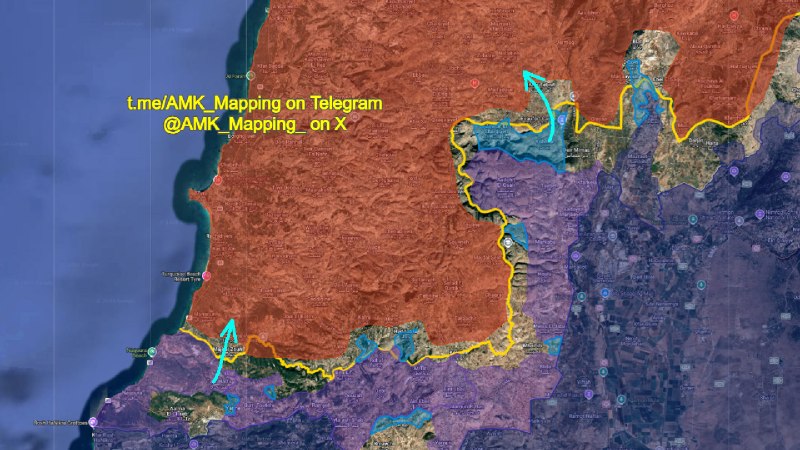
According to a Telegram post by @AMK_Mapping at 22:08 UTC on 13 June, the IDF has "expanded their ground operations in southern Lebanon, advancing into the towns of Kfar Tebnit and Majdal Zoun, both of which are north of" the Litani. The same account, citing what it described as extensive airstrikes and artillery bombardment preceding the ground push, frames the operation as a step-change in tempo rather than the slow, town-by-town grinding that has characterised previous Israeli movements in the sector.
That phrasing matters. The Litani, running roughly thirty kilometres inland from the coast, has been the de facto marker of how far into Lebanon Israeli armour is willing to operate. Saying that formations are now "north of" it publicly, even on a monitoring channel, is a quiet escalation in the Israeli public posture. Kfar Tebnit and Majdal Zoun sit on the southern approaches to the Nabatieh governorate, an area from which Hezbollah has historically staged anti-tank and rocket fire into northern Israel.
What Hezbollah says it is doing
Hezbollah's final statement of the day, circulated at 22:20 UTC by @wfwitness, frames the day's clashes as a direct response to "Israeli ceasefire violations" and asserts the group's "right to resist." The group did not, in that statement, claim the Merkava strike in Majdal Zoun by name — but the timing, the location, and the weapon class (guided anti-tank) are consistent with Hezbollah's published playbook for the sector.
The asymmetry is in the messaging. Hezbollah speaks in the legal-political grammar of a non-state armed actor: violations, rights, proportionality. The IDF, when it speaks on the Lebanese front at all, speaks in the operational grammar of a state army: manoeuvre, targets, neutralised infrastructure. Neither grammar is wrong. Neither, on its own, gives a reader the full picture of what is happening to civilians in the villages caught between them.
What the footage actually shows
A guided-missile hit on a Merkava is a serious tactical event, not a symbolic one. The Merkava is one of the most heavily armoured main battle tanks in service anywhere; a confirmed strike implies a modern anti-tank guided missile, line-of-sight or top-attack, fired at relatively close range. The wfwitness clip is short, cropped, and shot from a distance consistent with a Hezbollah media cell rather than a combatant.
This publication treats the footage as credible-but-unverified: the platform, the framing, and the weapon effect are all consistent with documented Hezbollah capability and with prior incidents in the same sector, but independent geolocation of the impact crater and the tank's unit marking has not been published in the channels reviewed. The Israeli military had not, as of 23:00 UTC on 13 June, confirmed or denied the loss on any of the channels monitored by Monexus.
The structural picture
The southern-Lebanon front has been a slow bleed for most of 2026: a low-tempo exchange of anti-tank fire, airstrikes, and village-by-village clearance operations that rarely breaks into the international news cycle for more than a day at a time. What 13 June's footage suggests is that the cycle is shortening again, at least in this sector. Two named towns taken in a single day, on the same evening as a confirmed anti-tank strike on a main battle tank, is more kinetic activity than the Litani sector has seen in several weeks.
The honest read is that the front is reheating, not exploding. The Israeli political incentive to keep the operation bounded — partly domestic, partly the weight of the ceasefire architecture that nominally still holds — and the Hezbollah incentive to avoid a repeat of late-2024-scale confrontation are both still in place. But bounded escalation is still escalation, and the civilians of Kfar Tebnit, Majdal Zoun, and the surrounding villages are the ones living inside the boundary.
The sources reviewed for this piece do not specify civilian displacement figures, casualty counts, or the precise size of the IDF force now operating north of the Litani. The wire services have not, as of publication, run a confirmed ground dispatch from either town. Readers should treat the named events as established; the surrounding scale as provisional.
How Monexus framed this: the wire services have largely gone quiet on the Litani sector; Telegram channels with explicit partisan leanings are doing most of the real-time reporting. We have leaned on the footage and the statements, flagged what is verified versus what is claimed, and declined to inflate tactical friction into a strategic breakthrough the evidence does not yet support.
Wire provenance
This editorial synthesis draws on the following public wire/social posts:
- https://t.me/wfwitness
- https://t.me/wfwitness
- https://t.me/wfwitness
- https://t.me/AMK_Mapping
- https://t.me/AMK_Mapping