IDF pushes into southern Lebanon as Hezbollah claims ambush of infiltration unit
The IDF advanced into Kfar Tebnit and Majdal Zoun on Friday after extensive airstrikes, while Hezbollah said it trapped an Israeli unit attempting to infiltrate near the border.
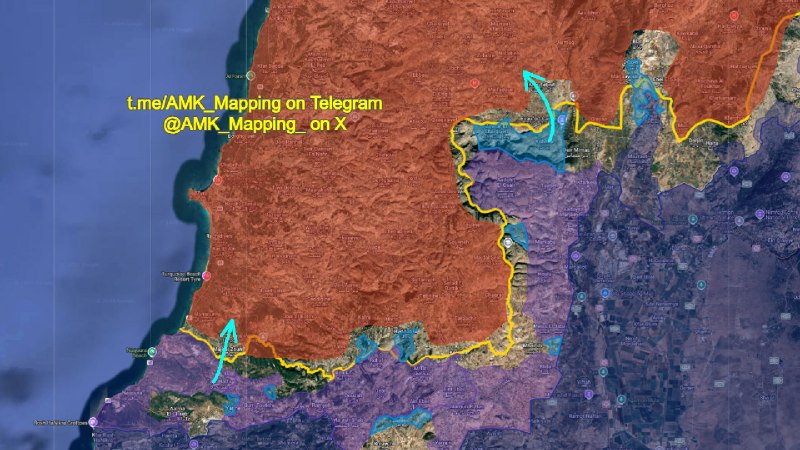
The Israel Defense Forces pushed ground troops into the southern Lebanese towns of Kfar Tebnit and Majdal Zoun on Friday evening, 13 June 2026, after what the open-source channel AMK Mapping described as extensive airstrikes and artillery bombardment preceding the advance. The two towns sit north of the Litani River corridor that has been the centre of gravity of cross-border operations since the November 2024 ceasefire framework came under sustained pressure earlier this year. By 22:08 UTC, AMK Mapping reported that the IDF had expanded ground operations into both communities; a parallel Hezbollah statement, distributed by the Tasnim news agency at 20:49 UTC, claimed the group had trapped an Israeli "infiltration unit" in a deadly ambush and was still engaged with it.
The exchange is the most concrete cross-border episode of the day and exposes a pattern this publication has tracked since the spring: a low-grade, plausibly deniable ground war in the south of Lebanon has hardened into positional combat, with each side framing the other's moves as violations of an arrangement both insist they still respect. Israeli security concerns along the northern frontier are real, and the casualty files from the October 2023–November 2024 war are not abstract. But the framing of "routine operations" is straining against the visible record of named towns, named units, and an Iranian-aligned wire service publishing battlefield claims in near real time.
What the IDF did, and what changed on the map
According to AMK Mapping's 22:08 UTC dispatch, the IDF's advance into Kfar Tebnit and Majdal Zoun followed what the channel called a sustained combined-arms preparation phase — airstrikes and artillery — intended to shape the ground before the troops moved in. The two towns are positioned along the eastern stretch of the Litani sector, north of the main ridge line that has historically marked the limit of Israeli ground penetration during the present round of operations. The channel's report does not specify unit identities or casualty figures, and the IDF has not, as of writing, published a formal readout naming the towns; the operational claim therefore rests on the mapping channel's geo-located feed and on prior reporting from the same outlet that has, in earlier phases of the conflict, correlated with Israeli official statements once a 24-to-48-hour embargo lapsed.
The map change matters because it pushes the line of contact further north at a moment when the diplomatic weather over the file is unsettled. US and French envoys have spent the past month shuttling between Jerusalem and Beirut trying to preserve the ceasefire architecture; advancing into towns that sit on the Lebanese side of the original understanding gives Beirut's negotiators a public case to make in those conversations — and gives Hezbollah a public case to make in its communiqués.
Hezbollah's claim: a trapped unit, a controlled narrative
Hezbollah's statement, relayed by Iran's Tasnim news agency at 20:49 UTC, asserts that the group "observed an Israeli unit that was trying to infiltrate" and then "grounded" it in a deadly ambush. The phrasing — "grounding of the infiltration unit" — is Hezbollah's own, not Tasnim's editorialising, and it tracks the movement's preferred vocabulary for engagements it wants to characterise as defensive, retaliatory, and successful. The statement does not name the location of the ambush, does not provide a unit designation, and does not give a casualty count. It does claim the engagement was still ongoing at the time of publication, which means that verification, in the form of after-action footage or independent confirmation, is unlikely to be available for at least several hours.
The structural read: Hezbollah is operating in a messaging environment in which it is simultaneously the combatant, the spokesperson, and, via allied wires like Tasnim, the wire service. That compression of roles is not unique to this fight, but it has consequences for how the day's events will be received. The group's supporters will read the Tasnim dispatch as confirmation that the IDF is paying a price for every metre of advance. Sceptical readers will note that the claim, the channel, and the editorial framing all originate from one institutional family, and will wait for an independent visual or a confirmation from the IDF (which on past form will be a denial or a silence) before assigning weight.
The ceasefire that is, and the ceasefire that isn't
The November 2024 arrangement, brokered under US and French auspices, was built on a layered premise: a halt to Hezbollah fire into northern Israel, an Israeli withdrawal behind the border line, and a monitoring mechanism staffed by a US-led committee and a UNIFIL-adjacent liaison. That third leg has been the weakest. The committee has not, at any point since its formation, produced a public determination on attribution for a single incident. UNIFIL's freedom of movement in the south has been contested; the Lebanese Armed Forces, the ostensible guarantor of the arrangement's southern bank, have been visibly absent from the contested ground.
In that vacuum, "ceasefire violations" has become a term of art that each side applies to the other. Hezbollah's 22:20 UTC "final statement for the day," distributed by the wfwitness channel, frames the day's rocket-and-antitank fire as a response to "Israeli ceasefire violations" and a vindication of the "right to resist." The IDF, for its part, has consistently described its operations as targeted actions against infrastructure used to stage attacks on Israeli towns. Both framings are sincere inside their own institutional logics; neither is, on the available record, a complete picture. A complete picture would require independent reporting from inside the affected towns, on-the-ground casualty figures, and an authoritative attribution mechanism — none of which the current architecture is producing.
Stakes, and what to watch through the weekend
The operational stakes over the next 72 hours are narrow and severe. If the IDF consolidates its positions in Kfar Tebnit and Majdal Zoun, Hezbollah will face a choice: escalate to force a withdrawal, absorb the loss of ground, or escalate rhetorically while waiting for a diplomatic off-ramp. The group's institutional memory of the 2006 war, in which an extended ground campaign produced heavy Israeli losses without a clear political outcome, suggests the second option is more likely than the first, but the Iranian signalling environment has hardened since 2006, and the calculus is no longer purely Lebanese.
Three signals to watch. First, the IDF's evening readout: if it confirms the advance and names units, the operation is intended to be visible, and the diplomatic pressure on Jerusalem will rise accordingly. Second, Hezbollah's next major statement: if the ambush claim is upgraded with footage and a casualty figure, the messaging battle is being fought for an audience that includes Tehran. Third, the UNIFIL and US-led committee channels: silence, at this stage, is itself a signal — it means the architecture is not performing the function it was built for, and the field is being left to the spokespeople.
What the sources do not settle
The day's record, as it stands, is a two-channel file: an open-source mapping account describing Israeli ground movement, and an Iranian-aligned wire carrying Hezbollah's combat claims. Neither is a substitute for on-the-ground reporting from inside the affected towns. The names of the units involved, the casualty figures on both sides, the status of any civilians who remained in Kfar Tebnit and Majdal Zoun through the bombardment phase, and the response of the Lebanese Armed Forces to an Israeli ground advance along this stretch of the border are all, as of 22:20 UTC on 13 June 2026, not in the public record in a form this publication can cite. The picture will sharpen over the weekend; the present article reflects what the available sources support and does not extend beyond them.
This article has been written from open-source and Iranian state-adjacent channels. Where Israeli or Lebanese official readouts are released, Monexus will update the record. The desk note for the file: a single day's cross-border exchange, told from both sides of the channel divide, with the gap between the two clearly marked.
Wire provenance
This editorial synthesis draws on the following public wire/social posts:
- https://t.me/wfwitness
- https://t.me/AMK_Mapping
- https://t.me/JahanTasnim