IDF pushes ground operation into south Lebanon as Hezbollah claims ambush in Majdal Zoun
Israeli forces have advanced into two towns north of the Litani, while a Hezbollah-aligned channel claims a Merkava column was hit in Majdal Zoun — the first real-time combat footage from this phase of the operation.
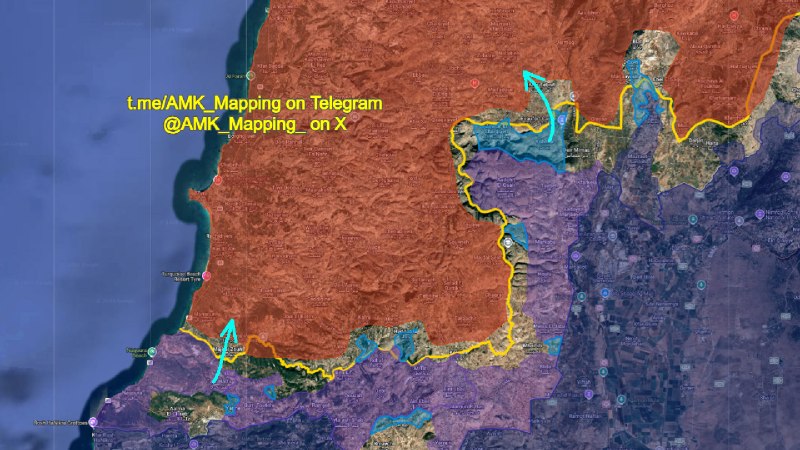
At 21:54 UTC on 13 June 2026, an Israel-bonded field channel reported that, after extensive airstrikes and artillery preparation, the Israel Defense Forces had expanded ground operations in southern Lebanon, pushing into the towns of Kfar Tebnit and Majdal Zoun — both lying north of the Litani. Within ninety minutes of that report, a Hezbollah-aligned Telegram account broadcast what it framed as a successful ambush against the same force, and a third account, Megatron, posted footage of what it identified as five Merkava tanks burning in Majdal Zoun. The three messages, taken together, are the first real-time combat signature of a new phase of a campaign that Israel has been signalling for weeks.
The pattern that matters is not a single engagement but a sequence. Artillery and air preparation, ground manoeuvre into named Lebanese towns, and simultaneous claims of attrition on the advancing force — all of it landing in a public Telegram feed within roughly two hours. That tempo, and the willingness of both sides to publish it, tells the reader something that the official communiqués do not: the operation is being fought in front of cameras, and the camera footage is now itself a weapon in the narrative war that runs parallel to the shooting war.
What the three sources actually say
The earliest of the three items, from the Israel-aligned field channel "wfwitness" at 21:54 UTC, is the most operationally explicit. It places IDF ground forces in two specific towns — Kfar Tebnit and Majdal Zoun — and frames the move as a deliberate expansion following preparatory fire. Both towns sit north of the Litani, which is the line Israeli officials have publicly insisted must be cleared of Hezbollah infrastructure as a condition of any sustained quiet along the frontier.
At 20:49 UTC, the Iranian state-affiliated outlet Tasnim published a Hezbollah statement claiming the group had observed an Israeli unit attempting to infiltrate and had engaged it in what it called a deadly ambush. Tasnim's framing uses the language of "the Israeli regime army" and describes the attackers as an "infiltration unit."
At 20:23 UTC, the account "megatron_ron" — a Hezbollah-affiliated channel that has carried battlefield footage in earlier rounds of the conflict — posted video of what it identified as five Israeli Merkava tanks on fire during a major battle in Majdal Zoun. The timestamp precedes the Hezbollah statement by roughly twenty-six minutes, which suggests the footage was either released by the group before the formal claim, or the chronology of the claim has been sequenced for effect. Either reading is plausible; the source material does not resolve it.
Reading the counter-narrative
The Hezbollah-side framing deserves to be set out in its own terms, not as background noise. Tasnim, a news agency tied to the Islamic Republic of Iran's security establishment, is not a neutral wire. It is, however, a primary outlet for the messaging of the Iran-aligned axis, and in that role it is doing what it has done across previous rounds of this conflict: present Hezbollah's tactical claims at face value, use the language of resistance, and frame any Israeli ground manoeuvre as a foreign intrusion onto Lebanese territory that invites local retaliation. The Majdal Zoun footage fits that script exactly — a firefight, an ambush, burning armour, and a quiet but unmistakable implication that the cost of advancing will be high.
The Israeli-side framing runs the other way. The wfwitness post does not deny that the force has come under fire; it simply puts the manoeuvre first and the contact second. The implicit argument is that even under fire, the IDF is executing a deliberate plan to clear a defined area. Both framings are doing real political work — one for a Lebanese and pan-Arab audience that needs to see Hezbollah standing up to an incursion, the other for an Israeli and Western audience that needs to see the army pressing forward through resistance.
What the evidence does and does not establish
The geographical specificity is the strongest part of the reporting. Kfar Tebnit and Majdal Zoun are real towns, north of the Litani, and the Israeli framing of an operation there is consistent with weeks of official Israeli signalling that any ground phase would push beyond the river. The Hezbollah claim of an ambush and the Megatron footage of burning armour are also specific: a named place, a named weapon system, a claimed number. None of that, however, establishes the strategic outcome of the engagement, only that it happened. The number of tanks destroyed, the number of Israeli casualties, and the proportion of the force that continues to hold ground inside the town are not in the source material and would require independent verification — satellite imagery, named-Israeli confirmation, or on-the-record reporting from a wire service with staff on the frontier.
The other thing the sources do not establish is the broader state of the operation. A push into two towns is a tactical event. Whether it is the opening of a wider ground campaign, a limited raid, or a deliberate feint to fix Hezbollah forces while airpower strikes elsewhere is not addressed in the three Telegram items. The Western wires had not, as of the timestamps in the thread, published confirmation; that confirmation, when it arrives, is likely to compress these three competing claims into a single factual ledger.
Stakes and forward view
For Israel, the operation's success will be measured less by footage of burning tanks — both sides have circulated such footage in earlier rounds — than by the durability of whatever security zone is established. For Lebanon, the immediate stakes are the civilian toll in the towns north of the Litani, where the population has been ordered to move south in earlier Israeli messaging. For Hezbollah, the political cost of a ground incursion it cannot easily repel is real, and the ambush narrative is the most plausible instrument it has for converting a tactical loss into a strategic argument: that the resistance is intact, that the cost of the operation is rising, and that a political settlement is the only way out.
The honest read of 13 June 2026 is that this is the first day on which a ground phase has been visible in real time, and that the three accounts in circulation are doing exactly what battlefield accounts do — competing for the framing of a fight that is still in progress. The picture will sharpen within forty-eight hours, when wire reporting, casualty figures, and named-confirmation catch up to the Telegram feed.
This publication has written the three claims in the order they were timestamped, and has deliberately set Israeli, Iranian-state, and Hezbollah-affiliated sources side by side so that the reader can see the same event from each. Where the evidence does not yet exist, we have said so rather than guessed.
Wire provenance
This editorial synthesis draws on the following public wire/social posts:
- https://t.me/wfwitness
- https://t.me/JahanTasnim
- https://t.me/megatron_ron